get_order_number(); $email = $order->get_billing_email(); $country = $order->get_shipping_country() ?: $order->get_billing_country(); $delivery_date = date( 'Y-m-d', strtotime( '+5 days' ) ); // estimate 5 days, adjust as needed $gtin = '9781291779493'; // your ISBN without hyphens ?> add_action( 'woocommerce_thankyou', 'add_google_reviews_optin' ); function add_google_reviews_optin( $order_id ) { $order = wc_get_order( $order_id ); if ( ! $order ) { return; } $order_num = $order->get_order_number(); $email = $order->get_billing_email(); $country = $order->get_shipping_country() ?: $order->get_billing_country(); $delivery_date = date( 'Y-m-d', strtotime( '+5 days' ) ); $gtin = '9781291779493'; ?>

Akajiofo Press

Category: Politics & Society, The Novel & Its World, National Memory & History.

  • Why Essays on Restorative Justice Matter

    Why Essays on Restorative Justice Matter

    A society is often most legible at the site of injury. Not in its slogans, not in its ceremonies, but in the way it answers harm – who is believed, who is restored, who is forgotten, and what kind of future becomes thinkable afterward. Essays on restorative justice matter because they slow us down at precisely that point. They resist the easy grammar of punishment and ask a harder question: what does repair require when damage is historical, intimate, and still unfolding?

    This is not a small question, and it is not only a legal one. In many public conversations, justice is reduced to the courtroom, the prison, the state. But restorative justice widens the frame. It asks us to consider relationships, memory, accountability, and the conditions under which people and communities might live again after violation. The essay, as a form, is uniquely suited to this work because it can hold ambiguity without surrendering moral clarity. It can move between testimony and theory, between the family archive and the national wound.

    What essays on restorative justice can do

    The best essays on restorative justice do more than explain a concept. They create a structure of attention. They teach readers how to stay with harm long enough to understand its shape, and how to imagine repair without pretending that every fracture can be mended cleanly.

    That distinction matters. Repair is not the same as erasure. A restored relationship is not a return to innocence. In communities marked by war, forced displacement, political persecution, racial violence, or domestic abuse, the language of healing can become sentimental very quickly. It can ask the injured to perform closure for the comfort of others. Serious essays resist that temptation. They insist that acknowledgment comes before reconciliation, and that accountability must mean more than apology.

    The essay form is powerful here because it permits moral thought to unfold in public. A scholar may map the genealogy of punitive systems. A survivor may write from the texture of lived experience. A novelist may approach justice through scene, silence, and character. Each method reveals something different. Together, they remind us that restorative justice is not merely a policy tool. It is also a way of reimagining social life.

    Restorative justice beyond the courtroom

    When people hear the term restorative justice, they often think first of victim-offender mediation, diversion programs, or school discipline reform. Those are important contexts, but they do not exhaust the idea. Restorative justice also belongs to literature, to memorial practice, to intergenerational dialogue, and to the work of nations that have never fully accounted for the violence on which they were built.

    This is where essays become especially necessary. Institutions often prefer closure language. They speak of transition, peace, unity, and development. But essays can ask what remains unsettled beneath those words. They can dwell in the afterlife of official forgetting. They can trace how violence migrates from one generation into another – through silence, shame, poverty, migration, estrangement, and inherited fear.

    For readers concerned with African histories and futures, this is not abstract. Across the continent and across the diaspora, the question of repair appears again and again in different forms. It appears in postwar memory, in the legacies of colonial rule, in stolen land, in language loss, in state denial, in the private griefs that never entered the archive. Restorative justice, in such contexts, cannot be reduced to one meeting, one commission, or one public statement. It must also involve narrative labor: who tells the story of harm, whose account is treated as credible, and what kind of collective memory can support a more honest future.

    Why the essay form fits restorative thought

    Restorative justice asks for more than argument. It asks for listening, revision, and a willingness to remain unsettled. The essay is built for that kind of intellectual and ethical movement.

    Unlike the slogan, the essay can admit that justice is uneven. It can say that some harms are repairable and others are not, at least not in full. It can acknowledge that forgiveness may be meaningful for one person and impossible for another. It can hold the tension between the desire for punishment and the desire for transformation. That tension should not be flattened. There are cases in which safety requires separation. There are conditions in which community-based repair can be manipulated or coerced. There are moments when the rhetoric of restoration is used to spare the powerful from consequence. A good essay does not hide these dangers.

    At the same time, the essay can expose the failures of punitive logic. Prisons do not necessarily produce accountability. Public shame does not always generate truth. Retribution can satisfy a political appetite while leaving the underlying wound untouched. Essays on restorative justice help readers think beyond that dead end. They ask what it would mean for justice to restore agency to those harmed, to confront the conditions that enabled the harm, and to make repetition less likely.

    There is also an aesthetic reason the essay matters. Restoration is not only institutional work. It is imaginative work. People need language for what happened to them. Communities need forms capable of carrying grief without reducing it to spectacle. Essays can braid history, criticism, memoir, and political reflection into a single moral field. That braid is often where new understanding begins.

    Essays on restorative justice and the politics of memory

    Every project of restoration eventually reaches the problem of memory. What must be remembered? What has been strategically forgotten? Who benefits from amnesia?

    Essays on restorative justice are often strongest when they refuse the separation between personal memory and public history. A family story about disappearance, exile, or wartime hunger is never only private. It exists within institutions that classified some losses as regrettable and others as irrelevant. To write such histories essayistically is to contest that hierarchy. It is to say that memory itself can be a site of justice.

    This is one reason literary presses and author-led platforms remain vital. They can host the kinds of reflective, difficult writing that market logic often sidelines – work that does not rush toward catharsis, that understands historical violence as more than background, and that treats the reader as a moral participant rather than a consumer of trauma. In that sense, essays become part of a larger culture of repair. They do not replace policy, activism, or legal reform. They deepen the ground on which those efforts stand.

    Still, memory work has its own risks. Not every act of recall is restorative. Some narratives harden into performance. Some invite identification without responsibility. Some aestheticize suffering so beautifully that the reader is moved but not changed. The challenge for the writer is to keep beauty answerable to truth. The challenge for the reader is to ask not only what a text reveals, but what it demands.

    How to read restorative justice essays well

    To read this kind of work seriously is to resist the urge for immediate resolution. The essay may not give a program. It may leave a reader with a sharper sense of difficulty rather than a clean policy prescription. That is not a weakness. It may be the most honest outcome.

    Read for the scale of the harm being described. Is it interpersonal, communal, national, historical? Read for the proposed form of accountability. Who is asked to answer, and to whom? Read for what repair means in context. Sometimes it means restitution. Sometimes it means truth-telling. Sometimes it means structural change. Sometimes it means preserving the conditions under which mourning and testimony can continue without denial.

    It also helps to notice what the essay does with time. Restorative thought is rarely immediate. It is recursive. It returns. It revises. It understands that an injury buried in one decade may reappear in another with a different name. The essay, when practiced well, mirrors that temporal reality. It circles the wound not to romanticize it, but to perceive it more fully.

    For writers, this offers a demanding invitation. Do not write about justice as though it were only a concept. Write it as relation, burden, inheritance, and possibility. Let history press on the sentence. Let the sentence remain accountable to the living.

    The real value of essays on restorative justice is that they keep open a space that many institutions would prefer to close. They let us ask what repair might mean before the future hardens again around old evasions. And sometimes that question, held long enough with honesty, becomes the beginning of a different civic imagination.

  • Speculative Repair – Week 1

    Speculative Repair – Week 1

    THE ARCHITECT’S TRAP

    Subtitle: Why the British Chose Stability Over Success

    (The “Readiness” Gap)

    🔥 TRENDING TOPIC HOOK:”Nigeria was not designed to succeed.” You’ve heard it. But here’s the part nobody tells you: the British knew the North wasn’t ready. They chose them anyway. Because “not ready” meant “safe.”

    Five people examining 1960s architectural scale models on a wooden table
    A group reviews architectural models for a 1960s urban development project indoors

    📜 HISTORICAL FACTS

    THE GREAT PARADOX OF 1960

    By the late 1950s, Southern Nigeria was a boiling pot of radical intellectualism. Leaders like Obafemi Awolowo and Nnamdi Azikiwe were demanding not just independence, but a total overhaul of the colonial economic machine. They were “ready” – perhaps too ready for British liking.

    In contrast, Northern leaders, led by Sir Ahmadu Bello (Sardauna of Sokoto), took a very different stance. On March 31, 1953, during a heated parliamentary debate over self‑government, Bello declared:

    > “We of the North wish our form of self‑government, once granted, to be such that its attainment should give us no cause for eventual regret… I remind the House that we are not a nation. We are a collection of different communities who have only recently been knit together. To rush this process would be very unwise.

    “The North, he admitted publicly, was not ready.

    THE QUESTION NO ONE ASKS: If the North wasn’t ready, and the South was “too ready,” why did the British insist on a system that gave the North permanent control over the South?

    A brass scale with a traditional hat on the left and a small palm tree with an oil barrel on the right, symbolizing Nigeria's North and South regions with maps and posters in the background.
    A vintage scale balances cultural and resource symbols representing Nigeria’s North and South regions.

    THE BRITISH STRATEGY – HOLDING THE REINS FROM THE GRAVE

    The last colonial Governor‑General, Sir James Robertson, made a cold calculation. British archives show he favored the Northern political class for one simple reason: they were “safe.” Southerners might nationalize British industries. Northerners would keep British “advisers” in key positions.

    As historian Douglas Anele noted: British officials wanted “the insular, undereducated and pliant Fulani to dominate post‑independent Nigeria” because they could be easily manipulated.

    Robertson knew the North was not ready – and that is exactly why he chose them. A hesitant leadership would maintain the status quo. Nigeria was designed for British continuity, not Nigerian success.

    THE “READINESS GAP”

    This created a permanent structural flaw: the North was given a political majority it had not earned through development. The South was given an economic engine but denied the political power to protect it. The result was a federation designed to fail – not because Nigerians are incapable, but because the architects prioritized British commercial interests.

    Map illustrating developed metro region with city center and industrial zones beside rural farmland and forests divided by a river and cliffs
    A detailed map showing the stark division between a developed metro region and a rural county landscape.

    WHAT COULD HAVE BEEN (If We Did It Right)

    THE COUNTERFACTUAL: Imagine that in 1960, the British had not forced a unitary “one‑size‑fits‑all” independence. Instead, they had granted regional self‑governance with a weak, coordinating federal center

    – a true confederation.

    – The North would have been given a 10–15 year “developmental mandate” with British technical assistance to build schools, civil service, and infrastructure at its own pace.

    – The South would have been allowed to sprint – implementing the Awolowo Free Education Policy (already launched in 1955) and the Okpara agricultural‑industrial model without federal sabotage.

    WHAT WOULD HAVE HAPPENED?

    – No 1966 coup, no Civil War, no 1–3 million deaths. The political pressure that led to the January coup would not have built up because the South would not have felt economically strangled by a Northern‑dominated center.

    – Two engines of growth instead of one drag. By 1970, the Western and Eastern regions would have likely achieved South Korean levels of agricultural transformation (5–7% annual growth). Nigeria’s combined GDP would have been 2–3x higher.

    – Meritocracy as the default. The South’s rapid educational expansion would have produced a generation of technocrats. The North, given time and support, would have modernized without the humiliation of being “outcompeted.”

    – No “Lazy Majority” syndrome. Without a rigged population‑based political advantage, every region would have had to compete on policy delivery.

    HOW NIGERIANS WOULD BE BETTER OFF TODAY:

    – Per capita GDP: ~$12,000 instead of ~$3,500.

    – Your passport would command visa‑free travel to most of the world.

    – Lagos and Kano would both be Asian‑tier megacities with reliable electricity.

    – The phrase “Are we really one Nigeria?” would be asked only by historians, not by grieving families.

    NEXT WEEK: Issue #2 – The Ghost of the Census (1952–1963)

    High-speed train on elevated track passing through futuristic city with skyscrapers and mountain sunset
    A sleek high-speed train travels through a futuristic city at sunset.

  • African Civil War Fiction That Refuses Amnesia

    African Civil War Fiction That Refuses Amnesia

    Some novels do not merely tell us what happened. They ask who gets to remember, who is forced to forget, and what kind of future can be built on damaged ground. That is where african civil war fiction matters most. Not as a niche shelf in world literature, but as a field of moral inquiry – one that turns war from spectacle into memory, consequence, and unfinished life.

    Too often, African war narratives are flattened by the habits of global reading. Conflict becomes backdrop. Atrocity becomes atmosphere. The continent is made to stand in for permanent emergency, as if violence were its native language rather than a political condition with colonial histories, ethnic manipulations, failed states, foreign interests, and intimate betrayals behind it. Serious fiction resists that flattening. It restores texture. It returns us to the village, the checkpoint, the refugee corridor, the family table, the afterlife of loss.

    What african civil war fiction is really asking

    At its strongest, african civil war fiction is not only about combat. It is about the rearrangement of ordinary life under pressure. It tracks what war does to language, to kinship, to childhood, to hunger, to faith, and to the idea of home. The battlefield may appear, but often the more enduring drama lies elsewhere – in displacement, rumor, suspicion, waiting, and the slow corrosion of trust.

    This is one reason the category can feel difficult to define from the outside. A novel may contain soldiers and massacres, yet its deepest concern may be grief. Another may seem domestic, even quiet, while carrying the full burden of civil conflict in every silence between its characters. Civil war is not just an event in these books. It is an organizing fracture. It enters the household and alters the grammar of daily life.

    That distinction matters. Readers looking for geopolitical explanation alone may miss what literature does best. Fiction can hold contradiction without rushing to resolve it. It can show that victimhood and complicity sometimes live uncomfortably close together. It can reveal how survival itself may require moral compromise. And it can insist that after war, there is no neat border between before and after.

    Beyond spectacle: the ethics of reading war

    There is always a risk in reading fiction set amid mass violence. Some readers come seeking education, others catharsis, others a kind of righteous sadness. But war literature asks more than sympathy. It asks discipline. It asks us to read without consuming pain as evidence of seriousness.

    With african civil war fiction, that ethical demand is especially urgent because African suffering has long been packaged for external audiences in familiar forms – the starving child, the ruined state, the warlord, the benevolent witness. Good novels break that frame. They do not deny horror, but they refuse to make horror the only available meaning. They give characters interiority beyond affliction. They allow humor, desire, vanity, tenderness, and boredom to survive alongside terror.

    This is where literary form becomes political. A fragmented narrative may mirror the shattering of memory. A child narrator may expose the absurdity adults normalize. A nonlinear structure may better reflect how trauma returns – not chronologically, but by sudden force. Even beauty in prose can be ethically charged. It does not beautify violence. It restores dignity to those whom history has treated as disposable.

    The histories underneath the novels

    Many of the most resonant works in this tradition emerge from specific conflicts – Biafra, Sierra Leone, Liberia, Sudan, Rwanda, the Democratic Republic of Congo, Mozambique, Algeria, and others. Yet the phrase “civil war” can be deceptively tidy. It suggests a domestic crisis contained within national borders, when many of these wars were shaped by colonial partition, Cold War alignments, resource extraction, arms flows, and regional intervention.

    Fiction often captures this complexity more honestly than summary can. It shows how large histories arrive in private rooms. A child goes hungry because a supply line collapses. A marriage frays because one spouse belongs to the wrong ethnic category at the wrong time. A schoolteacher becomes suspect. A neighbor becomes informer. A city becomes a map of absences.

    For diaspora readers especially, these novels can feel like contested archives. They offer neither official history nor pure testimony, but something more alive: remembered worlds under revision. They challenge inherited silences in families and nations. They also complicate nostalgia. Home is not always recoverable. Sometimes the homeland remembered in exile never truly existed in the form memory requires.

    African civil war fiction and the question of repair

    What distinguishes the best african civil war fiction is not only its willingness to remember, but its refusal to confuse remembrance with closure. Many novels end without resolution because the societies they describe remain unresolved. The dead are not fully buried. The disappeared do not return. Official reconciliations may leave private wounds untouched. Justice, where it comes at all, is uneven.

    And yet these books are not simply monuments to despair. Their seriousness lies in how they imagine repair without sentimentality. Repair may look small: a testimony given, a name spoken, a child protected, a broken lineage traced, a fragment of truth carried forward. In literature, repair rarely arrives as triumph. It arrives as continued relation to what has been broken.

    That is why memory matters so much in this field. Forgetting is often presented as pragmatic, even necessary for nation-building. Move on, we are told. Do not reopen wounds. But unresolved violence does not disappear because a state prefers silence. It settles into institutions, family structures, speech habits, and political reflexes. Fiction can disturb that settlement. It can reopen history not to trap us in injury, but to keep false innocence from hardening into national myth.

    What to look for as a reader

    If you are approaching african civil war fiction with care, it helps to ask different questions from the usual ones. Not simply, what happened, but who is permitted to narrate what happened? What forms of memory does the novel trust? Which losses are publicly mourned, and which are privatized? Where does the book place responsibility – in leaders, militias, empires, neighbors, fathers, witnesses, survivors?

    It also helps to notice when a novel resists explanatory convenience. Some books will offer a broad political map. Others stay tightly bound to one consciousness and leave the larger machinery partly obscured. That is not a weakness. It may be truer to lived experience. Most people survive history without ever possessing a complete account of it.

    Style matters too. A spare novel may communicate devastation through restraint. A lush, expansive one may insist that even amid war, life exceeds catastrophe. A satirical edge can expose the absurd theater of power. A haunted, recursive voice can embody trauma more faithfully than realism alone. There is no single correct aesthetic for writing civil war. The form must answer the pressure of the material.

    Why this literature remains necessary

    We live with the consequences of wars that public discourse often compresses into dates and factions. Literature slows that compression. It gives duration back to suffering and complexity back to history. It reminds us that civil war does not end when the guns quiet. It persists in migration patterns, in inherited fear, in state violence, in unresolved regional grievances, in the stories children are told and the stories they are denied.

    For readers tired of flattened narratives about Africa, this body of fiction offers a different encounter. Not innocence, not savagery, not uplift packaged for export, but human beings making meaning under impossible conditions. That is a harder gift. It asks more of the reader. It asks patience, humility, and a willingness to be changed by what cannot be neatly repaired.

    At Akajiofo Press, we care about literature that does not separate memory from responsibility. In that sense, african civil war fiction belongs to a larger archive of moral attention. It keeps faith with the fact that history is not over simply because the headlines moved on.

    Read these novels, then, not as tours through distant suffering, but as serious acts of encounter. Let them sharpen your sense of how violence enters ordinary life, and how ordinary life, stubbornly, sometimes outlives violence. The most enduring books in this tradition do not hand us comfort. They hand us a more demanding inheritance: the obligation to remember with precision, and to imagine repair without lies.

  • SPECULATIVE REPAIR – WEEK 0: THE ORIGINAL SIN

    SPECULATIVE REPAIR – WEEK 0: THE ORIGINAL SIN

    Why Nigeria Was Never Designed to Succeed (1914–1960)

    🔥 TRENDING TOPIC HOOK:
    “Is Nigeria designed to succeed?” The question is everywhere – from Twitter threads to protest songs. But before we answer, we must go back to the beginning. Not 1960. Not 1999. 1914. The year a British lord forced two worlds together and called it a country.

    Vintage map of Africa labeled Northern and Southern Protectorates, documenting their 1914 unification.
    This vintage-style map illustrates the 1914 unification of the Northern and Southern Protectorates across the African continent.

    ================================================================================

    📜 HISTORICAL FACTS

    THE AMALGAMATION OF 1914 – A FISCAL MARRIAGE

    Before 1914, there was no “Nigeria.” There was the Northern Nigeria Protectorate (conquered 1900–1903) and the Southern Nigeria Protectorate (including Lagos Colony, annexed 1861). They were governed separately. They had different cultures, different religions, different political systems.

    On January 1, 1914, Sir Frederick Lugard merged them. Why? Not for unity. For money.

    The Northern Protectorate ran a constant budget deficit – it did not generate enough revenue to pay for its own administration. The Southern Protectorate, with its palm oil, rubber, and cocoa, had healthy surpluses. The amalgamation was a subsidy scheme: the South would pay for the North.

    Lugard himself compared the South to a “rich wife of substance and means” and the North to a “poor husband.” The marriage, he said, would lead to a happy life for both. The implication was clear: the South would subsidize the North. In exchange, the North would provide… what? Political control, as it turned out.

    INDIRECT RULE – THE UNEVEN DEVELOPMENT TRAP

    In the North, Lugard applied “indirect rule.” The British did not dismantle the existing feudal system. They ruled through the Fulani emirs, who kept their authority over local affairs while answering to British Residents. The North was left largely intact – hierarchical, Islamic, and with limited Western education.

    In the South, indirect rule failed. The decentralized, republican societies of the Igbo and many Yoruba had no single traditional rulers to co‑opt. So the British exercised more direct control. Missionaries built schools. Western education spread. Bureaucratic modernization accelerated.

    By 1950, the South had a massive head start in educated elites, civil servants, and professionals. The North had preserved its traditional structure – but at the cost of being decades behind in human capital.

    Aerial view of a river separating a modern city from a rural village.
    A powerful aerial view captures the dramatic divide between a modern metropolis and a humble rural village.

    THE CONSTITUTIONS – INSTITUTIONALIZING IMBALANCE

    • 1922 Clifford Constitution: First limited elections – but only for Lagos and Calabar. The North was governed separately.
    • 1946 Richards Constitution: Formalized three regions (North, West, East) but was imposed without Nigerian consultation.
    • 1951 Macpherson Constitution: More representation, but still no fix for the North‑South gap.
    • 1954 Lyttleton Constitution: Introduced “federalism” – but with a central government that would soon dominate.

    THE 1953 KANO RIOT – THE CRACK BEFORE THE BREAK

    On March 31, 1953, Chief Anthony Enahoro moved a motion for self‑government by 1956. Southern members supported it. The Northern People’s Congress (NPC) rejected it. Sir Ahmadu Bello proposed an amendment: “as soon as practicable” – code for “not yet.”

    Southern members walked out. Northern delegates were jeered in Lagos. When a Southern delegation toured the North to campaign for self‑rule, violence erupted in Kano. The riot lasted four days. 46 people were killed, 500 injured. The colonial government declared a state of emergency in the North.

    THE 1960 HANDOVER – CHOOSING STABILITY OVER SUCCESS

    By the late 1950s, the British had a clear choice. The South was led by radicals – Awolowo, Azikiwe, Okpara – who wanted to nationalize industries and overhaul the colonial economy. The North, led by Ahmadu Bello, had publicly admitted it was not ready for self‑government.

    Governor‑General Sir James Robertson made the decision. He favored the North. Why? Because the Northern elite were “conservatives” who would keep British advisers in key positions. The Southerners were “troublemakers.”

    The British handed power to a class that admitted it was not ready – precisely because they were not ready. A hesitant leadership would maintain the status quo. Nigeria was designed for British continuity, not Nigerian success.

    THE GHOST OF THE CENSUS (1952–1963)

    The 1952–53 census gave the North 16.8 million people against the South’s 13.6 million – a 54% Northern majority. Harold Smith, a colonial officer, later confessed that the figures were deliberately inflated to favor the North.

    When a 1962 census showed the South had pulled ahead, the results were annulled. The 1963 census produced an impossible 29.8 million for the North – a 5.8% annual growth rate, demographically impossible. Demographers rejected it as inflated by up to 10 million.

    The “Lazy Majority” was born. The North never had to compete on policy or economic growth. Headcount alone guaranteed power.

    Futuristic coastal city featuring a bridge sign reading FEDERAL DISTRICT - PROSPERITY HUB.
    A stunning sunset illuminates a sustainable futuristic city featuring integrated greenery and advanced coastal infrastructure.

    ================================================================================

    🔁 WHAT COULD HAVE BEEN (If We Did It Right)

    THE COUNTERFACTUAL: TWO PATHS NOT TAKEN

    Option A (Separate destinies): The British had retained the Northern and Southern protectorates as separate territories, each developing at its own pace, with a customs union and free movement but separate independence. The South would have industrialized like Malaysia. The North would have modernized without humiliation.

    Option B (Genuine federalism within one Nigeria): A constitutional compact that guaranteed:

    • 50% derivation (regions keep half of what they produce)
    • Independent census board with international observers
    • No federal emergency powers without regional consent
    • Regional police forces

    WHAT WOULD HAVE HAPPENED?

    • No 1966 coup, no Civil War, no 1–3 million dead.
    • Awolowo would have become Prime Minister, implementing free education and universal healthcare nationwide.
    • Okpara’s Eastern Nigeria would have grown at 7–8% annually – becoming the Malaysia of Africa by 1970.
    • Oil would have been a bonus, not a curse. The Niger Delta would have world‑class infrastructure, not environmental devastation.
    • By 2026, Nigeria would be a top‑20 global economy with per capita GDP of $12,000–15,000.

    HOW NIGERIANS WOULD BE BETTER OFF TODAY

    MetricActual Nigeria (2026)Counterfactual Nigeria
    GDP per capita~$3,500~$12,000–15,000
    Poverty rate~40%~15%
    Reliable electricity~40% of the time~85% of the time
    Primary school completion~70%~98%
    Life expectancy~55 years~72 years
    Diaspora remittances~$20 billion~$5 billion (fewer leave)

    THE HUMAN DIFFERENCE:
    Your child does not need to “japa” for basic amenities. Your vote actually determines who governs you. You feel Nigerian before you feel Yoruba, Igbo, or Hausa – because the system has earned your loyalty.

    ================================================================================

    NEXT WEEK: Issue #1 – The Architect’s Trap (1960 Handover)

  • Why This Novel Now

    Beyond History, Toward Speculative Repair

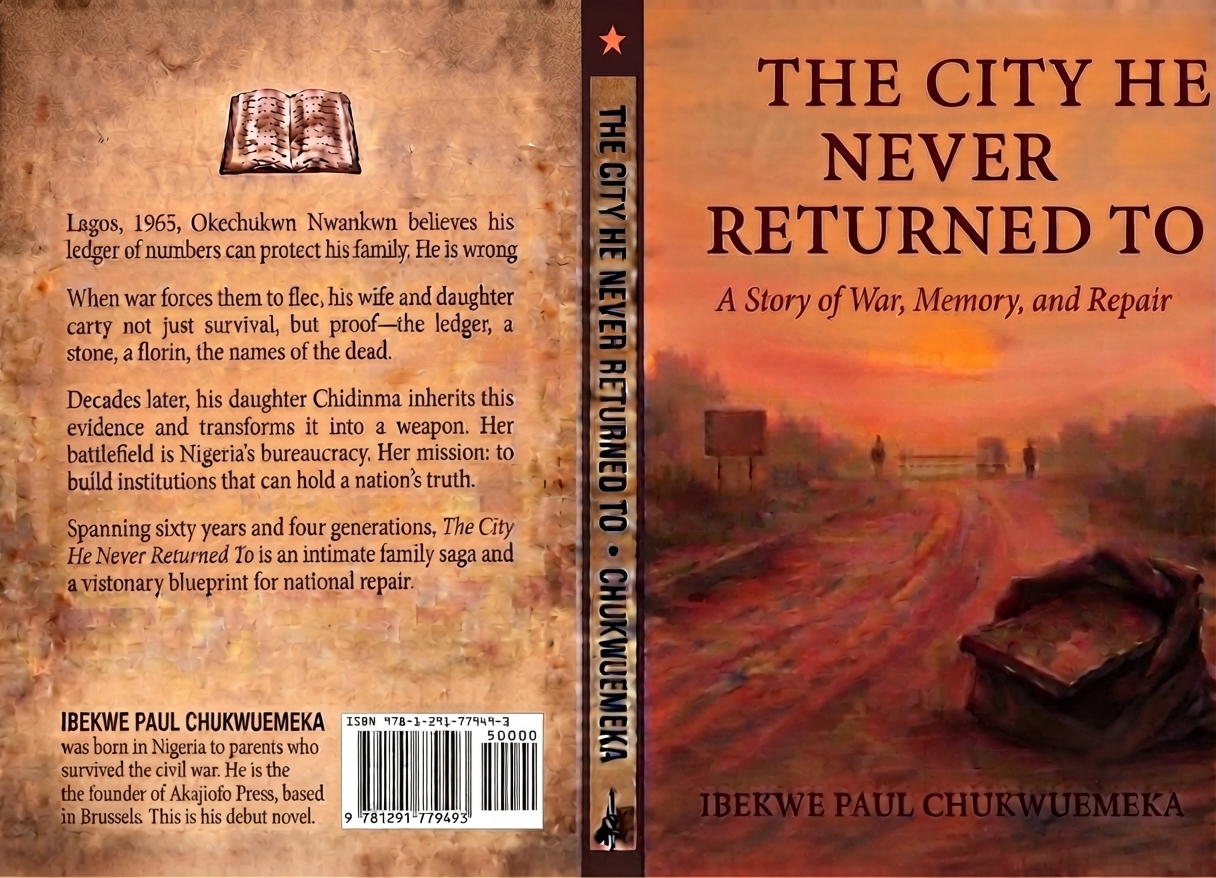
    A cinematic silhouette of a traveler in a wide-brimmed hat overlooking a misty, industrial landscape at sunset; promotional art for the ebook 'The City He Never Returned To' by Akajiofo Press.
    Journey into the heart of truth and justice. Download your digital copy of “The City He Never Returned To” today.

    Speculative Repair: Healing Nigeria’s Deepest Wounds

    Book jacket text: Lagos, 1965. Okechukwu Nwankwo believes his ledger of numbers can protect his family. He is wrong. When war forces them to flee, his wife and daughter carry not just survival, but proof—the ledger, a stone, a florin, the names of the dead. Decades later, his daughter Chidinma inherits this evidence and transforms it into a weapon. Her battlefield is Nigeria’s bureaucracy. Her mission: to build institutions that can hold a nation’s truth. Spanning sixty years and four generations, The City He Never Returned To is an intimate family saga and a visionary blueprint for national repair. IBEKWE PAUL CHUKWUEMEKA was born in Nigeria to parents who survived the civil war. He is the founder of Akajiofo Press, based in Brussels. This is his debut novel. CITY NEVER RETURNED CHUKWUEMEKA THE CITY HE NEVER RETURNED TO A Story of War, Memory, and Repair IBEKWE PAUL CHUKWUEMEKA Akajiofo Press, Brussels Akajiofo Press.
    The full book jacket for ‘The City He Never Returned To’ by Ibekwe Paul Chukwuemeka, a multigenerational saga exploring war and memory.

    The story of Nigeria is often told as a sequence of events—dates, battles, political maneuvers. But what of the unresolved echoes? What of the living memory that shapes today’s tensions and tomorrow’s possibilities? My novel does not emerge from a vacuum. It is born from the urgent, unresolved chords of our present, a deliberate act of what I call “speculative repair.” Here is why this work exists, and why its moment is now.

    1. The Unsettled Agitation: More Than Noise

    The persistent call for self-determination, championed by movements like IPOB, is often reduced in mainstream discourse to mere separatist clamour or political nuisance. This novel moves beyond the headlines to explore the rooted grief and generational yearning that fuels such agitation. It asks: What historical soil breeds this relentless demand? By stepping into the interior worlds of characters shaped by this reality, the fiction seeks not to endorse a position, but to humanize a profound and often misunderstood political expression, making its persistence comprehensible to all sides.

    2. The Toxicity of Suspicion: A Nation Trapped

    The high wall of suspicion between Nigeria’s ethnic nationalities is our collective prison. It ensures that our political arena is not a marketplace of ideas, but a gladiatorial pit of ethnic allegiance. This toxicity actively blocks the emergence of competent, compassionate leadership, as merit is forever sacrificed at the altar of origin. My novel dramatizes this cage, showing how suspicion corrupts every interaction—from the national assembly to the village square—and imagines what first, fragile steps out of it might look like.

    3. Confronting a Denied Trauma

    For the Igbo people, the deepest wound is often not the original atrocity of the civil war, but the sustained, systemic denial of that atrocity by the Nigerian state. A trauma unacknowledged is a trauma that festers, transforming into a spectral force that haunts the national psyche. This book explicitly recognises that trauma. It gives narrative space to the psychological and social legacy of that denial, not to dwell in victimhood, but to assert a fundamental principle of healing: you cannot repair what you will not first acknowledge.

    4The War That Never Ended: Marginalization as Policy

    The declaration of “No victor, no vanquished” rings hollow against the reality of deliberate political and infrastructural marginalization. When key appointments, federal projects, and national symbolism consistently exclude a major ethnic group, it perpetuates a cold war by other means. The novel illustrates this not through dry analysis, but through the lived experience of characters navigating a system designed to limit their horizons, asking the reader to feel the weight of a peace that feels like a prolonged defeat.

    5. Beyond “Victimhood”: A Call for Empathetic Awareness

    A common retort to Igbo complaints is an accusation of playing the victim. This novel challenges every Nigerian from other ethnicities to look past this easy dismissal. It constructs a mirror showing how narratives of victimhood are forged in the furnace of real, sustained experience. The goal is to foster awareness—to replace accusation with curiosity, and dismissal with the question: “If this were my reality, how would I feel? What would I demand?”

    6. The Blueprint for a Shared Future: Unity Through Understanding

    Ultimately, this is a novel aimed at foundation-laying. Its highest purpose is to foster the mutual understanding and respect without which true unity is a facade. By humanizing all sides of this complex national equation, it seeks to clear the toxic air and make space for a new, progressive patriotism. It imagines a Nigeria where loyalty is to justice and shared prosperity, not just to ethnic survival.

    7The Unanswered Question: From Analysis to Speculative Solution

    Many brilliant works have documented our war and dissected its aftermath. Historians and analysts have provided essential diagnosis. But a diagnosis alone is not a cure. This novel enters the space where most stop: the space of imaginative, practical solution-building. It dares to ask, “What if?” What if we addressed these roots with courage? What political architecture could emerge? This is the core of speculative repair: using the power of narrative not just to recount the break, but to actively imagine—and model—the mend.

    This novel is more than a story. It is an invitation to a crucial national conversation we have postponed for generations. It is a belief that fiction, in its deepest speculative form, can be a workshop for tomorrow’s politics.

    It is for everyone who has felt the uneasy silence after the news segment ends, for everyone who yearns for a Nigeria that lives up to its promise, and for everyone brave enough to believe that understanding our deepest wounds is the first step toward healing them.

    The discussion begins not in the halls of power, but in the imagination. This book is my opening statement.

    This poll is inspired by “The City He Never Returned To“, a novel that seeks to practice “speculative repair” on Nigeria’s deepest tensions. Your response will help shape the conversation around its themes. What do you think needs repairing first?

  • Exploring Healing in Nigeria’s Memory

    Exploring Healing in Nigeria’s Memory

    “Late is Different from Never”

    Book cover about war and memory
    A Story of War, Memory and Repair

    The Inheritance of Silence

    This journey did not begin with a plot, but with a question that followed me from the ancestral lands of Umuoti-Inyishi to my current home in Brussels: How does a nation live with a past that refuses to become past?

    For my parents, Ignatius and Christiana Ibekwe, survival was the primary goal. They carried their ambition, their ledgers, and their practical wisdom into a world that eventually shattered, leaving behind memories of checkpoints, hunger, and a twenty-pound note pressed between pages like a dried accusation.

    From Survival to Repair

    For a long time, I wondered: What comes after survival?

    The City He Never Returned is my answer. It is an act of speculative continuation. It imagines a Nigeria that addresses its foundational injuries not with denial or speeches, but with the meticulous, unglamorous tools of good governance—archives, audits, and transparent trusts.

    A Shared Invitation

    I believe that national healing is not a mysterious affair of the heart, but the most complex engineering project of our lifetime. This book is an invitation to envision a country where inherited grief is not a secret to be hidden, but a resource for resilience and justice.

    I invite you to join me in this conversation. Because as my parents taught me: a debt acknowledged, however belatedly, changes everything.

    Continue the conversation: What questions does your own family history ask of you? Share your thoughts in the comments, Or

    to be part of this novel’s journey from the beginning.

    News & updates

    akajiofo-press-forum-cover.jpg