
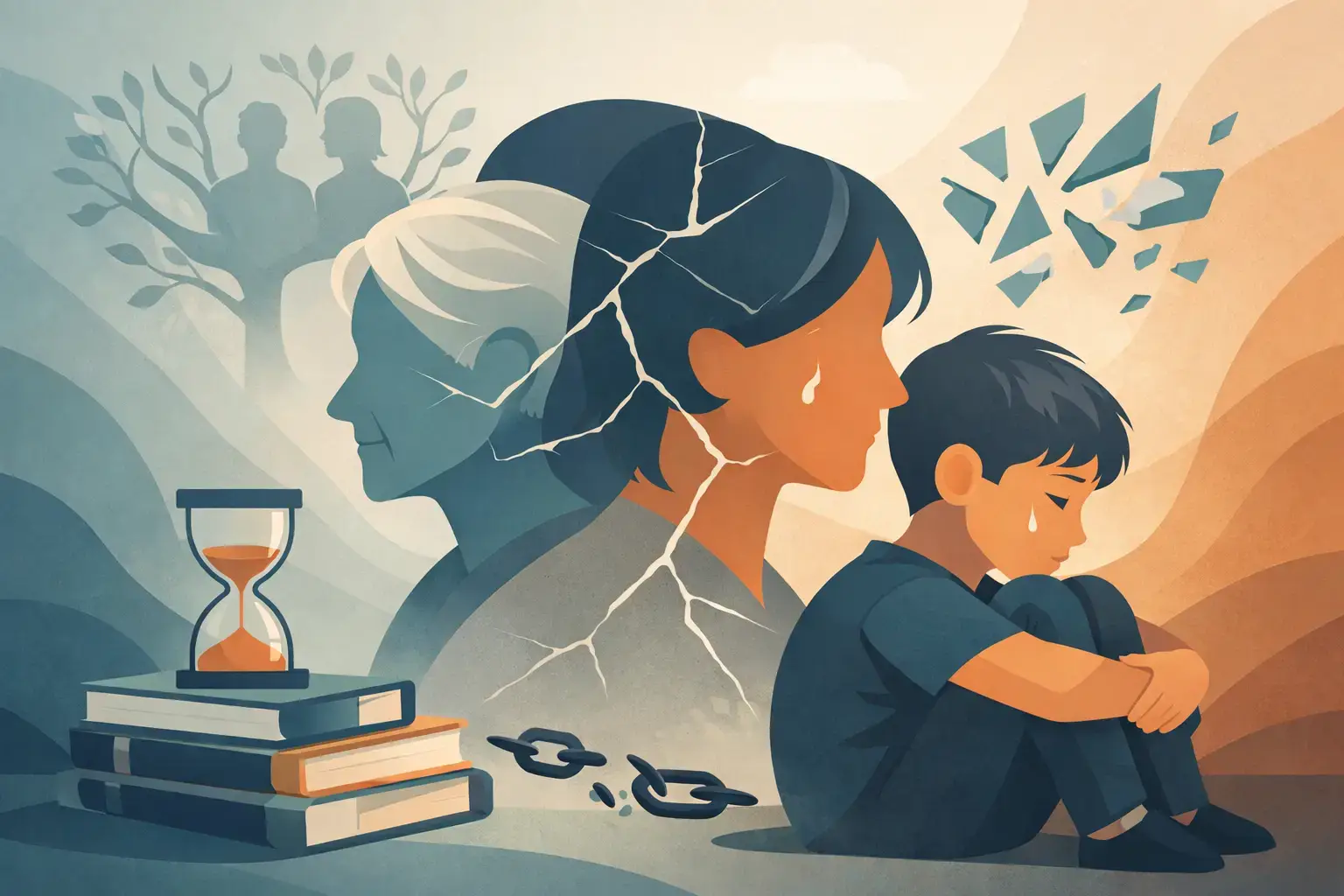
Some books do not merely tell a story. They expose the inheritance beneath one. The most searching books about intergenerational trauma show how grief travels through households, how silence hardens into family law, and how history leaves its residue in the body long after the event itself has passed.
That is why this category matters. Intergenerational trauma is not only a psychological term. It is also a literary problem, a political one, and often a national one. The child inherits not just memory but atmosphere. A family may never name the war, the exile, the partition, the enslavement, the disappearance, or the hunger that shaped it, yet the afterlife of that event can still organize intimacy, fear, language, and desire.
The best literature on this subject resists simplification. It does not treat trauma as a plot device or healing as a neat arc. Instead, it asks harder questions. What do children carry when parents cannot speak? What survives in gesture, ritual, appetite, caution, and shame? What becomes possible when a later generation chooses to remember differently?
Why books about intergenerational trauma matter
To read books about intergenerational trauma is to confront the fact that private pain rarely remains private. Families live inside larger structures – empire, race, caste, war, migration, patriarchy, dictatorship. What appears in one generation as discipline, withdrawal, secrecy, or volatility may have been forged in conditions of danger in another.
Literature gives us something clinical language cannot always hold. It gives us texture. It shows how inherited injury feels from the inside: in a daughter trying to decode a mother’s reserve, in a son learning the emotional grammar of a father shaped by loss, in grandchildren piecing together a history they were expected to survive without fully knowing.
For readers concerned with memory and justice, these books also clarify a moral point. Repair begins with attention. Before policy, before public commemoration, before even family reconciliation, there is the act of seeing clearly what has been passed down and what it has cost.
10 books about intergenerational trauma worth reading
Homegoing by Yaa Gyasi
Few contemporary novels render inherited history as powerfully as Homegoing. The book begins with two half-sisters in eighteenth-century Ghana and follows their descendants across generations, one line through the violence of the transatlantic slave trade and the other through the changing political landscape of West Africa.
What makes the novel remarkable is not only its scope but its precision. Gyasi shows how historical catastrophe becomes intimate. Prison, addiction, racial terror, displacement, and estrangement do not arrive as abstract themes. They settle into families. The structure can feel fragmented if you prefer deep immersion in a small cast, but that fragmentation is part of the point. The lineage itself has been fractured.
Beloved by Toni Morrison
Beloved remains indispensable because Morrison refuses to let slavery be treated as finished past. The novel insists that historical atrocity returns – in memory, in haunting, in motherhood, in the impossible choices forced by terror.
This is not the easiest starting point for every reader. Its language is layered, its chronology unsettled, its emotional force immense. But if you want to understand how a wound can exceed one lifetime and still command the living, few novels are as profound. Morrison writes trauma not as event alone but as a condition of afterlife.
The Joy Luck Club by Amy Tan
Amy Tan’s novel traces the tensions between Chinese immigrant mothers and their American-born daughters, but its real achievement lies in how it treats misunderstanding as historical inheritance. What one generation calls toughness, another experiences as distance. What looks like control may be fear shaped by war, abandonment, and dislocation.
The book is often remembered for its family drama, and rightly so, but it is also a study in translation across generations. Trauma here is carried not only in stories told, but in those delayed too long. It is especially compelling for readers interested in migration and the emotional costs of remaking a life in a new country.
The Bluest Eye by Toni Morrison
This novel is devastating, and it should be approached with care. Morrison examines how racial self-hatred, family violence, and communal failure form the conditions in which a child is broken.
What makes it essential to this conversation is Morrison’s refusal to isolate harm within one household. She shows how beauty standards, anti-Blackness, poverty, and sexual violence become internalized and reproduced. Intergenerational trauma here is social as much as familial. The novel asks what a community transmits when it cannot protect its most vulnerable.
On Earth We’re Briefly Gorgeous by Ocean Vuong
Written as a son’s letter to his mother, this book moves with lyric intensity through migration, queerness, labor, and inherited pain. Vuong is alert to the way war survives in domestic life – not as historical background but as a force that shapes touch, speech, rage, and tenderness.
Some readers may find the prose almost too luminous for the brutality it records. Others will find that this tension is exactly the achievement. The book understands that beauty does not cancel violence; sometimes it is the form through which the unsayable can finally be approached.
A Thousand Splendid Suns by Khaled Hosseini
Though often read as a sweeping story of friendship and endurance, this novel also reveals how patriarchy and war reproduce trauma across generations of women. The damage is not only physical. It appears in what women are taught to accept, in the futures they are denied, and in the forms of love they must invent under pressure.
Hosseini writes accessibly, which makes this a strong entry point for readers newer to the theme. At the same time, some may want a more structurally experimental treatment of inherited trauma. This is a novel of emotional clarity rather than formal difficulty.
The Woman Warrior by Maxine Hong Kingston
This hybrid work of memoir and myth is vital for anyone interested in the unstable border between family memory and narrative reconstruction. Kingston explores the stories that shaped her Chinese American girlhood, including silence, shame, migration, and gendered expectation.
The book does not offer stable ground at every moment. Legend, recollection, and interpretation blur. That uncertainty is part of its force. Intergenerational trauma often reaches us in partial form – through rumor, cautionary tale, omission, and inherited script. Kingston turns that fractured inheritance into literary method.
Cry, the Beloved Country by Alan Paton
This is not always the first title named in conversations about inherited trauma, but it belongs there. Paton’s novel traces personal loss within the larger violence of South Africa’s racial order. It is deeply concerned with what social rupture does to families, to moral vision, and to the possibility of national life.
Its framework is older, and some readers will want more from Black interiority than the novel provides. That limitation matters. Still, as a meditation on how structural injustice wounds generations, it remains instructive.
The Bone People by Keri Hulme
Hulme’s novel is difficult, formally strange, and ethically unsettling. It circles damaged adults and a brutalized child, while drawing on Maori identity, belonging, and fracture. This is not a gentle reading experience, nor is it a book that offers clean moral reassurance.
Yet for readers willing to sit with complexity, it poses urgent questions about violence, kinship, and the possibility of repair after repeated harm. Not every reader will agree with the novel’s handling of abuse. That discomfort is real and worth naming.
Maus by Art Spiegelman
Spiegelman’s graphic memoir about his father’s Holocaust survival and their difficult relationship remains one of the clearest accounts of trauma’s afterlife in the family. It shows how survival itself can harden into behaviors that burden the next generation – frugality sharpened into control, vigilance into emotional distance, memory into compulsion.
The graphic form is not a reduction of seriousness. It is part of the book’s brilliance. Image and text together show how historical horror is remembered, stylized, mediated, and still capable of wounding descendants.
How to choose the right books about intergenerational trauma
It depends on what kind of reading you need. If you want a wide historical lens, Homegoing offers breadth across centuries. If you want the psychic intensity of one family marked by an atrocity that should never be over, Beloved is unmatched. If your interest lies in migration and maternal inheritance, The Joy Luck Club and On Earth We’re Briefly Gorgeous speak in different but complementary registers.
It also depends on your tolerance for difficulty. Some of these books are emotionally punishing. Others are more accessible but still serious. There is no virtue in reading beyond your capacity at a given moment. Literature asks for openness, but it also asks for discernment.
For many readers, the deepest encounter comes not from reading one book in isolation but from placing several in conversation. When you read across slavery, migration, war, and colonial violence, a pattern emerges. Trauma is transmitted through silence and repetition, but so is resistance. So is care. So is the stubborn effort to make language where none was offered.
At Akajiofo Press, we are especially drawn to books that understand memory as a civic burden as well as a personal one. The family archive is never only familial. It touches the unfinished business of nations.
A good book on this subject does more than name injury. It changes the reader’s scale of attention. It teaches you to listen for what is missing, to recognize history in a gesture, and to ask what forms of repair might begin when the inherited silence is finally broken.
Leave a Reply