get_order_number(); $email = $order->get_billing_email(); $country = $order->get_shipping_country() ?: $order->get_billing_country(); $delivery_date = date( 'Y-m-d', strtotime( '+5 days' ) ); // estimate 5 days, adjust as needed $gtin = '9781291779493'; // your ISBN without hyphens ?> add_action( 'woocommerce_thankyou', 'add_google_reviews_optin' ); function add_google_reviews_optin( $order_id ) { $order = wc_get_order( $order_id ); if ( ! $order ) { return; } $order_num = $order->get_order_number(); $email = $order->get_billing_email(); $country = $order->get_shipping_country() ?: $order->get_billing_country(); $delivery_date = date( 'Y-m-d', strtotime( '+5 days' ) ); $gtin = '9781291779493'; ?>

Akajiofo Press

Tag: Ledger

  • Why African Futures Literature Matters

    Why African Futures Literature Matters

    A future is never only about tomorrow. In African futures literature, the future arrives carrying the dead, the dispossessed, the stolen archive, the unfinished war, the language that survived by whispering, and the city remade after catastrophe. That is what gives the field its force. It refuses the childish fantasy of a clean break. It asks what kind of tomorrow becomes possible when memory is not treated as a burden, but as material.

    Too often, African writing is received through a narrow moral script. It is expected to testify to suffering, explain crisis, or translate a continent into digestible themes for distant readers. Even when praised, it is frequently praised for proximity to damage. African futures literature disrupts that arrangement. It does not turn away from violence, but it refuses to let violence be the final grammar of African meaning.

    What African futures literature is really doing

    At its best, african futures literature is not simply a regional branch of science fiction. That description is too small. The field includes speculative fiction, yes, but also political allegory, mythic reworking, alternate history, climate imagination, postwar dreaming, and narratives that move between realism and the uncanny without asking permission from genre policing.

    What unites these works is not a shared aesthetic formula. It is a shared insistence that African people must be allowed to imagine historical agency beyond colonial aftermath. That means writing futures where infrastructure, governance, kinship, spirituality, migration, ecology, and technology can be rethought from African conditions rather than imported assumptions.

    This is why the field matters intellectually. It contests the old imperial habit of assigning Africa to the past. The colonial gaze treated Africa as raw material for other people’s futures – labor for empire, land for extraction, data for policy, spectacle for humanitarian feeling. African futures literature answers by restoring temporal sovereignty. It says, in effect, that African societies do not merely endure history. They interpret it, resist it, and generate worlds from within it.

    Beyond representation toward political imagination

    There is a thin way to talk about literary change, and a serious way. The thin way celebrates representation in the abstract. It is glad that new settings, new faces, and new names have appeared in speculative writing. That is not meaningless, but it is not enough.

    The serious question is what kind of imagination a text makes available. Does it merely place African characters inside borrowed futuristic templates? Or does it rethink the very terms of futurity – the state, the border, the archive, the sacred, the machine, the market, the family? The strongest work in african futures literature does the latter. It shifts the underlying argument about what a future is for.

    This is where trade-offs emerge. Not every text needs to be overtly political, and not every political text becomes art. Some novels lean toward world-building and technological speculation. Others work through grief, aftermath, and broken civic memory. Some are lush and mythic. Others are spare, urban, and brutally contemporary. The field is richer when we allow these differences to stand. A literature of the future should not become another site of rigid expectation.

    Still, there is a discernible moral pressure inside the best of this writing. It asks whether progress without remembrance is simply a more efficient form of forgetting. It asks whether development can mean anything if the people most damaged by history are excluded from the terms of repair. It asks whether the future can be legitimate if it is built on unburied truths.

    The role of memory in African futures literature

    One of the most distinctive features of African futures literature is its treatment of time. In much mainstream futurist storytelling, time is linear. Humanity advances. Technology escalates. Crisis appears, then is solved or deepened. The plot moves forward.

    African futures literature often works differently. Time folds. Ancestors remain active. Old wars leak into new institutions. Ruins become blueprints. Prophecy behaves like memory, and memory behaves like unfinished law. This is not stylistic decoration. It reflects a historical reality in which colonial violence, civil conflict, extraction, and forced migration continue to shape the present long after official timelines declare them over.

    For readers attentive to African history, this temporal complexity feels truthful. The nation is not born once. It is repeatedly made and unmade by memory, denial, inheritance, and struggle. A future-oriented African novel, then, may be less interested in prediction than in moral continuity. Who remembers? Who benefits from forgetting? What forms of life become imaginable when the archive is reopened?

    That question carries special weight for diaspora readers. Distance can intensify longing, but it can also flatten complexity into nostalgia. The best future-facing African writing resists easy sentiment. It offers neither simple homecoming nor painless rupture. Instead, it presents belonging as a negotiation with language, history, class, and estrangement. That honesty is part of its gift.

    Why genre labels can help and limit

    Terms like Afrofuturism, Africanfuturism, speculative fiction, and futurist literature can all be useful, but only up to a point. Labels help readers find conversations. They map influence and create a visible field. Yet labels can also become marketing shortcuts that reduce demanding work into a fashionable tag.

    This matters because African futures literature is frequently read too quickly. A novel with advanced technology is taken as futuristic even if its deepest concern is actually land theft or inherited silence. A story with spirits or altered timelines is categorized as fantastical when it may be grappling with the political afterlife of massacre. The frame is not wrong, exactly. It is just incomplete.

    A more faithful approach begins with the text’s governing anxieties. What wound is it circling? What world is it refusing? What kind of repair, if any, does it imagine? These questions open the literature rather than shrinking it.

    The future as a site of repair

    For a press like Akajiofo, the most compelling dimension of african futures literature may be this: it can make speculative repair thinkable. Not repair as sentiment, and not repair as branding language, but repair as a disciplined act of imagination. Literature cannot replace restitution, policy, or collective action. It cannot resurrect the dead or undo plunder. But it can clarify what has been broken and what forms of relation might still be rebuilt.

    That is no small thing. Public discourse often forces a false choice between mourning and hope. Either one remains loyal to injury, or one moves on. Serious literature refuses this bargain. It understands that hope without reckoning becomes amnesia, while reckoning without imagination can harden into despair.

    African futures literature creates another path. It lets writers and readers test the moral architecture of possible worlds. What would a city look like if it were organized around remembrance rather than erasure? What would citizenship mean after mass betrayal? What technologies would serve communal life rather than extraction? What stories would children inherit if adults stopped lying about how the nation was made?

    These are literary questions, but not only literary questions. They are civic questions disguised as narrative. That is why the field matters beyond classrooms and prize lists.

    Reading the field with seriousness

    To read this body of work well, one must resist the hunger for novelty alone. The point is not simply that African writers are imagining spaceships, alternate states, or post-collapse worlds. The point is that they are revising the moral terms under which the future has been narrated. They are asking who has the authority to imagine, whose losses count as historical, and what a livable tomorrow requires of the present.

    Some books will offer exhilaration. Others will disturb more than they console. Some futures will feel emancipatory; others will reveal how domination mutates rather than disappears. That variation is not a weakness. It is evidence of a living field thinking aloud.

    The wisest way to approach african futures literature is with patience and ethical attention. Read for form, but also for historical pressure. Read for invention, but also for what the invention is trying to rescue. Read for beauty, but do not confuse beauty with innocence.

    The future, in these works, is rarely clean. It is argued over, haunted, and built under conditions of unequal memory. Yet that may be precisely why it deserves our attention. A literature that can hold grief and possibility in the same sentence is not offering escape. It is teaching us how to remain answerable to history while still making room for the world that has not yet been born.

  • Why This Novel Now

    Beyond History, Toward Speculative Repair

    A cinematic silhouette of a traveler in a wide-brimmed hat overlooking a misty, industrial landscape at sunset; promotional art for the ebook 'The City He Never Returned To' by Akajiofo Press.
    Journey into the heart of truth and justice. Download your digital copy of “The City He Never Returned To” today.

    Speculative Repair: Healing Nigeria’s Deepest Wounds

    Book jacket text: Lagos, 1965. Okechukwu Nwankwo believes his ledger of numbers can protect his family. He is wrong. When war forces them to flee, his wife and daughter carry not just survival, but proof—the ledger, a stone, a florin, the names of the dead. Decades later, his daughter Chidinma inherits this evidence and transforms it into a weapon. Her battlefield is Nigeria’s bureaucracy. Her mission: to build institutions that can hold a nation’s truth. Spanning sixty years and four generations, The City He Never Returned To is an intimate family saga and a visionary blueprint for national repair. IBEKWE PAUL CHUKWUEMEKA was born in Nigeria to parents who survived the civil war. He is the founder of Akajiofo Press, based in Brussels. This is his debut novel. CITY NEVER RETURNED CHUKWUEMEKA THE CITY HE NEVER RETURNED TO A Story of War, Memory, and Repair IBEKWE PAUL CHUKWUEMEKA Akajiofo Press, Brussels Akajiofo Press.
    The full book jacket for ‘The City He Never Returned To’ by Ibekwe Paul Chukwuemeka, a multigenerational saga exploring war and memory.

    The story of Nigeria is often told as a sequence of events—dates, battles, political maneuvers. But what of the unresolved echoes? What of the living memory that shapes today’s tensions and tomorrow’s possibilities? My novel does not emerge from a vacuum. It is born from the urgent, unresolved chords of our present, a deliberate act of what I call “speculative repair.” Here is why this work exists, and why its moment is now.

    1. The Unsettled Agitation: More Than Noise

    The persistent call for self-determination, championed by movements like IPOB, is often reduced in mainstream discourse to mere separatist clamour or political nuisance. This novel moves beyond the headlines to explore the rooted grief and generational yearning that fuels such agitation. It asks: What historical soil breeds this relentless demand? By stepping into the interior worlds of characters shaped by this reality, the fiction seeks not to endorse a position, but to humanize a profound and often misunderstood political expression, making its persistence comprehensible to all sides.

    2. The Toxicity of Suspicion: A Nation Trapped

    The high wall of suspicion between Nigeria’s ethnic nationalities is our collective prison. It ensures that our political arena is not a marketplace of ideas, but a gladiatorial pit of ethnic allegiance. This toxicity actively blocks the emergence of competent, compassionate leadership, as merit is forever sacrificed at the altar of origin. My novel dramatizes this cage, showing how suspicion corrupts every interaction—from the national assembly to the village square—and imagines what first, fragile steps out of it might look like.

    3. Confronting a Denied Trauma

    For the Igbo people, the deepest wound is often not the original atrocity of the civil war, but the sustained, systemic denial of that atrocity by the Nigerian state. A trauma unacknowledged is a trauma that festers, transforming into a spectral force that haunts the national psyche. This book explicitly recognises that trauma. It gives narrative space to the psychological and social legacy of that denial, not to dwell in victimhood, but to assert a fundamental principle of healing: you cannot repair what you will not first acknowledge.

    4The War That Never Ended: Marginalization as Policy

    The declaration of “No victor, no vanquished” rings hollow against the reality of deliberate political and infrastructural marginalization. When key appointments, federal projects, and national symbolism consistently exclude a major ethnic group, it perpetuates a cold war by other means. The novel illustrates this not through dry analysis, but through the lived experience of characters navigating a system designed to limit their horizons, asking the reader to feel the weight of a peace that feels like a prolonged defeat.

    5. Beyond “Victimhood”: A Call for Empathetic Awareness

    A common retort to Igbo complaints is an accusation of playing the victim. This novel challenges every Nigerian from other ethnicities to look past this easy dismissal. It constructs a mirror showing how narratives of victimhood are forged in the furnace of real, sustained experience. The goal is to foster awareness—to replace accusation with curiosity, and dismissal with the question: “If this were my reality, how would I feel? What would I demand?”

    6. The Blueprint for a Shared Future: Unity Through Understanding

    Ultimately, this is a novel aimed at foundation-laying. Its highest purpose is to foster the mutual understanding and respect without which true unity is a facade. By humanizing all sides of this complex national equation, it seeks to clear the toxic air and make space for a new, progressive patriotism. It imagines a Nigeria where loyalty is to justice and shared prosperity, not just to ethnic survival.

    7The Unanswered Question: From Analysis to Speculative Solution

    Many brilliant works have documented our war and dissected its aftermath. Historians and analysts have provided essential diagnosis. But a diagnosis alone is not a cure. This novel enters the space where most stop: the space of imaginative, practical solution-building. It dares to ask, “What if?” What if we addressed these roots with courage? What political architecture could emerge? This is the core of speculative repair: using the power of narrative not just to recount the break, but to actively imagine—and model—the mend.

    This novel is more than a story. It is an invitation to a crucial national conversation we have postponed for generations. It is a belief that fiction, in its deepest speculative form, can be a workshop for tomorrow’s politics.

    It is for everyone who has felt the uneasy silence after the news segment ends, for everyone who yearns for a Nigeria that lives up to its promise, and for everyone brave enough to believe that understanding our deepest wounds is the first step toward healing them.

    The discussion begins not in the halls of power, but in the imagination. This book is my opening statement.

    This poll is inspired by “The City He Never Returned To“, a novel that seeks to practice “speculative repair” on Nigeria’s deepest tensions. Your response will help shape the conversation around its themes. What do you think needs repairing first?

  • The Significance of Ledgers in Preserving History

    The Significance of Ledgers in Preserving History

    Why a Ledger? The Origin of the Central Metaphor

    January 29, 2026 • Writing Process • 4 minute read

    1767999439634 1

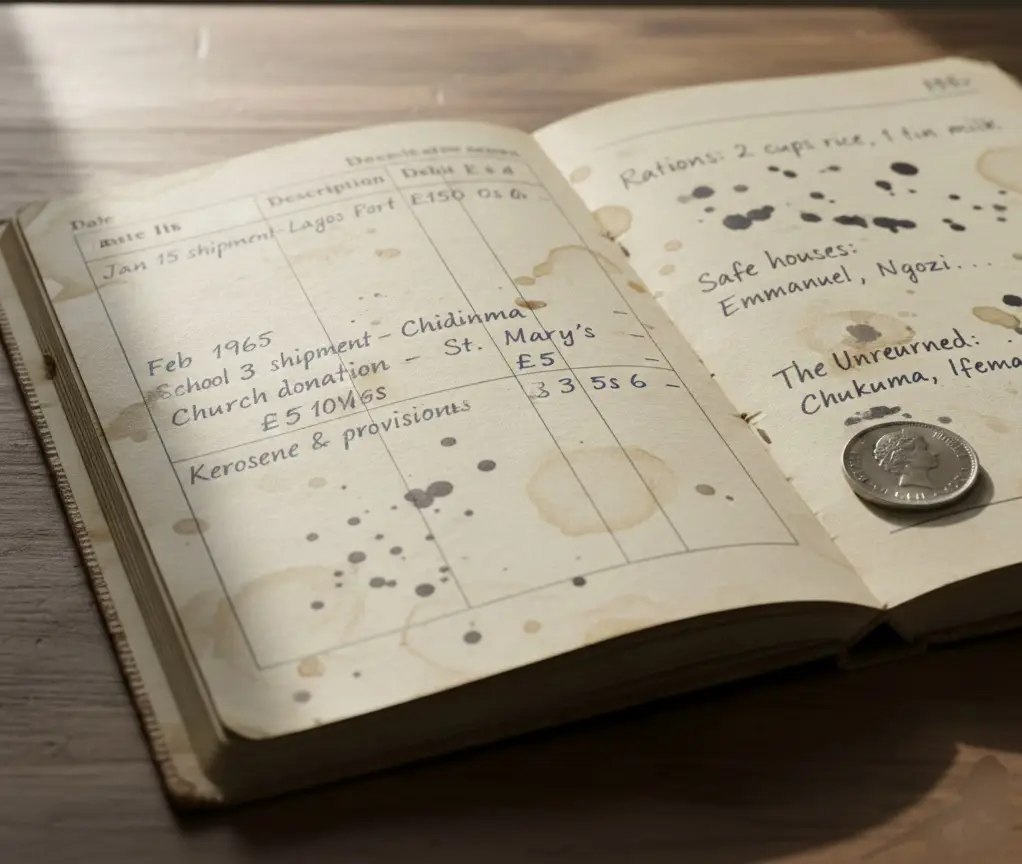
    Authentic 1965 Nigerian ledger showing fountain pen entries transitioning from financial accounts to survival records, with a 1964 florin coin resting on the page

    ✱Actual 1964 Nigerian florin

    Behind This Image

    This ledger represents the novel’s central metaphor: documents that begin as tools of order become repositories of memory. Notice the transition from neat columns to urgent handwriting—a visual representation of history interrupting ordinary life.

    Research reference for “THE CITY HE NEVER RETURNED TO.” Such documents often survived when little else did.

    When people ask what my novel is about, I say: “It’s about a ledger.” The response is usually a puzzled look. In our digital age, ledgers seem antiquated—relics of accounting past. But that’s precisely why I chose one.

    The Discovery

    While researching family histories from the 1960s, I encountered actual ledgers that had survived displacement. What struck me wasn’t the financial records, but the evolution of their purpose. Page by page, they transformed:

    • From recording profits and losses
    • To tracking rations during crisis
    • To listing names of the missing
    • Finally becoming sacred texts of memory

    More Than Numbers

    A ledger is a promise of order in chaos. In THE CITY HE NEVER RETURNED TO, Okechukwu believes his meticulous records can protect his family. He’s both right and terribly wrong. The ledger does protect—but not in the way he expects.

    “Some wounds are passports. Some ledgers are maps.” This line from the book captures what I came to understand: documents meant for one purpose can become something entirely different in history’s hands.

    Why This Matters Now

    In an era of digital ephemera, we’ve lost the physicality of records. A ledger has weight. It yellows. Its pages hold the oil from fingers that turned them decades ago. It’s a tangible connection to choices made under pressure.

    As Nigeria continues to navigate historical memory and national healing, I believe we need to pay attention to our ledgers—both literal and metaphorical. What are we recording? What are we choosing to remember? More importantly, what might future generations need those records to become?

    Promotional graphic for a special edition of "THE CITY HE NEVER RETURNED TO" by Heartyfall Channel Cream. The design features the dramatic split-title format with subtitle "A story of time, funny, and larger." Display includes website AKAJIOFO.COM and tagline "Unlock Your Potential -Get the Ebook."
    A STORY BEYOND CONVENTION

    “THE CITY HE NEVER RETURNED TO” takes an unexpected turn in this special edition. Described as “A story of time, funny, and larger,” this version by HEARTYFALL CHANNEL CREAM explores memory through a different lens—one that intertwines temporality, unexpected humor, and expansive perspective.

    What happens when a serious story meets a touch of the unexpected? How does humor change our relationship with loss and memory?

    Experience this unique literary approach
    Discover why “funny” can be profound in context
    Explore what “larger” truly means in storytelling

    Ready for a narrative that defies expectations?

    Unlock Your Potential – Get This Special Edition
    AKAJIOFO.COM

    Ibekwe Paul Chukwuemeka

    Author of THE CITY HE NEVER RETURNED TO, a novel exploring how personal records become national conscience through one family’s journey from 1965 Lagos to present-day Nigeria.

    Your Experience?

    Have you encountered family documents that revealed unexpected histories? How do you think physical records differ from digital ones in how they preserve memory? Share your thoughts in the comments to Continue the conversation or join the waitlist to be part of this novel’s journey from the beginning.