get_order_number(); $email = $order->get_billing_email(); $country = $order->get_shipping_country() ?: $order->get_billing_country(); $delivery_date = date( 'Y-m-d', strtotime( '+5 days' ) ); // estimate 5 days, adjust as needed $gtin = '9781291779493'; // your ISBN without hyphens ?> add_action( 'woocommerce_thankyou', 'add_google_reviews_optin' ); function add_google_reviews_optin( $order_id ) { $order = wc_get_order( $order_id ); if ( ! $order ) { return; } $order_num = $order->get_order_number(); $email = $order->get_billing_email(); $country = $order->get_shipping_country() ?: $order->get_billing_country(); $delivery_date = date( 'Y-m-d', strtotime( '+5 days' ) ); $gtin = '9781291779493'; ?>

Tag: necessary conversation

  • 📜 Week 5: The Okpara Miracle (What We Lost)

    📜 Week 5: The Okpara Miracle (What We Lost)

    The Fastest Growing Economy You’ve Never Heard Of

    🔥 TRENDING TOPIC HOOK:

    Old cracked map with a glowing light at the center showing roads and regions
    An aged, cracked map with a glowing golden center highlights an intricate network of roads and regions.

    Did you know that Eastern Nigeria was once one of the fastest‑growing economies in the world? Dr. Michael Okpara did it without oil.

    Then the federal government sabotaged him. What if we brought back the Okpara model?

    📜 HISTORICAL FACTS

    THE ECONOMIC TITAN

    While the federal center rotted with rigging and political crisis, Dr. Michael Okpara, Premier of Eastern Nigeria (1959–1966), was quietly building an economic miracle. At just 39 years old when he took office, he deployed a philosophy called “pragmatic socialism” and bet everything on agriculture.

    Dr. Michael Okpara was proving in the East that Nigeria could work. Using “Agricultural Pragmatism,” he built a region that didn’t need a kobo from oil.

    WHAT HE BUILT:

    – Farm settlements: Okpara established massive, state‑sponsored farm settlements across the East – in Umuahia, Abakaliki, Calabar, and Nsukka. Each settlement had modern equipment, housing, schools, and healthcare for farmers.- Rice revolution: He turned Abakaliki into Nigeria’s premier rice processing hub, making rice a major regional staple by 1965.- Palm oil dominance: Through the Eastern Nigeria Development Corporation (ENDC), he transformed the region into a global palm oil powerhouse.- Industrialization: Agricultural profits were reinvested into light industries – textiles, furniture, plastics, and tire manufacturing.

    THE RESULTS:

    – Between 1960 and 1966, Eastern Nigeria’s GDP grew at an average annual rate of 7–8% – comparable to South Korea and Taiwan at the same period.- The region became a net exporter of food, even as the rest of Nigeria imported.- Okpara built over 1,000 miles of rural roads and electrified hundreds of villages.- Primary school enrollment tripled, funded entirely from internally generated revenue, not federal handouts.

    The Sabotage:

    The British‑designed federal system forced Okpara to funnel his region’s wealth through a Federal Center that he did not control. The North‑dominated federal government took the bulk of Eastern Nigeria’s palm oil and coal revenues and redistributed them elsewhere. Okpara complained repeatedly that his region was being “milked” to subsidize the North’s slower development.

    This created the friction that eventually led to secession.

    The Lesson :

    The East did not want to leave Nigeria because they hated the North; they wanted to leave because the “Design” was an economic anchor dragging them down. If Okpara had been allowed to keep 50% of his region’s revenue, the Biafran war might never have happened.

    Speculative Repair :

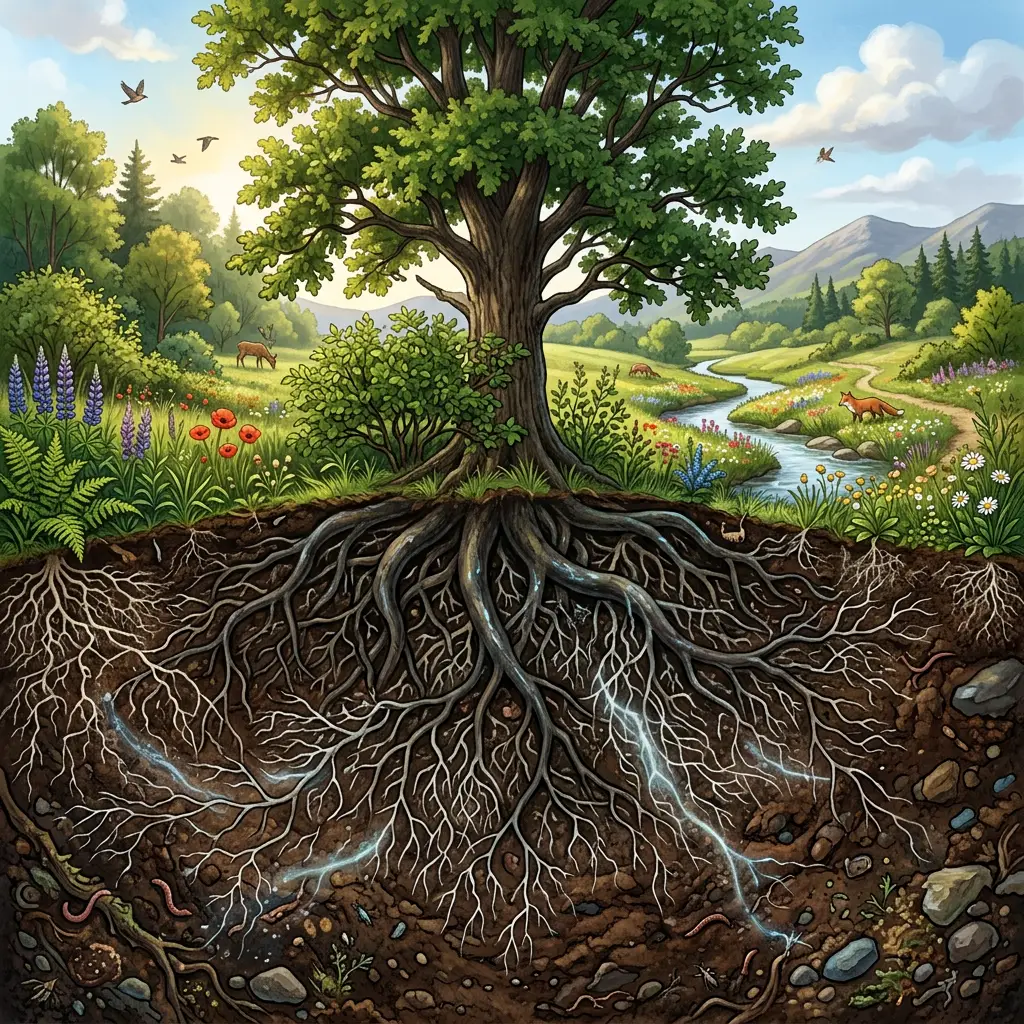
    Cross-section of tree roots with soil organisms and vibrant forest landscape
    An illustrated cross-section showing a tree’s roots intertwined with soil life in a vibrant forest landscape

    🔁 WHAT COULD HAVE BEEN (If We Did It Right)

    THE COUNTERFACTUAL:

    Imagine that the federal government, instead of sabotaging regional development, had adopted the Okpara model nationally in 1964.- Every region would have established agricultural development corporations, farm settlements, and rural infrastructure banks.- The 50% derivation rule would have been enshrined from independence, so Okpara would have kept half of Eastern Nigeria’s palm oil, rubber, and coal revenues to reinvest.

    The 50% Derivation Rule. If we go back to letting regions keep half of what they make, the North will stop being a “dependency” and start being the “Agricultural Powerhouse” it was always meant to be.

    WHAT WOULD HAVE HAPPENED?

    – Oil would have been a bonus, not a curse. When oil was discovered in commercial quantities in the 1970s, Nigeria would already have had a diversified agricultural and industrial economy. The Dutch Disease (where oil kills other sectors) would have been avoided. Nigeria would be like Indonesia (GDP per capita $5,000) or better.- Food security would be absolute. The farm settlements would have spread nationwide. Nigeria would be a net exporter of rice, palm oil, cocoa, and groundnuts, not the world’s largest importer of rice (spending $2 billion annually today).- Rural poverty would be halved. The Okpara model was designed to keep young people in villages with viable farming cooperatives, not drive them to Lagos to become okada riders.

    HOW NIGERIANS WOULD BE BETTER OFF TODAY:

    – Your food bill would be 40% cheaper.- Your uncle in the village would have a bank account, a functional primary school, and a health center with electricity.- Nigeria would be a member of the G20 on economic merit, not just population.- The word “Okpara” would be taught in schools the way we teach Lee Kuan Yew or Mahathir Mohamad – as the man who showed Africa how to grow.

    Discussion Questions

    The Okpara Miracle​”Dr. Okpara used agricultural cooperatives to fund industrialization in the 1960s.

    Why do you think this model disappeared from our national discourse?

    ​What is one product or resource in your home region that, if turned into an export business today, could make your state self-sufficient?

    Footer Snippet

    The Mission :

    Beachfront luxury villas with private pools and palm trees during sunset
    A luxurious beach resort with private pools and palm trees at sunset

    If we can’t fix the past, we must redesign the future.​Most people look at Nigeria’s history and see a series of unfortunate accidents. I see a design flaw.​The “Speculative Repair” mantra is built on a simple, radical premise: To solve Nigeria’s current crisis, we must first accept that the country was “manufactured” by colonial architects to favor stability over success and compliance over competence.​In this series, we don’t just complain about what went wrong. We perform “Digital Surgery” on our history. We ask:​What if the 1959 election hadn’t been rigged? * What if the regional economic miracles of Michael Okpara and Obafemi Awolowo had been protected instead of sabotaged? * What if the North had been allowed to develop at its own pace instead of being forced to “anchor” the rest of the nation?​By “repairing” these historical moments speculatively, we find the credible facts and structural solutions needed to build a New Nigerian Federation.​Join me every week as we stop mourning the Nigeria that “wasn’t designed to succeed” and start building the one that is.The Six Geopolitical Zones must become the new centers of power, leaving Abuja as a mere “Manager of the Common Room.”Closing Statement:Nigeria was not designed to succeed, but we are the designers now. The ghost of 1960 only haunts us because we refuse to turn on the light.

  • War Memory Fiction and the Work of Repair

    War Memory Fiction and the Work of Repair

    A child remembers a door left open during shelling. An old man recalls the taste of powdered milk from a relief camp more vividly than the speeches that justified the war. A city keeps rebuilding over mass silence. This is where war memory fiction begins – not in military triumph, and not in official commemoration, but in the unstable ground where lived memory outlasts the stories states prefer to tell.

    For readers shaped by African history, diaspora inheritance, and the unfinished afterlives of conflict, this genre matters because it restores proportion. It reminds us that war is never only an event. It is a rearrangement of family, language, appetite, prayer, geography, and time itself. The battle may end; the memory does not. Fiction that takes memory seriously can therefore do something that archives, tribunals, and textbooks often cannot. It can show how violence continues inside ordinary life.

    What war memory fiction is really doing

    War memory fiction is sometimes mistaken for historical fiction with sharper emotional stakes. That description is too thin. The distinguishing feature is not simply that a war occurred in the background. It is that memory becomes the governing structure of the narrative. The story is shaped by recall, distortion, repetition, repression, inheritance, and belated understanding.

    In this kind of work, chronology is rarely innocent. The past interrupts the present. A character may be cooking, courting, migrating, or aging, yet the war enters through image, smell, dream, rumor, or fragment. This is not a stylistic flourish. It is a formal truth about trauma and historical aftermath. People do not remember violence in neat sequence, and communities do not recover by moving forward in a straight line.

    The best war memory fiction also resists the temptation of clean moral architecture. It does not confuse empathy with exoneration, and it does not flatten complexity into slogan. A village may contain both victims and collaborators. A soldier may be brutalized and brutal. A survivor may be unreliable not because she is dishonest, but because memory itself has been injured. Such fiction asks readers to dwell with ethical difficulty rather than flee from it.

    Why war memory fiction matters in African literary life

    In many African contexts, public memory is managed through omission. States minimize certain atrocities, commemorate selectively, or convert catastrophe into national myth. Families do their own editing, often out of love, fear, or fatigue. Children inherit moods before they inherit facts. Silence becomes a household language.

    This is why literature carries unusual weight. It can return human scale to histories that have been abstracted by diplomacy, journalism, or official forgetting. It can ask what a war did to kinship, to speech, to belief, to a generation’s capacity for tenderness. It can reveal that the true archive of violence may live in domestic rituals, damaged landscapes, and the habits of those who survived.

    For African readers in particular, the stakes are not merely representational. Too often, the continent’s wars are narrated from outside through familiar frames: tribal chaos, humanitarian pity, geopolitical convenience. War memory fiction can refuse that arrangement. It can insist on interiority, texture, and moral specificity. It can locate war not as spectacle for distant consumption, but as a wound inside real communities with their own vocabularies of grief and endurance.

    That refusal matters. It protects memory from simplification. It also protects the future from amnesia dressed up as progress.

    The ethics of writing from memory after war

    There is always risk here. Memory can dignify the dead, but it can also aestheticize suffering. A novelist may render atrocity beautifully and still fail the people whose histories are being borrowed. So the question is not whether fiction should approach war, but how.

    The most responsible work tends to avoid two opposite errors. The first is sentimental innocence, where suffering is purified and made spiritually useful for the reader. The second is voyeuristic excess, where violence is reproduced in lingering detail without sufficient moral purpose. Between these errors lies a harder path: to write with clarity about damage while preserving the irreducible humanity of those who endured it.

    This often means shifting attention away from the spectacular scene of violence and toward its long aftermath. What happens to friendship after denunciation? What does hunger do to a child’s understanding of trust? How does displacement alter the meaning of home when return is possible in theory but impossible in feeling? Such questions move fiction from event to consequence. They also align literature with a deeper form of witness.

    There is another ethical challenge. Whose memory gets centered? The veteran’s? The orphan’s? The mother’s? The exile’s? The child born decades later into inherited grief? It depends. No single vantage can hold the whole truth of war. But fiction can create a conversation among partial truths, and in that conversation readers may glimpse a fuller history than any single testimony can provide.

    War memory fiction as a form of public thinking

    One reason this genre endures is that it does more than remember. It interprets. It asks what kind of society is produced when violence is denied, misnamed, or unevenly mourned. It tests the relationship between private pain and civic life.

    A novel about war memory may appear intimate on the surface, yet it is almost always political in the deepest sense. Not partisan, necessarily, but political in its concern with power, recognition, and the distribution of grief. Who is counted as grievable? Which losses are nationalized, and which are left to households to carry alone? Which children are taught history, and which are taught silence?

    These are not abstract questions. They shape institutions, belonging, and future violence. A society that cannot tell the truth about its dead rarely knows how to protect its living. Fiction cannot substitute for justice, but it can prepare the moral ground on which justice becomes thinkable.

    That is one reason readers return to work centered on civil wars, partitions, insurgencies, and state terror. Not because pain is attractive, but because memory clarifies the cost of political lies. The novel becomes a site where testimony, imagination, and judgment meet.

    What readers often seek in war memory fiction

    Readers who come to this genre are often looking for more than plot. They want language equal to difficult inheritance. They want historical seriousness without academic coldness. They want stories that neither exploit trauma nor rush toward redemption.

    Some seek recognition. They grew up around fragments – names not fully explained, silences around certain years, elders who changed when particular songs played. Fiction gives shape to what family memory could not fully narrate.

    Others seek orientation. They know the broad outlines of a conflict but not its emotional weather. They want to understand how war enters ordinary life and remains there, shaping marriage, migration, ambition, and even humor. The best books offer this without pretending that understanding is the same as closure.

    There is also a readerly hunger for forms of repair. Not healing in the shallow sense of erasure, but repair as an honest encounter with damage. In that encounter, fiction can be companion, witness, and provocation. It can ask readers not only to feel, but to remember more responsibly.

    Why this genre resists closure

    A conventional war novel may end with a ceasefire, a surrender, or a return home. War memory fiction usually knows better. Home has changed. The self that returns has changed. Even the meaning of survival has changed.

    This resistance to neat endings is not pessimism. It is fidelity. Historical violence reverberates across generations, and literature that treats memory with seriousness must leave room for that duration. A daughter may inherit fears whose origin she does not know. A nation may celebrate unity while preserving the architecture of exclusion that produced conflict. A survivor may speak at last and still remain partially unknowable.

    Such endings can unsettle readers who want decisive moral settlement. Yet they offer something more durable than reassurance: truthfulness about the slow labor of living after ruin.

    At Akajiofo Press, this is part of why literature remains central to any serious conversation about memory and justice. Fiction can hold fracture without surrendering meaning. It can make room for mourning while still asking what kind of future might deserve the dead.

    War memory fiction, at its strongest, does not simply tell us what happened. It teaches us how aftermath lives in bodies, households, and nations. And if we read it with the patience it asks of us, it may enlarge our capacity not just to remember, but to become answerable to what memory requires.

  • Why Truth Telling in Literature Matters

    Why Truth Telling in Literature Matters

    A society does not only forget through silence. It also forgets through style, through euphemism, through the neat arrangement of pain into something palatable. That is why truth telling in literature matters so much. Literature has always done more than narrate events. At its best, it contests official memory, preserves the texture of lived experience, and insists that what happened to people must not be softened into abstraction.

    For readers shaped by histories of colonialism, civil war, migration, dictatorship, or inherited dispossession, this question is not merely aesthetic. It is moral. What does it mean for a novel, an essay, or a poem to tell the truth when the archive is damaged, when public language is evasive, and when power has already decided which lives are grievable and which stories are inconvenient?

    What truth telling in literature actually asks of a writer

    Truth in literature is often misunderstood as factual accuracy alone. Facts matter. Dates matter. Names matter. The record matters. But literary truth is not exhausted by documentation. A novel can invent characters and still tell the truth about a system. A poem can compress time and still tell the truth about grief. An essay can move between memory and history and still be rigorously honest.

    What matters is not whether every scene is literally verifiable. What matters is whether the work is faithful to moral reality. Does it name violence clearly? Does it refuse the false innocence of empire, caste, race, or class? Does it honor complexity without using complexity as an escape route from judgment?

    This is where serious literature distinguishes itself from propaganda and sentimentality alike. Propaganda simplifies in order to control. Sentimentality simplifies in order to comfort. Truth telling asks for something harder. It asks the writer to remain with contradiction without surrendering clarity.

    A character may love a country that has harmed them. A family may carry tenderness and cruelty in the same room. A nation may call itself free while resting on unacknowledged graves. Literature becomes truthful when it can hold these tensions without lying about their consequences.

    Truth telling in literature and the problem of erasure

    Many communities do not suffer only from violence itself. They also suffer from the later management of memory. Archives disappear. Testimonies are dismissed as partial. Schoolbooks become instruments of convenience. Public language drifts toward phrases that conceal agency – conflict broke out, unrest occurred, mistakes were made.

    Literature can interrupt that drift. It restores human scale to what institutions often flatten. It gives speech back to those who were rendered marginal, and it preserves the interior life of people who might otherwise appear in history only as statistics or footnotes.

    This is especially urgent in African and diasporic contexts, where both colonial narration and global publishing habits have often reduced entire societies to spectacle. The result is a double distortion. First, violence is sensationalized. Then its causes are obscured. A truthful literary practice refuses both moves. It does not turn suffering into theater, and it does not treat history as background scenery.

    To write truthfully from such contexts is to ask who has been authorized to narrate reality, and whose language has been treated as noise. It is also to recognize that memory is unevenly distributed. Some people inherit documents. Others inherit fragments, rumor, scar tissue, and silence at the dinner table. Literature is one of the few forms capacious enough to work with all of that.

    The difference between exposure and witness

    Not every work that describes harm is telling the truth. There is a difference between exposure and witness. Exposure can be shallow, even extractive. It can present atrocity for effect, borrowing the authority of pain without carrying its ethical weight.

    Witness is different. Witness pays attention to consequence. It understands that suffering alters time, language, intimacy, and selfhood. It does not rush to redemption because redemption makes the reader feel settled. Sometimes the truthful ending is unresolved, because history itself remains unresolved.

    That distinction matters for any reader who has grown wary of books that seem to use political catastrophe as a stage set for personal enlightenment. Literature should illuminate, yes, but it should also answer to the lives it draws from.

    Why fiction can tell the truth better than official speech

    Official speech is often constrained by legitimacy, diplomacy, and institutional survival. It must protect itself. Fiction has other responsibilities. It can enter private rooms, overhear suppressed thoughts, track the afterlife of policy inside the body. It can show how historical violence is not only enacted in public but absorbed in daily gestures, inheritance patterns, accents, absences, and fear.

    This is one reason fiction remains indispensable in societies where public truth is delayed. A commission may produce a report. A court may issue a finding. Both are necessary. But literature can reveal what those forms cannot fully capture – the shame that outlives the event, the family myth built to survive it, the child who grows up inside a silence they did not choose.

    Fiction also makes room for the truth of possibility. It can ask not only what happened, but what has been foreclosed. Which futures were stolen? Which forms of kinship, safety, or civic belonging were interrupted? In that sense, truth telling is not only retrospective. It is also a way of measuring loss against the future that should have been available.

    The risks of truth telling

    We should not romanticize this work. Truth telling in literature comes with risks, and the risks are not distributed evenly. Some writers face censorship, exile, public attack, or the intimate cost of reopening family and communal wounds. Others face subtler pressures – market demand for simplification, institutional pressure toward respectability, the expectation that trauma be translated into something legible for distant audiences.

    There is also the risk of overclaiming. No single book can tell the whole truth of a people, a war, or a generation. Literature becomes dangerous when it mistakes its own perspective for totality. The most honest works often know their own limits. They speak with conviction, but not with false omniscience.

    This humility is part of literary ethics. The writer does not stand above history as a clean interpreter. The writer is implicated, positioned, partial. Yet partiality does not cancel truth. It can deepen it. A situated voice, accountable to its own location, is often more trustworthy than the universal tone that pretends to come from nowhere.

    Style is part of the ethics

    How something is written is part of what it means. A book cannot claim moral seriousness while using language that trivializes the lives inside it. Style is not decoration laid over truth. Style determines whether truth is dulled, sharpened, sentimentalized, or betrayed.

    Sometimes a restrained sentence carries more force than a dramatic one. Sometimes fragmentation is the only honest form for damaged memory. Sometimes repetition is not excess but evidence – proof that trauma returns because history has not been metabolized. The question is never simply whether a work is beautiful. It is whether its beauty serves revelation or concealment.

    For this reason, the strongest literary works often resist easy consumption. They ask the reader to slow down, to listen harder, to inhabit discomfort without demanding immediate relief. That is not a flaw. It is part of the encounter.

    Literature as remembrance and repair

    Truth telling alone does not repair a broken world. Books do not replace policy, restitution, archive work, or collective action. But without truthful narration, repair becomes thin and performative. A society cannot mend what it refuses to name.

    Literature contributes to repair by making memory shareable. It creates a meeting ground between the private wound and the public conscience. It allows a reader to recognize that what they were told was isolated may in fact be structural, and that what felt unspeakable may belong to a larger historical pattern.

    That recognition matters. It can shift shame away from the violated and back toward the systems that produced violation. It can also widen the moral imagination. Readers begin to understand that justice is not only legal or economic. It is narrative. Who gets remembered correctly is part of the struggle itself.

    This is one reason essay-driven literary communities such as Akajiofo Press matter. They treat storytelling not as content to be consumed and discarded, but as a living practice of memory, interpretation, and speculative repair. They make room for the long thought, the difficult inheritance, the unfinished sentence history has left in our mouths.

    The deepest value of literary truth is not that it offers purity. It does something more demanding. It teaches us to remain answerable to reality, even when reality is fractured, painful, or politically inconvenient. A truthful book does not ask for applause first. It asks whether we are willing to remember with precision, read with conscience, and imagine a future that has told the truth about its past.

  • What National Healing Fiction Can Do

    What National Healing Fiction Can Do

    Some novels do not merely tell a story. They reopen a wound a nation has tried to hide under official language, patriotic ritual, or exhausted silence. National healing fiction belongs to that difficult tradition. It asks what narrative can do after massacre, civil war, dictatorship, displacement, or communal fracture – not by offering sentimental closure, but by making remembrance bearable enough to share.

    This kind of fiction matters because nations rarely heal in the way politicians promise. There is no speech, holiday, commission, or textbook revision that can settle historical violence on its own. Public memory is uneven. Some losses are archived, others denied. Some dead are named, others absorbed into statistics. Fiction enters here not as decoration, but as a serious mode of witness. It is gives language to experiences that public discourse often flattens or refuses.

    <

    h2>What is national healing fiction?

    National healing fiction is literature that grapples with collective injury and asks how a people might live after it. The injury may come from war, enslavement, state repression, ethnic cleansing, colonial extraction, or a long history of humiliation organized as normal life. What distinguishes this fiction is not simply that trauma appears in the plot. Many novels contain trauma. National healing fiction is concerned with the relationship between personal suffering and the moral life of a polity.

    In these works, the family archive and the national archive are never far apart. A missing parent may stand beside a disappeared generation. A ruined household may echo a ruined republic. A survivor’s silence may reveal the grammar of a country built on denial. The novel becomes a place where grief can be narrated without being reduced to therapy, and where political violence can be examined without becoming an abstraction.

    That last point matters. Healing, in serious literature, is not innocence recovered. It is not a return to a pure beginning. More often, it is the hard work of learning how truth, mourning, accountability, and imagination must coexist.

    Why nations need fiction for repair

    Official histories tend to prefer clean lines. They sort events into causes, dates, casualties, and settlements. That work has value, but it cannot fully hold the textures of fear, shame, complicity, survival, and inherited memory. Fiction can. It moves through rumor, dreams, broken chronology, domestic detail, and intimate consciousness. It can show how violence enters the ordinary – a kitchen, a schoolyard, a bus stop, a marriage – and remains there long after the headlines pass.

    For societies marked by censorship or selective remembrance, this capacity is especially powerful. A nation may be unable to say, in formal public terms, what happened to it. Yet a novel can gather fragments the state cannot organize without implicating itself. It can hold conflicting loyalties. It can present the victim, the beneficiary, the witness, the exile, and the child of the perpetrator in the same moral frame.

    This does not mean fiction replaces archives, tribunals, or political struggle. It does something different. It helps form a reading public capable of ethical attention. And ethical attention is not a small thing. Before people can repair a shattered civic world, they must be willing to perceive one another beyond slogans.

    National healing fiction is not comfort literature

    One reason the phrase can be misunderstood is that healing sounds gentle. But national healing fiction is rarely gentle. It may be lyrical, but it is not evasive. It often asks readers to remain in discomfort long enough to understand the structures beneath suffering.

    That means refusing false reconciliation. A novel cannot heal a nation by pretending every side was equally harmed in the same way, or by dissolving responsibility into the vague language of tragedy. Serious work names asymmetries. It recognizes that some groups were hunted, starved, erased, or made disposable by design. It also recognizes that unresolved violence reproduces itself across generations in quieter forms – suspicion, silence, militarized politics, internal exile, and damaged intimacies.

    The best books in this mode, therefore, resist neat endings. They may offer gestures toward repair, but these gestures are earned. A burial. A testimony. A recovered name. A return to a city once abandoned. A letter was finally opened. Such moments matter precisely because they do not pretend history has been settled.

    How these novels work on the reader

    The force of national healing fiction lies partly in scale. It teaches the reader to move between a single life and a wounded collective. A child searching for a lost father becomes a way of asking what a country owes to its disappeared. A family divided by war becomes a way of reading a divided state. This movement between micro and macro is not simply technical. It is moral. It reminds us that public catastrophe is always lived in bodies, homes, and memory.

    These novels also unsettle time. Trauma is never fully past. The war ended decades ago, yet it continues in inheritance, in school curricula, in border anxieties, in the unasked question at a family gathering. National healing fiction often uses fractured chronology because linear time cannot describe the historical afterlife. The reader is made to feel recurrence rather than just sequence.

    Language itself can become part of the repair. Some writers strip the sentence down, as if clarity were an ethical obligation. Others work through density, repetition, or polyphony to mimic the burden of memory. Neither approach is inherently superior. It depends on what history demands. But in both cases, style is not ornamental. Form carries the argument.

    https://lenovo-in.zlvv.net/9VJvK4

    The African literary stakes

    For African readers and for the diaspora, this question carries special urgency. Too much of the continent’s public suffering has been narrated from outside, often through a vocabulary of crisis that recognizes spectacle more easily than history. National healing fiction offers a corrective. It returns interpretive authority to those who live with the aftermath of partition, military rule, civil war, economic dispossession, and the long debris of empire.

    This is one reason the category should not be reduced to issue-based storytelling. Its task is larger. It does not merely expose pain. It interrogates the terms under which a nation remembers itself. Who is included in the national “we”? Which dead are grievable? What does citizenship mean after betrayal? Can a future be imagined without first contending with the lies that made the present possible?

    Within that frame, African fiction has produced some of the most searching meditations on memory and collective injury anywhere in the world. Not because Africa has a monopoly on trauma, but because its literary traditions have repeatedly had to write against erasure – colonial, imperial, and domestic.

    The limits of national healing fiction

    Still, literature should not be romanticized. A novel cannot prosecute war crimes. It cannot redistribute land. It cannot resurrect the murdered. Readers who want fiction to deliver immediate political cure will be disappointed, and perhaps should be. Art becomes thin when forced to perform what institutions have failed to do.

    There is also the risk of aestheticizing pain. Some books turn historical catastrophe into atmosphere, using suffering as a backdrop for prestige. Others convert “healing” into uplift, as if readers need reassurance more than truth. These failures are real. The answer is not to abandon the category, but to read it with sharper standards.

    The most honest national healing fiction understands its own limits. It does not claim to heal a nation by itself. It clears a space in which mourning, historical recognition, and political imagination might become thinkable together. That is already a profound contribution.

    Why the category still matters now

    We live with many forms of organized amnesia. States rename atrocities. Diasporas inherit fragments. New crises bury old ones before they are understood. Under such pressure, fiction can keep open a chamber of feeling and thought that public life would rather close.

    This is why the form remains necessary. Not because stories are softer than politics, but because they can make moral seriousness durable. They can teach readers how to stay with complexity without surrendering judgment. They can show that repair begins not with forgetting, but with learning how to remember in common.

    At its best, national healing fiction does not offer a cure. It offers a practice – of attention, of witness, of refusing the convenience of silence. And for any people asked to live after rupture, that practice may be where a more truthful future begins.

  • A Rejoinder: The Real Fear is Not Peter Obi, but the End of an Era of Failure

    A Rejoinder: The Real Fear is Not Peter Obi, but the End of an Era of Failure

    I have just read the piece, “Why the North is Afraid of Peter Obi.” It is a masterclass in recycling the same discredited propaganda points from the 2023 presidential campaign — points that were repeatedly and thoroughly debunked by Peter Obi himself on national television.

    Yet, here they are again, repackaged in a blog post, hoping to implant a negative perception in the public mind.

    Let us be clear: the North, as a people, has nothing to fear from Peter Obi. The fear resides solely with a tiny, parasitic political elite whose decades of misrule have brought Nigeria to its knees. This elite is terrified of one thing: losing their iron grip on power to a man of competence, integrity, and a proven track record.

    Using the same seven-point structure of the original, let us expose the real reasons for this fear and present the truth the establishment is desperate to hide.

    1. The Lie of “Limited Experience”The original article claims Obi’s experience as a two-term governor of Anambra State is somehow “insufficient.”

    The Truth: Peter Obi’s record shows what focused leadership can achieve. As an executive, he turned Anambra into a reference point for governance. He was recognized by the Debt Management Office as the only governor who never borrowed from them and by the Ministry of Works for having the most extensive road network in the state. If every Nigerian state, especially those in the North that have ruled for decades, had such “limited experience” in governance, our nation would be a paradise.

    2. The “Anambra Precedent” is a Manufactured SmearThe allegation that non-indigenes were marginalized during Obi’s tenure is a tired, evidence-free propaganda line used during the 2023 campaign.

    The Truth: Peter Obi has a track record of choosing competence over ethnicity. His running mate in the 2023 election was a Muslim Northerner, Dr. Datti Baba-Ahmed. This single action speaks louder than a thousand anonymous blog allegations. The real tragedy of the “Anambra Precedent” is the deliberate and violent marginalization of Igbos in northern cities like Kano and Kaduna over the years — a reality the original author conveniently ignores in his selective moral outrage.

    3. The “Christian-Coded” Campaign is a Deliberate Distortion.

    The accusation that Obi’s 2023 campaign ignored Muslim-majority states is a flat-out falsehood.

    The Truth: Peter Obi’s campaign was a youth-led, pan-Nigerian movement. He received significant votes across Northern states, including Nasarawa, Plateau, and Taraba. In fact, verified election data shows that Obi received 14.2% of the total votes cast in the entire North. The real “coded” message is the one the Northern elite has sent for decades: power must remain in the North, irrespective of merit or performance. Peter Obi’s pan-Nigerian appeal is a direct threat to that regressive, “pay-your-chiefs” mentality.

    4. The Silence on Biafra/IPOB is a Tool for Blackmail.

    This is the most cynical of the recycled propaganda points.

    The Truth: Peter Obi has consistently called for dialogue and a united Nigeria. His refusal to engage in the type of chest-thumping, violent rhetoric that some northern politicians use against “Igbos” and “southerners” is a mark of statesmanship. The demand for him to “condemn” IPOB is a manufactured trap. The genuine question the North should ask its own leaders is: why has their decades-long rule created the exact conditions of marginalization and despair that fuel separatist agitations in the first place? A man who was blackmailed with a fabricated video falsely showing him declaring “war on Northerners” knows a smear campaign when he sees one.

    5. The LGBTQ Question is a Gross Invasion of Privacy.

    Dragging a candidate’s family member into a political debate to question their moral standing is a new low in Nigerian politics.

    The Truth: This point has nothing to do with governance. It is a calculated attempt to exploit deep-seated religious and social conservatism for political gain. A leader’s ability to fix the economy or provide security is not determined by their adult child’s private life. The hypocrisy here is breathtaking, as the northern political class remains silent on the countless allegations of corruption and immorality within its own ranks.

    6. “The Weight of History” is a Self-Inflicted Burden.

    Here, the original author makes our point for us.

    The Truth: The North has controlled power for the vast majority of Nigeria’s political history, holding the presidency for over 47 years since independence. And the result of this prolonged dominance? Statistics show that the northern region has one of the highest poverty rates in the country, with the World Bank noting poverty remains “elevated in the north… compared to about 3 in 10 in the south”. Some northern states have a staggering poverty rate of over 80% with millions of children out of school.

    The North’s “weight” is not a history of glory, but of stagnancy. Its elite are not afraid of a resurgent Igbo presidency; they are afraid of a competent presidency that will expose their catastrophic failure of leadership, a failure that forced even former Governor Nasir El-Rufai to admit the region is “backward, unhealthy, and less educated.”

    Wooden lectern with microphone under spotlight in empty auditorium seating
    A spotlight highlights a wooden lectern in an empty auditorium.

    7. The “Pathway to Trust” is a False Premise.

    The article suggests Obi must “gain national-level experience” and “condemn IPOB” to earn trust.

    The Truth: He has already demonstrated his capacity at the highest level, from managing a state treasury to building a global business. The real pathway to a better Nigeria does not involve Peter Obi earning the trust of the northern elite; it involves the Nigerian people, including progressive northerners, rejecting that same failed elite. Nigerians are not fooled. They see this “hatchet job” for what it is: a desperate final act from a political class that has run out of ideas.

    Conclusion: The Real Fear is Progress

    Map of Nigeria divided into North and South regions with labeled cities and geographic features
    A detailed map highlighting Nigeria’s northern and southern regions with key cities.

    The North does not fear Peter Obi. The people of the North, suffering from elite-induced poverty, insecurity, and lack of opportunity, are crying out for the Obi-movement just as much as anyone else.

    The only ones afraid are the elite whose entire existence depends on keeping the masses ignorant, divided, and poor. They fear a leader who famously refused to sign a jumbo pension for himself, who left billions in state coffers, who has no mansion in Abuja, and who cannot be bought.

    This propaganda is rehabilitated.

    A man breaking a rusty chain with glowing light at the break point
    A determined man breaking a rusty chain with glowing light

    The Nigerian people have moved on. 2027 is about accountability, and that is the only thing the political establishment should truly fear.

    Signed,

    Ibekwe Paul Chukwuemeka

    A Nigerian tired of recycled lies and desperate for a new Nigeria.

  • The Future of Paid Writer Newsletters

    The Future of Paid Writer Newsletters

    A few years ago, many paid newsletters were sold as a clean escape from the noise of platforms. Writers could leave the algorithm behind, speak directly to readers, and build a living from attention that was chosen rather than harvested. That promise still matters. But the future of paid writer newsletters will not be decided by convenience alone. It will be decided by whether writers can offer readers something rarer: steadiness, interpretation, and a meaningful reason to remain.

    The early phase of the newsletter boom rewarded speed. A writer with a recognizable name, a sharp take, or a timely niche could gather subscribers quickly. In some corners, the model resembled a digital tip jar for commentary. In others, it became a premium lane for opinion that felt more intimate than social media and less formal than traditional publishing. Yet as the novelty has worn off, readers have become more exacting. They are asking harder questions. Not simply, is this writer interesting? But what kind of intellectual life does this subscription make possible?

    That question is especially urgent for literary writers, essayists, and independent presses whose work is not built on daily outrage or market chatter. A paid newsletter can certainly deliver access. It can offer drafts, notes, and private reflections. But access alone is a thin foundation. Readers may enjoy proximity to a writer for a season, yet they remain for coherence, seriousness, and the feeling that each installment participates in a larger act of thought.

    What the future of paid writer newsletters will reward

    The next phase belongs less to volume than to distinctiveness. Readers are already saturated with commentary. What they cannot easily find is writing shaped by a durable worldview. A newsletter that merely reacts will have trouble justifying recurring payment. A newsletter that interprets the present through history, art, memory, or political imagination has a stronger claim on a reader’s attention.

    This is where many writers will face a useful correction. The paid model is often described as independence, but independence is not the same as sustainability. To be sustainable, a newsletter has to become a form with its own logic. It needs rhythm. It needs an editorial center. It needs a reason for existing that is deeper than “support my work” even when support is part of the exchange.

    For some writers, that center will be service. They will help readers understand a field, learn a craft, or navigate a profession. For others, especially those working in literature and criticism, the center will be meaning. They will create a place where readers can return not just for information but for orientation. In a fractured public culture, orientation is no small offering.

    The paid newsletter that lasts will therefore look less like a stream of posts and more like a body of work in installments. It will accumulate. It will remember what it has said before. It will let readers feel they are entering an ongoing conversation rather than buying isolated dispatches.

    The economics of the future of paid writer newsletters

    There is a temptation to discuss this model in romantic terms, as though direct reader support frees writing from every old compromise. It does free writers from some of them. But it introduces others.

    A subscription business creates pressure to be regular, visible, and continuously valuable. That pressure can sharpen a writer’s practice, but it can also flatten it. Work that requires silence, research, or long gestation does not always fit neatly into a monthly billing cycle. A novelist, critic, or essayist may begin with the hope that a newsletter will protect serious work, only to find that the machinery of ongoing publication starts feeding on the time and inwardness serious work requires.

    This is one of the central trade-offs ahead. Paid writer newsletters can provide recurring income, but they can also turn the writer into both maker and manager – editor, publisher, marketer, and host. Some will thrive in that arrangement. Others will discover that the true cost of directness is a constant performance of availability.

    The strongest models will likely be hybrid. A writer may use the newsletter not as the whole house, but as one room in a larger literary ecosystem that includes books, events, courses, community gatherings, or archival projects. In that arrangement, the newsletter supports the work without exhausting it. It becomes a site of exchange rather than a factory of endless output.

    That is one reason author-led platforms and small presses may have an advantage. When the newsletter is attached to a coherent intellectual and creative world, each issue does more than fill a slot in the calendar. It can deepen a relationship already rooted in fiction, essays, and shared commitments. The paid tier then feels less like a transaction and more like patronage with purpose.

    Readers are not only paying for content

    One of the least understood facts about subscriptions is that readers are often paying for arrangement. They are paying for a trusted sensibility to gather, weigh, and shape material on their behalf. This matters because content is abundant. Judgment is not.

    For literary audiences, that judgment includes moral judgment. Which histories are being remembered? Which silences are being broken carefully rather than exploited? Which futures are being imagined beyond spectacle? A paid newsletter can become important when it helps readers think with rigor about such questions without reducing them to slogans.

    That kind of trust is difficult to build and easy to damage. If the writer treats the paid list as a place for half-formed excess, manipulative urgency, or disposable provocation, readers will notice. Likewise, if every post sounds like a plea to upgrade, the subscription starts to feel spiritually thin. People do not only subscribe to words. They subscribe to a relationship with a voice, a discipline, and a set of values.

    This is why community will matter, but only in the right sense. Not every newsletter needs a chat thread or branded belonging. Forced intimacy can cheapen serious work. Still, many readers want to feel that their subscription joins them to others who are reading with care. The future may belong to newsletters that cultivate forms of quiet community – shared interpretation, live conversations, annotated readings, subscriber notes, or early access that invites response rather than mere consumption.

    Why literary newsletters may become more important

    As mainstream media narrows attention and publishing continues to reward simplification, independent literary newsletters have an opening. They can hold complexity without apology. They can publish essays that do not fit magazine trend cycles. They can serialize thought in ways that allow an argument, an archive, or a meditation to unfold over time.

    This is particularly significant for writers working across history, politics, and memory. Some subjects are too layered for the market’s preferred speed. They need recurrence. They need a reader’s return. A paid newsletter can provide that temporal space. It can carry a long conversation about civil war memory, postcolonial inheritance, migration, repair, or the political uses of literature without asking those themes to become simplified for broad appeal.

    In that sense, the future of paid writer newsletters may be brightest where the work is most rooted. The newsletters that endure may not be the broadest but the most grounded – in place, in method, in language, in ethical purpose. A writer who knows what their work is for can survive fluctuations in trend more easily than one who built an audience on general visibility.

    For a platform like Akajiofo Press, that future is not abstract. It suggests a model in which readers subscribe not merely to receive writing, but to inhabit an intellectual commons shaped by literature, historical reckoning, and speculative repair. That kind of offering cannot be mass-produced, which is precisely why it may endure.

    What writers will need to practice now

    Writers who want to build paid newsletters for the long term will need patience with scale. A smaller readership with deep trust is often worth more than a larger one built on passing intrigue. They will need editorial discipline, because readers can feel the difference between an intentional series and a pile of thoughts. And they will need enough humility to let the form evolve. Some newsletters should become slower. Some should become more selective. Some should stop pretending to be magazines and become what they truly are: letters from a mind at work.

    The platform tools will change. Payment systems will change. Audience habits will change. The deeper question will remain. Can a writer create a recurring space that readers experience as necessary, not because it is addictive, but because it is clarifying?

    That is the threshold ahead. The future of paid writer newsletters will belong to those who understand that attention is fragile, but devotion is built slowly. If a newsletter can help readers remember better, think more honestly, and imagine beyond the terms handed to them, it will have earned more than a subscription. It will have earned a place in the reader’s moral and intellectual life.

    A worthwhile newsletter does not simply arrive in the inbox. It gathers a world, issue by issue, until the reader recognizes that returning to it has become part of how they read the times and remain human within them.

  • The Young Majors’ Gamble

    The Young Majors’ Gamble

    Speculative Repair – Week 4

    Was the 1966 Coup an “Igbo Plot” or a Failed Repair?

    🔥 TRENDING TOPIC HOOK:

    History books call January 15, 1966 an “Igbo Coup.” But the young majors who struck that night had a different plan: release Awolowo from prison and install a meritocratic government. So why did it go so wrong?

    📜 HISTORICAL FACTS

    THE COUP

    On January 15, 1966, a group of young majors led by Major Patrick Chukwuma “Kaduna” Nzeogwu struck. They assassinated 22 people, including:- Sir Abubakar Tafawa Balewa (Prime Minister of Nigeria)- Sir Ahmadu Bello (Premier of the Northern Region)- Chief Samuel Akintola (Premier of the Western Region)- Chief Festus Okotie‑Eboh (Federal Minister of Finance)The coup failed militarily – Nzeogwu was unable to seize control of Lagos or secure the surrender of the army’s General Officer Commanding, General Johnson Aguiyi‑Ironsi. But it succeeded politically: the First Republic collapsed, and Ironsi took power as the first military Head of State.

    WAS IT AN “IGBO COUP”?

    Consider these facts:- Major Nzeogwu was culturally Hausa, spoke fluent Hausa, and was born in Kaduna. He saw himself as liberating the North from corrupt politicians.- The plotters’ stated goal was to release Chief Obafemi Awolowo from prison, end political corruption, and install a meritocratic government.- Former military President Ibrahim Babangida has confirmed that the January 1966 coup had “nothing to do with the collective will of the Igbo nation.”

    THE FATAL FLAW

    The execution was asymmetrical. Northern and Western leaders were killed, while Eastern leaders were largely spared. This turned a “revolutionary reset” into a “tribal war.”In the North, the coup was immediately perceived as an Igbo plot to dominate the country. Rumors spread that Igbo officers had targeted Northern leaders.

    THE JULY COUNTER‑COUP & POGROMS

    On July 29, 1966, Northern officers led by Lieutenant Colonel Murtala Muhammed struck back. They assassinated General Ironsi and dozens of Igbo officers.Then came the pogroms – massacres of Igbo civilians in Northern cities. Between May and September 1966, an estimated 30,000 to 50,000 Igbo were killed. Survivors fled in massive numbers back to the East.By 1967, the Eastern Region declared independence as the Republic of Biafra, and the Civil War (1967–1970) began. An estimated 1–3 million civilians (mostly Igbo children) died from starvation and violence.

    THE TRAGEDY:

    The coup makers wanted to end the “readiness gap” by force, but they only succeeded in deepening the fear. A failed repair is worse than no repair at all.

    🔁 WHAT COULD HAVE BEEN (If We Did It Right)

    THE COUNTERFACTUAL:

    Suppose the January 1966 coup had never happened – because the political system had already been repaired by the alternative histories above.But let us go deeper: imagine that instead of a violent coup, the young majors had channeled their frustration into a constitutional reform movement. By 1965, a coalition of Southern intellectuals and progressive Northerners had successfully convened a “National Sovereignty Conference” to rewrite the independence constitution.

    WHAT WOULD HAVE HAPPENED?

    – No counter‑coup, no pogroms. The massacres that killed 30,000–50,000 Igbo civilians would not have occurred. The trauma of ethnic cleansing would not be embedded in three generations of memories.- No Biafran war. The secession would have been unnecessary because the East would have had fiscal autonomy and political security. The 1–3 million civilian deaths would have been avoided. Think of the scientific, literary, and entrepreneurial talent that was not lost.- The Igbo “mercantile spirit” would have powered national growth. Instead of being resented as “dominating” commerce, the Igbo would have been celebrated as Nigeria’s venture capitalists. Their post‑war reconstruction ethos would have been directed at building factories, not just surviving.

    HOW NIGERIANS WOULD BE BETTER OFF TODAY:

    – Nigeria would have an additional 30 million people (the war dead plus those never born due to displacement).- The South‑East would have industrial cities rivaling Lagos.- There would be no “Biafran separatist movement” to periodically destabilize the nation.- Nigerians would have learned that meritocracy and ethnic inclusion are not opposites – they are twins.

    Glowing digital map of Nigeria with interconnected regions representing unity and progress
    A futuristic glowing map of Nigeria highlighting unity through connected regions.

    Discussion Questions:

    The 1966 Reset (Failed Repair)​

    “History often paints the 1966 coup as a purely tribal event. After reviewing the plan to release Chief Awolowo, do you think it was actually a failed attempt at a national meritocratic reset

    How do we separate the ‘meritocratic goals’ of the 1966 plotters from the ‘bloody execution’ that destroyed their legitimacy?”

    Tipped over official ballot box with scattered paper ballots on gym floor
    An official ballot box lies tipped over with ballots scattered on the floor of a gym.

    Snippet

    The Mission

    If we can’t fix the past, we must redesign the future.​ Most people look at Nigeria’s history and see a series of unfortunate accidents. I see a design flaw.​The “Speculative Repair” mantra is built on a simple, radical premise: To solve Nigeria’s current crisis, we must first accept that the country was “manufactured” by colonial architects to favor stability over success and compliance over competence. ​In this series, we don’t just complain about what went wrong. We perform “Digital Surgery” on our history.

    We ask:​

    What if the 1959 election hadn’t been rigged? What if the regional economic miracles of Michael Okpara and Obafemi Awolowo had been protected instead of sabotaged? What if the North had been allowed to develop at its own pace instead of being forced to “anchor” the rest of the nation?​

    By “repairing” these historical moments speculatively, we find the credible facts and structural solutions needed to build a New Nigerian Federation.​

    Join me every week as we stop mourning the Nigeria that “wasn’t designed to succeed” and start building the one that is.

    The Six Geopolitical Zones must become the new centers of power, leaving Abuja as a mere “Manager of the Common Room”.

    Closing Statement:

    Nigeria was not designed to succeed, but we are the designers now. The ghost of 1960 only haunts us because we refuse to turn on the light.
  • A Guide to Literary Subscription Memberships

    A Guide to Literary Subscription Memberships

    A book can change the atmosphere of a life. A literary subscription can change the conditions under which that life keeps reading, thinking, and returning. That is the real subject of any guide to literary subscription memberships: not only what subscribers receive, but what kind of intellectual and moral relationship a membership makes possible between writers, presses, and readers.

    For readers who are tired of thin promotional culture, literary memberships offer a different arrangement. Instead of asking you to appear only at the point of purchase, they invite you into process, correspondence, and sustained attention. The best ones do not merely distribute content. They create a world of recurring encounter, where fiction, essays, notes, drafts, and conversation gather into a more durable form of literary life.

    What literary subscription memberships actually are

    A literary subscription membership is a recurring relationship, usually monthly or annual, between a reader and a writer, magazine, press, or publication platform. In practical terms, it often includes a free tier and one or more paid tiers. In deeper terms, it asks a different question than traditional publishing asks. Not simply, Will you buy this book? but, Will you remain in conversation with this body of work over time?

    That distinction matters. A single book purchase is valuable, but it is episodic. A subscription creates continuity. It gives readers a way to follow the development of an author’s ideas, the evolution of a press’s editorial vision, and the unfolding of work that may not fit neatly into the format of a one-time release.

    Some memberships are built around volume – more reading, more recommendations, more frequent updates. Others are built around intimacy and depth – field notes, unfinished reflections, early chapters, correspondence, and essays that would be flattened by the speed of social media or the market logic of mass publishing. Neither model is inherently better. The question is what kind of reading life you want, and what kind of literary labor you want to sustain.

    A guide to literary subscription memberships for serious readers

    If you are considering a literary membership, begin by asking what you are truly paying for. Many readers make the mistake of thinking only in terms of perks. Perks matter, but they are not the whole value. Early access, bonus essays, subscriber-only commentary, or discounts on books can be worthwhile. Still, the deeper value often lies in access to a coherent intellectual project.

    A strong membership should feel like entering an evolving archive. The materials should speak to each other. A novel excerpt should illuminate an essay. A behind-the-scenes note should sharpen your sense of form, memory, structure, or political stakes. The best memberships are curated, not piled high. They help readers trace an argument, a sensibility, a preoccupation.

    This is especially important in literary spaces concerned with history, displacement, justice, and the afterlives of violence. In such work, context is not decorative. It is part of the reading itself. A subscription can make room for what the bound book cannot always hold: the reflection after publication, the historical tangent, the author’s reckoning with sources, the unfinished question that continues to press on the finished page.

    When evaluating a membership, pay attention to rhythm. Does the publication schedule feel thoughtful or anxious? Some subscription models promise constant output and then exhaust both writer and reader. Others publish less frequently but with care, creating a sense that each dispatch has earned its arrival. It depends on your habits. Some readers want a weekly pulse. Others want substantial monthly work they can sit with.

    What makes a literary membership worth paying for

    Worth is not measured only by quantity. Ten rushed posts in a month may be less valuable than one essay that alters how you understand a novel, a nation, or your own inheritance. A paid membership becomes worthwhile when it offers one or more of three things: depth, relation, and continuity.

    Depth means the writing goes beyond promotion. It gives you thinking you could not get from a jacket copy, a social post, or a generic newsletter. Relation means the membership lets you feel the presence of an actual literary mind at work, not a content machine. Continuity means your subscription builds over time, so that one month’s reading enriches the next rather than disappearing into a stream of forgettable updates.

    There is also the economic question. Readers sometimes hesitate to pay for literary subscriptions because digital work can appear intangible. But literature has always depended on forms of patronage, circulation, and communal support. A subscription is one contemporary way of funding serious writing before and beyond the marketplace of blockbuster books. It allows readers to support work that may be urgent, difficult, or formally ambitious, even when such work is not built for mass demand.

    That said, not every membership deserves your money. If the paid tier feels indistinguishable from free material, if the writing is inconsistent, or if the offer is built mostly on access theater rather than genuine substance, you may be subsidizing branding more than literature. Readers should be generous, but not uncritical.

    How to choose the right literary subscription membership

    The best choice usually begins with fit, not prestige. A famous platform may offer broad visibility, but a smaller author-led or press-led membership may provide the sharper, more meaningful experience. Look first at the center of gravity. Is the work anchored in criticism, fiction, poetry, political thought, craft reflection, or a blend of forms? The more clearly the membership knows itself, the more likely it is to reward sustained attention.

    Next, consider editorial coherence. Does the publication have a recognizable vision, or does it feel scattered? Serious readers often want more than miscellany. They want an atmosphere of thought. They want to feel that each essay or excerpt participates in a larger inquiry, whether that inquiry concerns migration, language, postcolonial memory, speculative futures, or the ethics of witness.

    Community is another factor, though here the trade-off is real. Some readers want active discussion spaces, live sessions, and direct engagement. Others prefer quiet receipt: the pleasure of reading without the obligation to perform readership publicly. A good membership should make clear what kind of community it is offering. Intimacy can be nourishing, but overstructured interaction can also drain the solitude that literary reading requires.

    Price should be evaluated in relation to use and conviction. If you know you will read closely, annotate, return, and think with the material, a modest monthly fee may be more valuable than several impulse purchases that leave no intellectual trace. If you rarely open newsletters, even excellent ones, then honesty matters. The right subscription is not simply the most admirable one. It is the one you can actually inhabit.

    Why literary memberships matter now

    The strongest reason to care about literary subscriptions is not convenience. It is independence. Subscription models can help writers and small presses remain answerable first to their readers and to their own artistic conscience, rather than only to market trends, platform volatility, or institutional gatekeeping.

    For readers of African literature, diaspora writing, and politically serious fiction, this matters acutely. Too often, public literary culture reduces African narratives to a narrow set of expectations – trauma without theory, identity without history, beauty without structure, politics without formal innovation. Reader-supported literary memberships can resist that flattening. They make room for slower argument, stranger forms, and fuller memory.

    They also create a place where literature can do more than entertain. It can remember. It can interpret the wounds that official narratives prefer to leave unnamed. It can test new language for grief, survival, nationhood, and repair. When a membership is built with care, subscribing becomes more than a transaction. It becomes a vote for a literary public capable of seriousness.

    That is part of what makes author-led and independent press memberships so compelling. A platform such as Akajiofo Press does not only circulate books and essays. It invites readers into a sustained conversation about memory, justice, and African futures. In that kind of membership, exclusivity is not the point. The point is proximity to a living body of thought.

    The real question behind this guide to literary subscription memberships

    In the end, the most useful guide to literary subscription memberships asks a simple question: what kind of reader do you want to be in relation to the work that moves you? If you want only occasional acquisition, the bookstore remains enough. If you want accompaniment, context, and a steadier share in literary making, membership offers something richer.

    Choose the subscription that respects your intelligence, deepens your reading, and enlarges your sense of what literature is for. The right one will not merely send you more words. It will give those words a place to keep working on you.

  • The Future of Direct to Reader Publishing

    The Future of Direct to Reader Publishing

    A decade ago, many writers were told that scale was the only serious ambition. Find an agent. Reach a major house. Win placement in the shrinking physical spaces where books still announce themselves. Build a following elsewhere, if you must, but treat the reader relationship as secondary to distribution. The future of direct to reader publishing begins by refusing that hierarchy.

    What is changing is not simply the route by which a book reaches a buyer. What is changing is the meaning of publishing itself. For independent presses, author-led platforms, and serious literary projects, direct-to-reader publishing is becoming less a workaround than a governing model. It offers a way to build not only revenue, but continuity of thought, moral atmosphere, and community memory.

    This matters most in places where mainstream publishing has been structurally inattentive. Readers looking for work on historical violence, postcolonial aftermath, African futures, or diasporic memory often do not suffer from a lack of content in the abstract. They suffer from dilution. Their histories are packaged as trends, their crises translated for distant comfort, and their literatures too often filtered through institutions that still mistake legibility for truth. Direct relationship changes the terms.

    Why the future of direct to reader publishing is not just commercial

    There is a narrow way to discuss this subject, and it usually centers on margin. If a writer sells directly, they keep more of each sale. If a press owns its customer relationship, it does not surrender that knowledge to retailers. All true. But that frame is too thin for what is actually happening.

    Direct-to-reader publishing rearranges authority. It allows the writer or press to decide what belongs together: a novel, a field note, an essay on memory, an early chapter, a dispatch from the archive, a private reflection that would never survive a marketing meeting. It permits a body of work to be presented as a living conversation rather than a sequence of disconnected products.

    For literary culture, this is significant. Readers do not only want access. They want orientation. They want to know what a writer is seeing, what questions persist between books, what historical pressures shape the work, and why a story arrives in the form it does. The direct model makes room for this intellectual intimacy.

    That intimacy is not casual. It asks for seriousness from both sides. The reader is no longer a demographic abstraction. The writer is no longer a distant signature on a spine. What emerges, at its best, is a covenant of attention.

    The real shift: from audience building to reader stewardship

    One reason the language around publishing often feels inadequate is that it borrows too much from startup culture. We hear about funnels, conversion, and content velocity. Those terms may describe part of the machinery, but they do not describe the deeper work. Literary publishing, especially in politically charged and historically burdened contexts, is not merely about acquiring an audience. It is about stewarding readers.

    Stewardship means treating people not as traffic but as participants in an evolving intellectual world. It means writing that does not flatter them with simplification. It means consistency without emptiness. It means understanding that a subscription is not only a payment mechanism but a declaration of trust.

    This is where newsletters, memberships, and serialized publishing have become more important than many in traditional publishing once assumed. They create cadence. Cadence creates memory. And memory, sustained over time, becomes allegiance.

    A reader who buys one book may admire the work. A reader who returns monthly for essays, notes, fragments, and argument enters a different relation altogether. They begin to inhabit the writer’s concerns. They recognize motifs across forms. They see the making of a literary and political imagination, not only its finished artifacts.

    What the future of direct to reader publishing will reward

    The next phase will not reward everyone equally. It will reward clarity of vision more than generic productivity.

    Readers are already oversupplied with content. What they lack is coherence. The presses and authors most likely to thrive will be those who can offer a distinct sensibility and sustain it across formats. Not every writer needs a community platform, and not every book should become a subscription ecosystem. But where there is a genuine body of thought, direct publishing allows that world to become legible.

    Three qualities will matter more than raw output.

    First, interpretive depth. Readers will continue paying for work that helps them think, remember, and locate themselves in history. A shallow stream of updates will not hold them. A well-shaped stream of insight might.

    Second, formal range. The future belongs not only to books, but to the relationship among books, essays, annotations, letters, audio reflections, and limited releases. Readers increasingly understand that a writer’s thought exceeds any single container. Direct publishing lets that excess become part of the offering.

    Third, trustworthiness. This includes editorial quality, ethical seriousness, and disciplined communication. Direct access can create closeness, but closeness without rigor quickly becomes noise. Readers will support work that respects their time and intelligence.

    The trade-offs no one should romanticize

    Direct-to-reader publishing is often described with missionary zeal, as though disintermediation solves every problem. It does not. It shifts burdens as much as it creates possibility.

    The writer or small press must now handle, or deliberately coordinate, work once dispersed across departments: editorial development, design, fulfillment, subscription management, customer care, release planning, and audience communication. That can be liberating, but it can also exhaust the very people whose deepest task is to think and write.

    There is also the question of scale. A direct model may produce a more loyal readership and stronger recurring revenue, yet still reach fewer casual readers than a large trade distribution network. For some projects, that is an acceptable trade. For others, especially books that require institutional adoption or broad retail visibility, hybrid strategies remain necessary.

    And then there is the moral risk of overexposure. Not every part of a writer’s process should be monetized. Not every private thought should become subscriber content. The pressure to remain constantly present can flatten the silence from which serious literature emerges.

    So the future is not a simple replacement story where direct publishing defeats traditional publishing. It is a sorting story. Different works require different structures. What direct publishing offers is not universal superiority, but greater freedom to align form, audience, and purpose.

    Why this model matters for African and diasporic literary work

    For African and diasporic writers in particular, direct-to-reader publishing carries another significance. It can help correct long-standing asymmetries in who gets to frame the work.

    Too often, books from the continent or its diasporas are mediated through institutions that demand simplification, trauma legibility, or geopolitical packaging. The result is not always censorship in the crude sense. More often, it is tonal management. Nuance is pared down. Historical density is thinned. Political vision is narrowed to what the market already knows how to praise.

    A direct model creates room for another arrangement. A writer can place fiction beside essays on memory. A press can organize a reading community around speculative repair rather than around the commercial life cycle of a single title. The book is still central, but it is no longer isolated from the world of thought that made it possible.

    This is one reason platforms like Akajiofo Press feel less like storefronts and more like literary homes. The value lies not only in access to a novel or paid essay, but in the chance to join an unfolding argument about history, nationhood, and what repair might require.

    The next decade: fewer gatekeepers, higher expectations

    As direct infrastructure becomes more common, the novelty will fade. Readers will no longer support a platform simply because it is independent. Independence by itself is not a vision. The standard will rise.

    That is good news for serious literary work. It means readers will choose with greater care. They will ask whether a subscription gives them a deeper encounter with language and thought, or merely another inbox obligation. They will ask whether a press stands for something coherent. They will ask whether the work can bear repeated return.

    The future of direct to reader publishing, then, is not merely technical. It is ethical and aesthetic. It asks who deserves sustained attention, what kinds of communities literature can still gather, and how publishing might become a practice of remembrance rather than just circulation.

    The writers and presses that endure will be those that understand a simple fact: readers are not looking only for access to content. They are looking for forms of attention worthy of their own. If you can offer that with discipline, beauty, and truth, the relationship will outlast the transaction.

  • Operation Wetié: Lessons from Nigeria’s Political Turmoil

    Operation Wetié: Lessons from Nigeria’s Political Turmoil

    SPECULATIVE REPAIR – WEEK 3: “OPERATION WETIÉ” & The Fall Of The First Republic

    Subtitle: When the Center Tried to Swallow the West

    🔥 TRENDING TOPIC HOOK:

    “Wetié” – a Yoruba word that means “burn and tear down.” In 1962, the federal government declared a state of emergency in the Western Region, arrested Awolowo, and installed a puppet premier. The people responded with fire. Sound familiar?

    📜 HISTORICAL FACTS

    The Breaking Point

    By 1962, the federal government, dominated by the NPC, saw the Action Group (AG) in the West as an existential threat. The AG, led by Chief Obafemi Awolowo, had won the Western Region elections in 1959 and had ambitions to expand nationally. The NPC feared that if the West succeeded economically and politically, the North would lose its stranglehold.On May 29, 1962, a violent fracas erupted in the Western House of Assembly between supporters of Awolowo and a breakaway faction led by Chief Samuel Akintola (who had aligned with the NPC). The federal government seized the opportunity.They declared a State of Emergency – the first in Nigeria’s history. A federal administrator was appointed to run the Western Region, effectively overthrowing the democratically elected government.

    THE ARREST OF AWOLOWO

    On September 22, 1962, Awolowo and several of his colleagues were arrested. They were charged with treasonable felony – accused of plotting to overthrow the federal government by force. The trial was widely seen as politically motivated.In September 1963, Awolowo was convicted and sentenced to 10 years in Calabar Prison. The Action Group was crushed. Akintola was installed as a puppet premier.”OPERATION WETIÉ”The Yoruba people of the Western Region did not accept this quietly. “Wetié” – burn and tear down – became the rallying cry of mass protests.Markets were torched. Property destroyed. Political violence spread like harmattan fire. The federal government deployed police and army units to suppress the revolt.In the Nigerian Army’s official history, Major General IBM Haruna noted that the NPC’s perceived dominance was “like a threat” to the more educated Southerners, and every military deployment in the West was seen as another provocation.

    THE LESSON:

    Whenever a central government tries to “rig” the internal politics of a region to ensure “loyalty,” the result is always fire. The Western Crisis of 1962 taught Nigerians that the federal government could not be trusted to respect regional democracy. That lesson led directly to the 1966 coup.

    🔁 WHAT COULD HAVE BEEN (If We Did It Right)

    THE COUNTERFACTUAL:

    Imagine that the Nigerian constitution had contained a clear, non‑justiciable “non‑interference clause” – the federal government could not declare a state of emergency in a region except for genuine natural disasters or foreign invasion, and any such declaration required a 2/3 majority of both houses and judicial review.

    In 1962, instead of arresting Awolowo, the federal government would have allowed the Western Region to resolve its own political crisis through fresh regional elections.

    WHAT WOULD HAVE HAPPENED?

    – Awolowo would have served as Prime Minister or President. The most brilliant strategist and administrator of his generation would not have spent 10 years in prison. He would likely have led Nigeria by 1965 or 1967, implementing his free education and universal healthcare policies nationwide. Imagine a Nigeria with 100% primary school enrollment by 1975.- No military intervention in politics. The 1966 coup happened partly because politicians had shown they could not resolve disputes without violence and federal manipulation. If the Western crisis had been resolved democratically, the military would have stayed in the barracks. Nigeria would have had an unbroken civilian democratic tradition from 1960 to today – like India, not like a dozen failed African states.- The rule of law would be sacred. The lesson of 1962 would have been: you cannot use federal power to jail your rival. That precedent alone would have saved Nigeria from the “victor takes all” poison that still infects our politics.

    HOW NIGERIANS WOULD BE BETTER OFF TODAY:

    – Your governor could not be arrested by the EFCC on trumped‑up charges ordered from Abuja.- State elections would be genuinely local.- Nigeria would have a Supreme Court that actually settles political disputes, not a presidency that overrules them.- We would be a beacon of federal democracy in Africa, not a cautionary tale.

    Map of Nigeria showing 1960s political crisis with regions labeled by tensions, coups, and secession
    A historical map illustrating Nigeria’s political crisis in the 1960s, highlighting regionalism, coups, and secession.

    Snippet: The Mission:

    If we can’t fix the past, we must redesign the future.​

    Most people look at Nigeria’s history and see a series of unfortunate accidents. I see a design flaw.​The “Speculative Repair” mantra is built on a simple, radical premise: To solve Nigeria’s current crisis, we must first accept that the country was “manufactured” by colonial architects to favor stability over success and compliance over competence.​In this series, we don’t just complain about what went wrong. We perform “Digital Surgery” on our history. We ask:​What if the 1959 election hadn’t been rigged? * What if the regional economic miracles of Michael Okpara and Obafemi Awolowo had been protected instead of sabotaged? * What if the North had been allowed to develop at its own pace instead of being forced to “anchor” the rest of the nation?​By “repairing” these historical moments speculatively, we find the credible facts and structural solutions needed to build a New Nigerian Federation.​Join me every week as we stop mourning the Nigeria that “wasn’t designed to succeed” and start building the one that is.The Six Geopolitical Zones must become the new centers of power, leaving Abuja as a mere “Manager of the Common Room.”Closing Statement:Nigeria was not designed to succeed, but we are the designers now. The ghost of 1960 only haunts us because we refuse to turn on the light.

    Men counting ballots in a room with a wooden ballot box and scattered papers
    Two men count and review ballots in a dimly lit room with vintage equipment

    Weekly Discussion Questions:

    The Western Crisis & “Wetié”​”How does the concentration of police power in Abuja (instead of your local community) affect your sense of safety?”​”If regional governments had the power to protect their own borders, would the political violence of the 1960s have been contained?”