
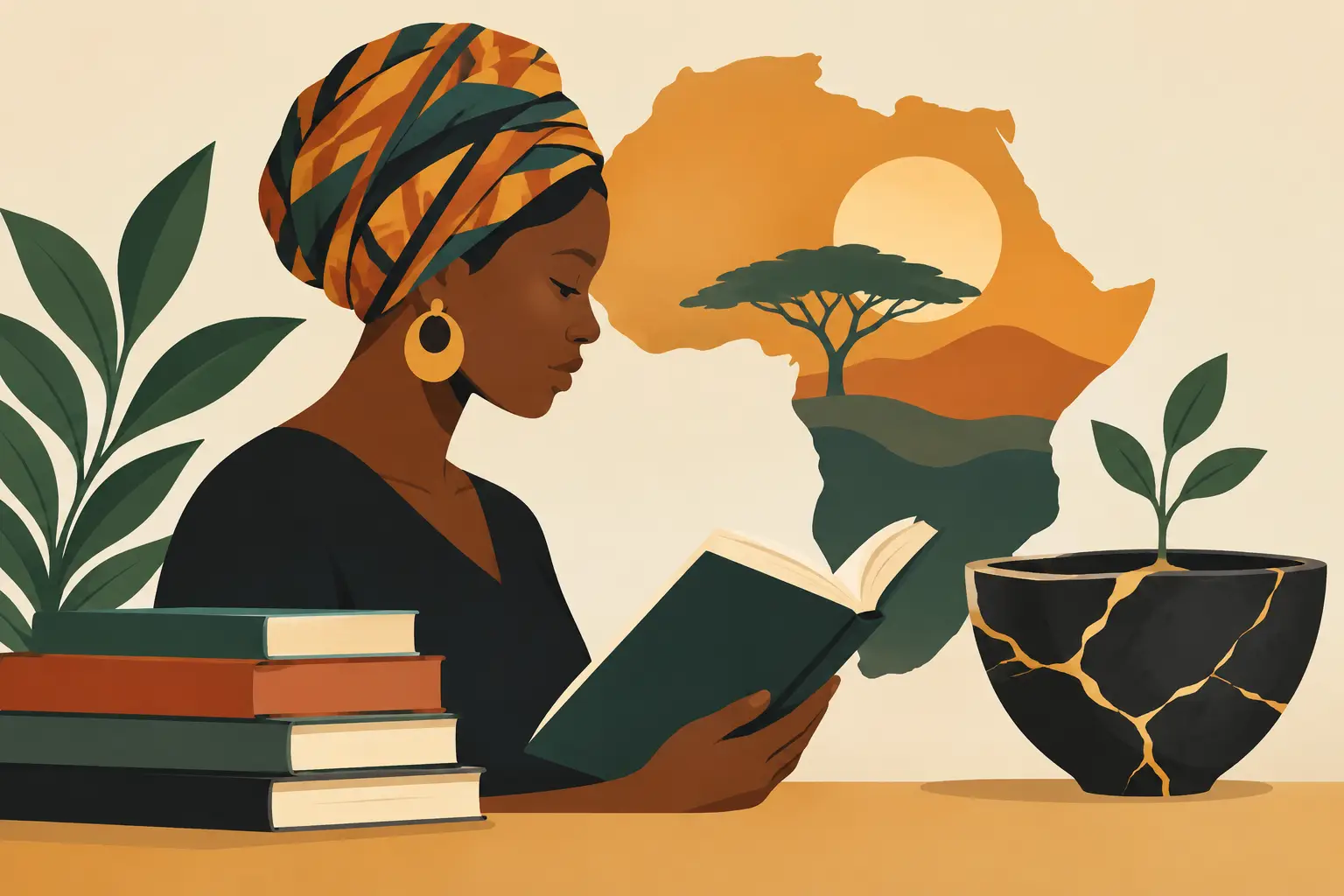
A name spoken in a colonial classroom, a mother tongue corrected into silence, a passport that promises entry while withholding belonging: African literature on identity often begins at such intimate points of pressure. Its great achievement is to show that identity is never merely personal. It is shaped by conquest and migration, family inheritance and state violence, by what a people are permitted to remember and what they are asked to forget.
For readers seeking more than a simplified story of tradition versus modernity, this body of work offers a richer proposition. Identity is made under conditions. It is argued over, narrated, revised, and sometimes defended at great cost. The novel, poem, memoir, and essay become places where private consciousness meets the unfinished record of history.
African Literature on Identity Refuses a Single Story
There is no singular African identity waiting to be neatly described. The continent contains thousands of languages, layered spiritual and political traditions, distinct colonial histories, and vast differences of class, gender, geography, and generation. African writing does not flatten this complexity. At its strongest, it makes the demand for a single, legible identity appear suspicious.
Chinua Achebe’s fiction, for example, did not simply oppose an African world to a European one. It examined the internal moral order of Igbo society alongside the disruption of colonial intrusion. In Things Fall Apart, Okonkwo’s tragedy cannot be reduced to colonialism alone, even though colonial power sharpens the catastrophe. His fear of tenderness, his conception of masculinity, and his estrangement from his son matter too. Identity emerges as a contested inheritance rather than a stable possession.
That distinction remains essential. A literature concerned with identity is not necessarily literature searching for cultural purity. It may instead reveal the costs of purity as a political fantasy. Many African writers portray identities formed in contact zones: the mission school, the market, the court, the border post, the city neighborhood, the refugee camp, the overseas apartment. These are spaces where languages mix, loyalties divide, and inherited categories prove insufficient.
Language Is More Than a Medium
The question of language sits near the center of African literary identity because colonialism did not only seize land and labor. It reordered what could be considered educated, modern, official, or worthy of preservation. To write in English, French, Portuguese, Arabic, Kiswahili, Igbo, Gikuyu, Yoruba, or any other language can carry a different set of literary and political consequences.
Ngugi wa Thiong’o’s commitment to writing in Gikuyu makes this question explicit. His work asks whether a people can fully recover their imaginative freedom while their stories remain mediated through the language of domination. Yet the answer is not as simple as declaring European languages illegitimate. Writers such as Achebe, Ama Ata Aidoo, and Chimamanda Ngozi Adichie have bent English toward African speech patterns, social rhythms, and moral worlds. The language arrives marked by empire, but it can be remade.
This is less a contradiction than a record of historical reality. For many African and diasporic readers, several languages coexist in one life, though not with equal power. One may be the language of a grandmother’s warning, another of school examinations, another of work, and another of prayer. Literature can preserve the emotional texture of this plurality, including the grief of losing words that once carried a whole world.
Translation and the Ethics of Reading
Translation broadens access, but it also asks readers to practice humility. A translated novel is not a transparent window onto a continent. It is an encounter shaped by choices of rhythm, idiom, register, and cultural reference. The responsible reader does not demand that every unfamiliar word be immediately explained or every custom be made comfortable.
That patience matters because opacity can be a form of dignity. African texts do not exist to provide ethnographic instruction for outsiders. They are works of art, addressed to particular communities and to the wider human world at once. Reading closely means allowing the text to retain its own center of gravity.
Nationhood, Memory, and the Self
Postcolonial nationhood has given African literature some of its most enduring questions. What does it mean to belong to a nation whose borders were often drawn through colonial convenience? How does a citizen live with civil war, dictatorship, ethnic targeting, or the betrayal of independence promises? And what happens when official history requires silence from those who survived?
These questions are especially urgent in writing shaped by the Nigerian Civil War. In novels and essays concerned with Biafra, identity is not an abstract category. It is bound to hunger, displacement, military power, mourning, and the difficult obligation to speak after public silence. The individual remembers what the nation prefers to leave unspoken.
This is why memory in African literature is often political without becoming merely programmatic. A family story can expose the architecture of a state. A childhood recollection can reveal the afterlife of war. A character’s reluctance to return home can contain an entire argument about damaged belonging.
Tsitsi Dangarembga’s work offers another powerful account of identity under pressure. Her characters confront the promises and humiliations of colonial education, as well as the gendered expectations that constrain women within both colonial and patriarchal structures. Education may offer mobility, but it can also create distance from home and self. Liberation, the novels insist, is not a clean upward path.
Gender Changes the Question of Belonging
African literature on identity is incomplete if gender is treated as a secondary concern. The question of who belongs, who speaks, who inherits, and who is believed is deeply gendered. Women’s writing has repeatedly challenged nationalist stories that imagine women only as mothers of the nation, symbols of tradition, or witnesses to men’s political struggle.
Buchi Emecheta, Aidoo, Dangarembga, and many others bring domestic life into full political view. Marriage, labor, motherhood, sexuality, education, and economic dependence are not private matters floating outside history. They are where history becomes daily life. Their work exposes the gap between national liberation rhetoric and the actual freedoms available to women.
Queer African writing extends this challenge further. It contests the false claim that queer life is foreign to Africa, a claim often sustained by colonial legal codes and contemporary political opportunism. Here identity may be marked by secrecy, chosen kinship, danger, joy, and refusal. Such writing reminds us that belonging cannot be ethically built by expelling those whose lives unsettle dominant norms.
Diaspora Is Not an Exit From History
For diasporic writers, identity often takes shape through distance. Migration can bring safety, education, and opportunity, but it may also produce the strange condition of being visible as a racial category while remaining unread as a person. The immigrant is asked to explain an entire country, perform gratitude, soften an accent, or translate grief into something consumable.
Writers such as Teju Cole, NoViolet Bulawayo, and Adichie have explored these frictions without treating diaspora as one uniform experience. The child of migrants, the exile, the student abroad, the undocumented worker, and the returnee carry different relationships to home. Return itself may be tender, disappointing, or impossible. The place remembered is rarely identical to the place encountered.
Still, diaspora can also generate a widened political imagination. It reveals the connections between African histories and global systems of race, extraction, war, and capital. The best diasporic literature does not turn Africa into a lost origin or the West into a final destination. It holds both spaces accountable to the people who move between them.
Reading Identity as a Practice of Repair
To read this literature well is to resist the urge for easy resolution. Not every novel offers reconciliation, and not every wound can be transformed into a lesson. Sometimes the most honest work of art preserves a fracture. It tells us that repair begins not with a polished national story, but with the willingness to hear what that story excluded.
This is where literature becomes a civic practice. It trains attention toward lives that statistics, headlines, and official commemorations cannot adequately hold. It gives form to ambivalence without making ambivalence an excuse for moral vagueness. It asks readers to recognize that identity can be a source of beauty and solidarity, but also a site where power decides whose pain is legible.
For a press committed to memory, justice, and African futures, the task is not to treat identity as a market category. It is to keep open the space where inherited harm can be named, where imagination can exceed the damage, and where new forms of belonging may be rehearsed. Read beyond the familiar canon. Sit with what resists quick interpretation. Then carry the question outward: what histories are shaping the identities we claim, and what might it take to make those identities more capacious, truthful, and free?
Leave a Reply