
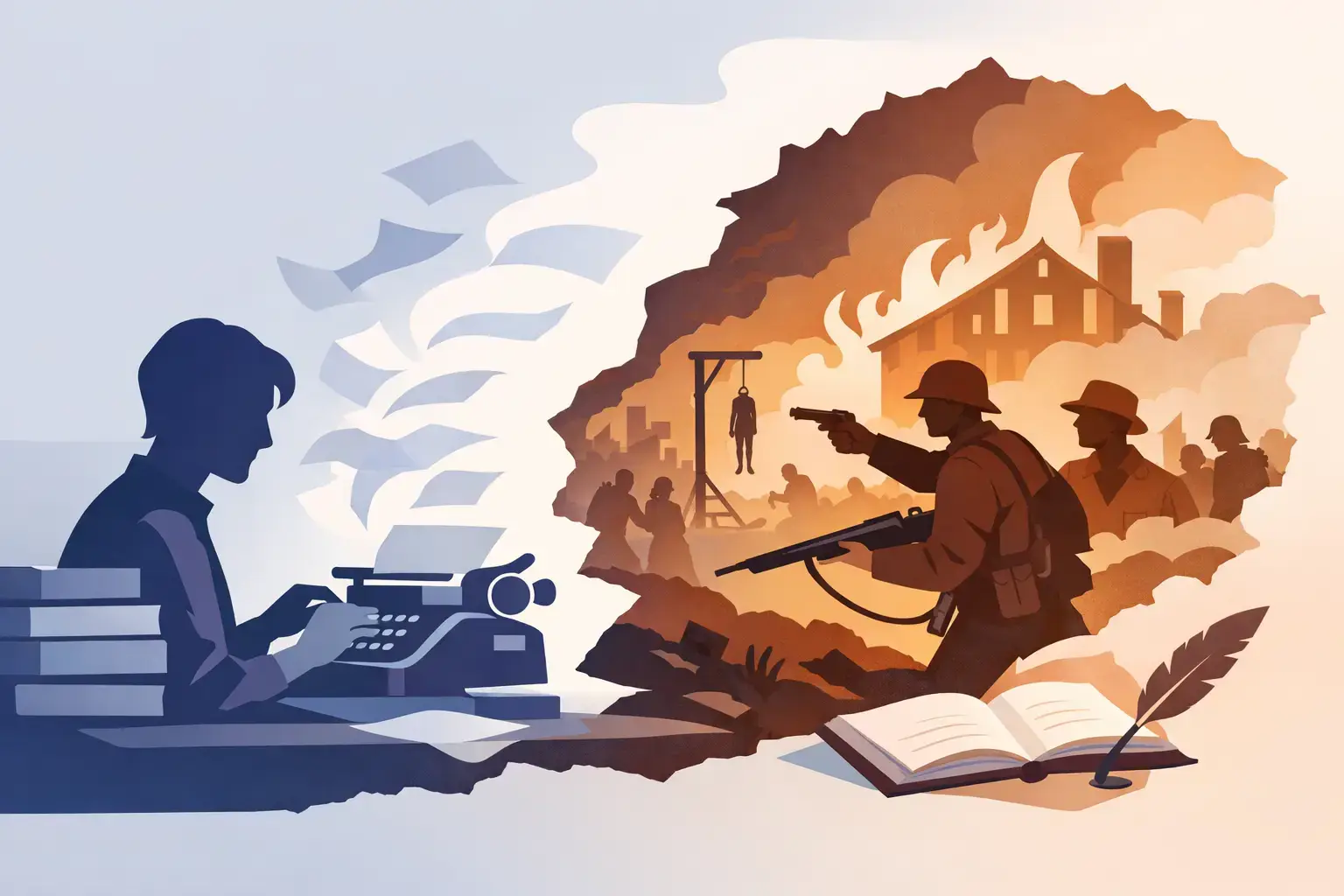
A massacre rarely arrives in the archive with its full human weather intact. Official reports count bodies, name dates, record decrees, and preserve the language of states. But terror is also carried in smaller things – the mother who no longer cooks a certain meal, the son who never asks where his father disappeared, the town that forgets its own songs because singing once invited danger. This is where the question becomes urgent: can fiction address historical violence in a way that history books, tribunals, and public memorials often cannot?
The short answer is yes, but only if fiction understands its burden. It cannot replace the archive. It cannot pardon the state. It cannot invent its way out of accountability. What it can do is restore scale to suffering, texture to memory, and moral pressure to events that are too often flattened into statistics or patriotic myths.
Can fiction address historical violence without distorting it?
That depends on what we ask fiction to do. If we ask it to behave like a legal document, it will fail. Fiction is not sworn testimony. It does not establish forensic proof. Its relation to truth is different, but not weaker. It works through human plausibility, emotional accuracy, and the arrangement of experience into forms we can bear to face.
Historical violence usually produces two kinds of silence. One is imposed silence – censorship, denial, the intimidation that follows war, ethnic cleansing, slavery, occupation, or state repression. The other is intimate silence – the unspeakability that settles inside families and communities after devastation. Fiction can move through both. It can imagine speech where records have been destroyed. It can stage memory where public discourse has refused it.
That is not the same as making things up carelessly. The ethical novelist working near catastrophe must know that invention is dangerous. A fabricated scene can illuminate, but it can also sentimentalize. A composite character can reveal structural truth, but it can also erase the distinct lives of actual people. So the question is not whether fiction invents. Of course it does. The question is whether invention serves remembrance or replaces it.
Why fiction reaches places the archive cannot
The archive is often built by power. Colonial governments archived conquest. Militaries archive operations. Courts archive what can be entered into evidence. Even when archives are indispensable, they preserve only part of the event. They are better at recording administration than atmosphere, better at preserving command than fear.
Fiction enters where the official record thins out. It can ask what violence felt like at dusk, what rumors traveled before soldiers arrived, what shame survived after the newspapers moved on. It can follow how violence remakes courtship, language, religion, appetite, migration, and the ordinary gestures by which people recognize one another.
This matters especially in societies where historical violence remains politically unsettled. When the dead have not been publicly mourned, when perpetrators have been folded back into respectable life, when schoolbooks reduce atrocity to a paragraph, narrative art becomes one of the few places where moral attention can still be held long enough to matter.
A novel can also show duration. Violence is rarely only the event itself. It extends into widowhood, inherited anxiety, displaced childhoods, silenced lineages, and the architecture of future cities. Fiction is unusually suited to tracing this long aftermath. It can connect a checkpoint in one decade to a marriage in another, a war crime to an estranged household, an unburied body to a national mood.
The ethics of writing the wound
There is no innocent way to narrate atrocity. Some books convert historical violence into spectacle. They linger on brutality with such aesthetic pleasure that the reader is trained to consume pain rather than reckon with it. Others overcorrect, becoming so careful that violence loses its force and arrives abstracted, bloodless, morally safe.
The better path is harder. It asks the writer to remain answerable to both art and the dead.
That means refusing pornography of suffering. Graphic detail is not automatically truthful. Sometimes the most ethical scene is the one that stops before violation becomes entertainment. At other times, restraint itself can become evasive, especially when readers from protected contexts prefer historical comfort to historical clarity. The judgment is always local. It depends on who is speaking, from what history, to whom, and for what purpose.
It also means resisting false redemption. Not every story of historical violence should end in healing. Some endings must remain unfinished because the history itself is unfinished. Reconciliation that arrives too quickly can become another form of erasure. Fiction should leave room for grief that does not resolve on schedule.
For readers concerned with Africa and its diasporas, this ethical question carries particular weight. Too much writing about African suffering has been shaped for outside consumption, trimmed into familiar scripts of tribal chaos, victimhood, or inspirational survival. Serious fiction must refuse those permissions. It should restore political context, historical depth, and human specificity. It should insist that violence is not an exotic trait of the continent but a material outcome of power, policy, empire, extraction, and fractured nationhood.
Can fiction address historical violence across generations?
Often, this is where fiction is strongest. The first generation may survive the event but lack the language to narrate it. The second inherits fragments, moods, prohibitions, and sudden bursts of anger. The third encounters the past as both absence and demand. Fiction can hold these layered temporalities in one frame.
A daughter can become the vessel of a father’s unfinished war. A city can become an archive of what its citizens were ordered to forget. A family argument can reveal the afterlife of a massacre more clearly than a commemorative speech. These are not minor domestic matters. They are the social forms through which historical violence persists.
Intergenerational fiction also does something politically significant. It reminds readers that violence is not past simply because it is no longer visible. A famine, civil war, enslavement, partition, or campaign of state terror does not end when the guns are quiet. It continues in institutions, inheritance patterns, migration routes, and conceptions of who belongs.
This is one reason literary work remains essential to public memory. It can make later generations feel the pressure of events they did not witness without pretending that inherited knowledge is the same as firsthand survival. That distinction matters. Fiction can build relation, but it should not counterfeit ownership.
What fiction cannot do
To defend fiction is not to romanticize it. Novels do not prosecute war criminals. Stories do not substitute for reparations, truth commissions, open archives, or public education. A beautifully written book can still circulate inside a society that refuses justice.
There is also the problem of authority. Not every writer is equally positioned to narrate every history. Imagination is necessary, but so are humility, research, and a clear sense of one’s distance from the wound. The market often rewards confidence more than accountability, which is why some historical novels feel morally thin even when stylistically accomplished.
Readers should keep their standards high. A powerful work of fiction does not merely announce that violence occurred. It shows how violence reorganized consciousness, how language itself was damaged, how memory became a contested terrain. It does not ask to be praised for courage while reproducing old simplifications.
Fiction as witness, not substitute
When fiction is at its best, it becomes a form of witness. Not witness in the strict legal sense, but witness as sustained moral attention. It keeps company with what a culture would rather rush past. It refuses both denial and easy catharsis.
This is why the question can fiction address historical violence matters far beyond literary debate. It is really a question about what kind of public we hope to become. A society that cannot narrate its own injuries honestly will repeat them in disguised form. A society that leaves memory entirely to the state will inherit the state’s evasions. Fiction offers another chamber of remembrance – intimate, contested, imaginative, and often more faithful to lived experience than official speech.
At Akajiofo Press, this is part of why literature remains inseparable from justice. Not because every novel heals, and not because every story repairs what history has broken, but because serious fiction can refuse the loneliness that violence tries to impose. It can gather fragments. It can return names to consequence. It can make the living answerable to the dead without pretending that words alone are enough.
The deepest promise of fiction is not that it resolves historical violence. It is that it teaches us how to remain in truthful relation to it – long enough, honestly enough, that repair might become imaginable.
Leave a Reply