
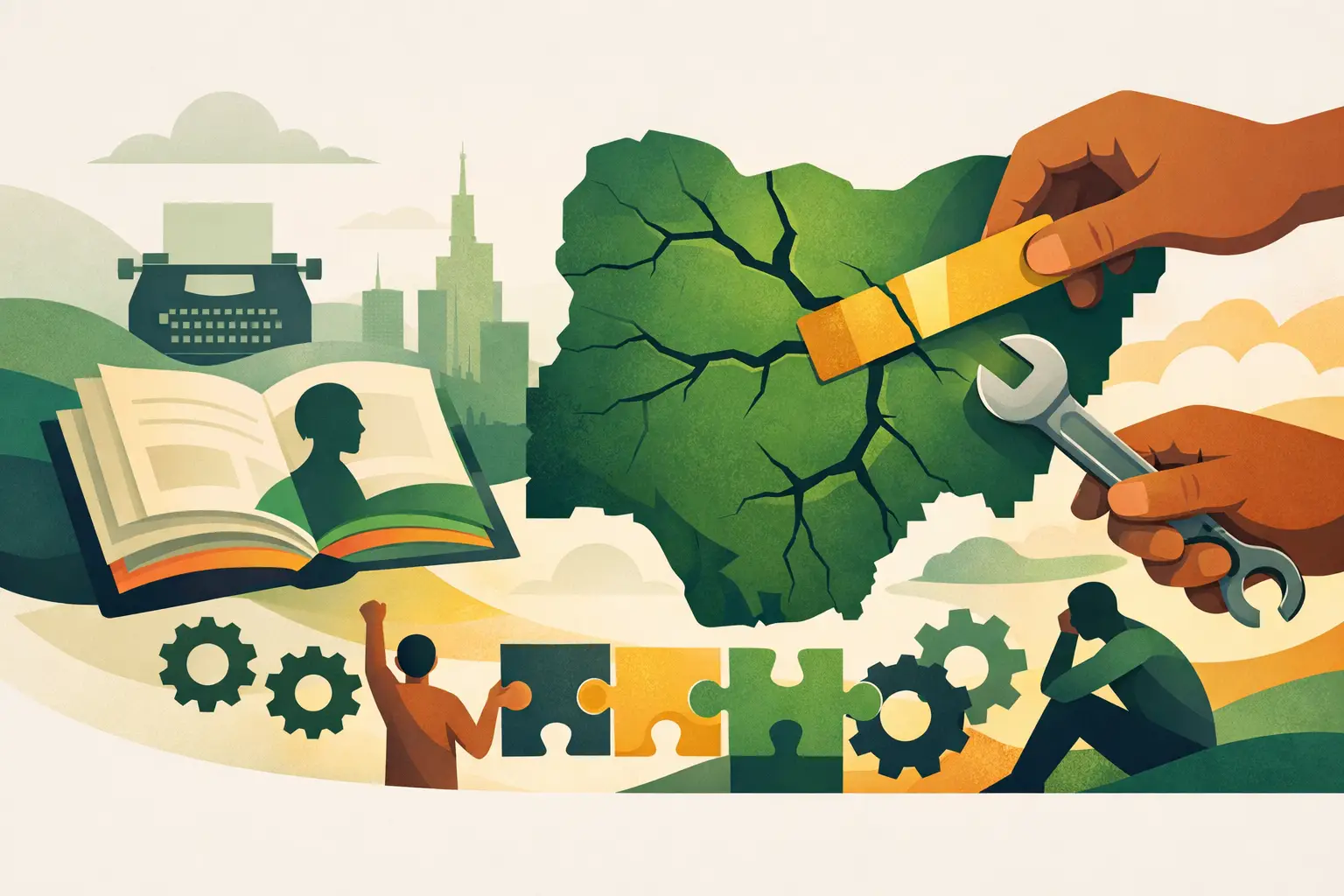
A nation can be wounded twice: first by violence, and then by the stories told to make that violence seem inevitable, distant, or finished. Nigerian metafiction enters this second wound. It refuses the comfort of a narrator who appears to know everything, a history that moves cleanly from cause to consequence, or an archive that claims to contain all the people it has failed.
At its most searching, this mode of writing asks readers to notice the machinery of narration itself. Who is speaking? Who has been given the authority to arrange events? What has been cut from the record, mistranslated, fictionalized, or made too painful to say plainly? These are not merely formal questions. In a country shaped by colonial extraction, civil war, military rule, ethnic contestation, migration, and unfinished demands for justice, they are civic questions.
What Nigerian Metafiction Makes Visible
Metafiction is often described as fiction that knows it is fiction. A narrator may interrupt a story, question its own version of events, address the reader, invent documents, expose a missing archive, or present several incompatible accounts of the same past. The technique can be playful, but play is not its only purpose. In Nigerian writing, self-awareness can become an ethics of representation.
A conventional historical novel may invite us to inhabit a settled past. A metafictional novel asks whether the past has ever been settled at all. It may place official language beside rumor, family testimony beside state silence, or a character’s remembered scene beside the version preserved in a newspaper. Rather than repairing those contradictions into one polished account, it lets their friction remain visible.
That refusal matters because official histories frequently inherit the habits of power. Colonial records named communities through administrative convenience. Postcolonial states have often elevated certain narratives of unity while leaving others to private grief. War survivors may hold memories that do not appear in textbooks. Children inherit silences without being told what, exactly, they have inherited. A self-conscious narrative form can make room for this unevenness without pretending that every account bears equal moral weight.
The distinction is crucial. Nigerian metafiction is not relativism dressed in literary language. To say that history has competing narrators is not to say that atrocities become unknowable or that evidence no longer matters. It is to recognize that evidence is gathered, preserved, interpreted, and sometimes suppressed by institutions with interests. Fiction can reveal those interests by showing us the frame around the picture.
The Archive Is Not Innocent
The archive carries an aura of finality. A file, a court record, a colonial dispatch, or a newspaper clipping can seem more authoritative than a grandmother’s interrupted recollection. Yet archives are made by selection. Someone decided what could be written down, what was worth retaining, and which language would make an experience legible to the state.
Metafiction often returns to this problem through invented manuscripts, unreliable testimonies, disputed photographs, footnote-like interruptions, and narrators who confess the limits of what they know. Such devices do not make reality less serious. They show how easily reality is made available only on the terms of those who hold the pen.
For Nigerian writers working near the terrain of war memory, displacement, and political violence, this can be a necessary formal pressure. The novelist cannot simply stand outside historical pain as a neutral collector. The very act of shaping a narrative raises questions: Is the dead person being remembered, used, simplified, or made to speak in a language they never chose? Does a beautiful sentence clarify suffering, or does it turn suffering into ornament?
There is no technique that solves this problem once and for all. A fragmented narrative can honor trauma’s dislocations, but it can also become evasive if fragmentation replaces historical specificity. An overtly self-questioning narrator may cultivate humility, but too much authorial display can draw attention away from those whose lives are at stake. The work is not to find a pure form. It is to make form answerable to what it carries.
Nigerian Metafiction Against the Single Story
The demand for a single, easily consumable Nigerian story has long shaped how African literature is received elsewhere. One book is asked to explain a country. One family is made to bear the burden of a people. One crisis becomes the permanent lens through which a vast and internally varied society is viewed.
Metafiction resists this compression. It does so not by denying coherence, but by making coherence accountable. A narrator may tell us that this is only one version. A novel may reveal that its central voice is implicated in the omissions it mourns. A document within the story may contradict the story surrounding it. The reader is no longer permitted to consume nationhood as a finished object.
This has particular force in relation to Biafra and the Nigerian Civil War, where remembrance is still divided across region, generation, ethnicity, and political interest. The point is not that no truth can be spoken about the war. The point is that the nation has too often treated public quiet as reconciliation. Fiction that exposes its own construction can also expose the constructions that keep such quiet in place.
This is where literature becomes more than witness. Witness says: this happened, or this was felt. Metafiction can add another question: what conditions made this experience difficult to tell, difficult to hear, or convenient to forget? The question opens a space between commemoration and repair.
Form as a Practice of Speculative Repair
Repair is not the same as restoration. Restoring a damaged object suggests returning it to a previous condition. But nations cannot return to an innocent before. The dead do not come back because a commission issues a statement. The dispossessed are not made whole by a more elegant national myth.
Speculative repair begins elsewhere. It asks what forms of relation might become possible if we stop demanding that the past resolve itself before we face it. In fiction, this can mean allowing uncertainty to remain without allowing responsibility to disappear. It can mean giving room to the gaps in testimony while naming the forces that produced those gaps. It can mean refusing a redemptive ending when the conditions for redemption have not yet been built.
The concerns surrounding Obodo ọ nweghị mgbe ọ laghachiri belong to this wider literary horizon: the return that cannot be completed, the city as both location and evidence, and memory as an encounter with what public language has left behind. Such writing does not offer closure as a service. It asks what readers might owe the unfinished.
For readers, this changes the task. Nigerian metafiction is not always designed for speed or certainty. Its repetitions, revisions, and interruptions may feel demanding because they reproduce, at the level of form, the difficulty of arriving at an honest account. The reader must become alert to what is absent as well as what is present.
That alertness need not remain inside the book. It can shape how we read histories, family legends, headlines, and the confident language of states. Whose account has been treated as natural? What grief has been translated into a statistic? What future becomes imaginable once the official story is no longer the only story in the room?
Reading Beyond the Formal Trick
It is tempting to approach metafiction as a set of recognizable devices: the story within the story, the narrator addressing the reader, the archive that turns out to be incomplete. Those devices can be useful, but they are not the heart of the matter. A novel becomes politically meaningful not because it breaks the fourth wall, but because its formal choices sharpen our sense of what power does to memory.
The strongest works do not congratulate themselves for being clever. They make cleverness subordinate to attention. They understand that a fractured structure may be required by fractured inheritance, that an unstable voice may register the pressure of survival, and that silence may sometimes be more truthful than an invented confession.
To read in this way is to resist both extremes: the desire for fiction to provide a clean historical lesson and the desire for formal complexity to excuse moral vagueness. Nigerian literature has never needed permission to be aesthetically ambitious. What it continues to demand is a readership willing to meet ambition with patience, historical curiosity, and an appetite for difficult truth.
The next time a novel pauses to question its own telling, do not rush past the interruption. Stay with it. It may be where the book asks not only how a story is made, but what kind of future can be built by those willing to remember differently.
Leave a Reply