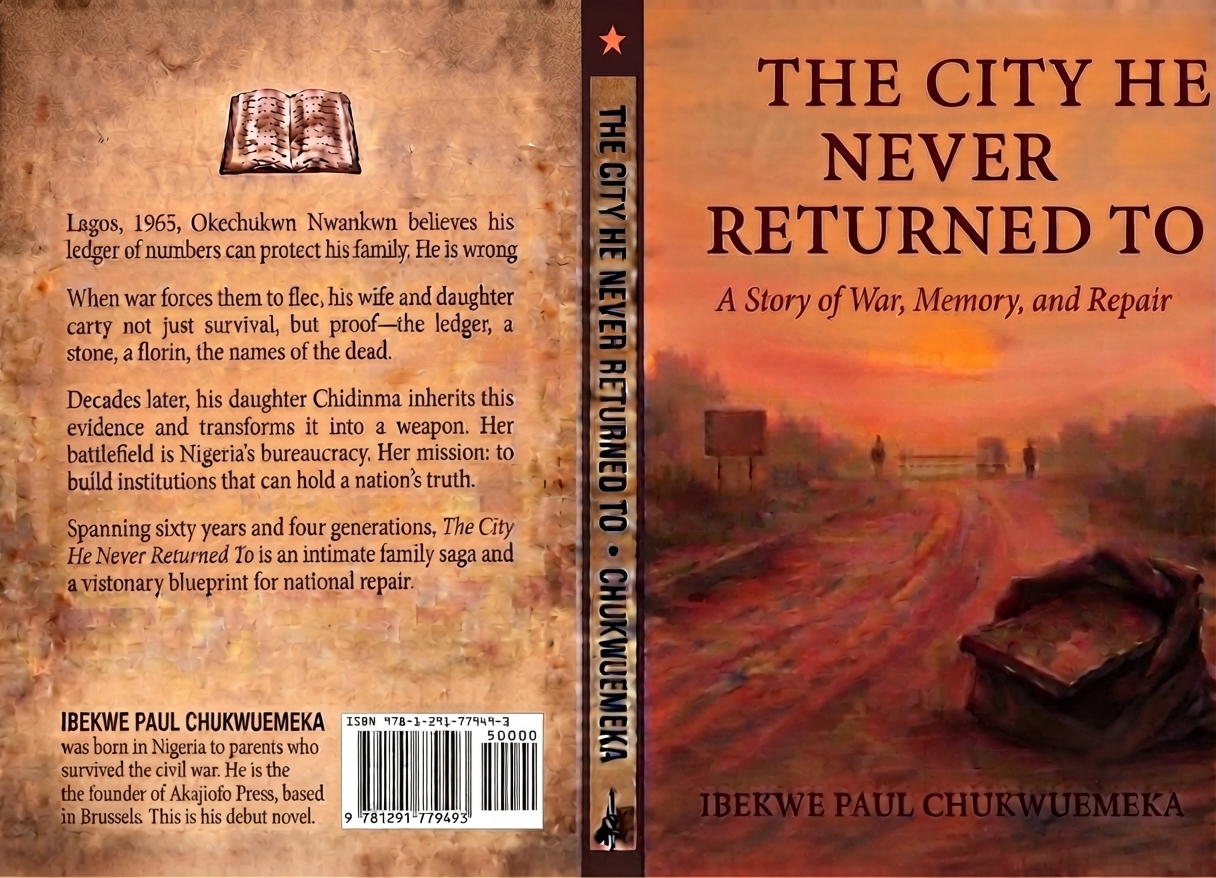
get_order_number(); $email = $order->get_billing_email(); $country = $order->get_shipping_country() ?: $order->get_billing_country(); $delivery_date = date( 'Y-m-d', strtotime( '+5 days' ) ); // estimate 5 days, adjust as needed $gtin = '9781291779493'; // your ISBN without hyphens ?> add_action( 'woocommerce_thankyou', 'add_google_reviews_optin' ); function add_google_reviews_optin( $order_id ) { $order = wc_get_order( $order_id ); if ( ! $order ) { return; } $order_num = $order->get_order_number(); $email = $order->get_billing_email(); $country = $order->get_shipping_country() ?: $order->get_billing_country(); $delivery_date = date( 'Y-m-d', strtotime( '+5 days' ) ); $gtin = '9781291779493'; ?>

Tag: hope

  • Virtual Book Launch & Review: The City He Never Returned To

    Virtual Book Launch & Review: The City He Never Returned To

    Virtual Book Launch & Review: The City He Never Returned To

     Event Overview: 

    Join us for the exclusive virtual launch and literary review of The City He Never Returned To, the gripping debut novel by Ibekwe Paul Chukwuemeka, published by Akajiofo Press (Brussels). 

    Spanning sixty years and four generations, this deeply moving fiction narrative is drawn from real-life history and family archives. The story follows the Nwankwo family from the bustling streets of Lagos in 1965, through the trauma of the Nigerian Civil War, into the hardships of refugee camps, and through the landscape of the infamous post-war £20 flat settlement policy. Decades later, the journey culminates in a daughter’s fierce quest to build the institutions and administrative procedures required to preserve a nation’s truth. 

    This is not a traditional war story—it is a masterclass in memory, accountability, the silence of survivors, and the profound architecture of institutional repair. 

    Event Details Date: 

    • Saturday, June 20, 2026, 
    • Time: 7:00 PM CET (Brussels) / 6:00 PM WAT (Nigeria)
    • Location: Streaming globally via YouTube Premieres
    •  Admission: Free (Open to the public)

    What to Expect During the Broadcast. 

    This virtual launch is designed as a cinematic, high-retention digital experience:

    1. The Cinematic Deep-Dive (19 Minutes):  A highly polished video presentation walking you through the core narrative, the 60-year timeline, and the structural themes of the novel. 

    2. Live Author Commentary:

     Experience an exclusive reading of select, precise excerpts from the book, giving you a direct look into the author’s precise and emotional prose.

    3. Live Interactive Chat & Q&A:

     The author and publishing team will be live in the interactive chat box throughout the entire premiere. Bring your questions about the book’s history, writing process, and the family archive that inspired it.

    Immediate Access to Ordering:

    Who Should Attend?

    •  Lovers of contemporary African literary fiction (fans of Chimamanda Ngozi Adichie, Chigozie Obioma, and Helon Habila). 
    • Members of the Nigerian and broader African diaspora exploring themes of exile, identity, and the meaning of “home.”
    • Academics, students, and professionals working in transitional justice, history, peace studies, and post-colonial reconstruction. 

    How to Participate: 

    You do not need to download any special software or wait in a virtual lobby. Simply click the event link below, head to the official YouTube page, and tap the “Remind Me” bell icon. YouTube will automatically alert you right as our cinematic countdown begins.👉 Political Imagination

  • SPECULATIVE REPAIR – WEEK 7: THE JULY 1966 COUNTER‑COUP & THE POGROMS

    SPECULATIVE REPAIR – WEEK 7: THE JULY 1966 COUNTER‑COUP & THE POGROMS

    Forked road splitting into dark forest path and sunlit valley path with signposts
    A fork in the road at sunrise offers a choice between a dark path and a bright path.

    Subtitle: How a Failed Repair Became a Massacre

    🔥TRENDING TOPIC HOOK:

    The January 1966 coup was a failed repair. The July counter‑coup was not a repair – it was revenge. And the pogroms that followed were genocide. This is the week Nigeria lost its soul.

    📜 HISTORICAL FACTS

    THE CONTEXT

    After the January 15, 1966 coup, General Johnson Aguiyi‑Ironsi (an Igbo) took power. He was a professional soldier, not a politician. But his first major decision was disastrous: on May 24, 1966, he issued Decree No. 34, which abolished the federal system and turned Nigeria into a unitary state.

    The regions were gone. The North, which had enjoyed autonomy under federalism, was now to be governed directly from Lagos.

    Northern officers and politicians saw this as an Igbo takeover. The North had lost its leaders (Ahmadu Bello was killed in the coup). Now it was losing its political structure. Resentment boiled.

    THE COUNTER‑COUP

    – JULY 29, 1966 led by Lieutenant Colonel Murtala Muhammed (a Northerner) and Major Theophilus Danjuma, Northern officers struck in the early hours of July 29.

    They assassinated General Ironsi in Ibadan. They also killed dozens of Igbo officers and soldiers stationed in the North. The counter‑coup was brutal and targeted.

    THE POGROMS – MAY TO SEPTEMBER 1966

    Three classic cars driving on a dusty dirt road in a desert at sunset
    Three vintage cars kick up dust as they drive along a winding dirt road at sunset in a rocky desert landscape.

    Before and after the counter‑coup, a wave of violence swept Northern cities. Igbo civilians were slaughtered in Kano, Kaduna, Zaria, Jos, and Makurdi.

    The killings were not random riots – they were organized. Hausa mobs, sometimes led by local officials, went house‑to‑house hunting for Igbo families.

    Eyewitness accounts describe:- Children thrown into wells- Pregnant women cut open- Men burned aliveThe official death toll is disputed, but historians estimate between 30,000 and 50,000 Igbo civilians were killed. The Eastern Region government claimed over 30,000 dead in the North by October 1966.

    THE FLIGHT

    Survivors fled in massive convoys back to the East. Over one million Igbo left the North, abandoning homes, businesses, and land. Many never returned.

    The trauma of the pogroms created the emotional fuel for secession. By May 1967, the Eastern Region declared itself the Republic of Biafra.

    THE VERDICT:

    The January 1966 coup was a failed repair. The July counter‑coup was not a repair – it was a revenge massacre. And the pogroms were genocide. Nigeria had crossed a line from which it has never fully recovered.

    WHAT COULD HAVE BEEN (If We Did It Right)

    THE COUNTERFACTUAL:

    Imagine that after the January 1966 coup, the following had happened:1. No unitary decree. Instead of Decree No. 34, Ironsi had convened an immediate constitutional conference with all regions to discuss genuine federalism – including 50% derivation, regional police, and a rotational presidency.2. International mediation. The British and the Commonwealth had stepped in to broker a power‑sharing agreement, as they did in Kenya after the 2007 election violence.3. Accountability, not revenge. The killers from the January coup (including Nzeogwu) had been tried fairly, but no ethnic group was collectively blamed. Northern officers who felt threatened were given amnesty and included in a transitional government.

    WHAT WOULD HAVE HAPPENED?

    – No July counter‑coup. Without the unitary decree and with a credible process for restructuring, Northern officers would have had no justification for violence.- No pogroms. 30,000–50,000 Igbo civilians would have lived. Families would not have been torn apart. The East would not have become a traumatized enclave.- No Biafran war. The secession would have been unnecessary. The 1–3 million civilian deaths (mostly Igbo children starving) would have been avoided.- A different military legacy. Nigeria would have returned to civilian rule by 1969 or 1970, not after 30 years of military dictatorship.

    HOW NIGERIANS WOULD BE BETTER OFF TODAY:

    | Metric | Actual Nigeria (2026) | Counterfactual (No Pogroms, No War) ||——–|———————-|————————————-|| Igbo population in the North | ~500,000 (massively reduced) | ~5 million (normal migration) || Trust between ethnic groups | Very low | Moderate to high || South‑East GDP per capita | ~$3,000 | ~$8,000 (no war destruction) || Number of war widows/orphans | Millions | Near zero || Secessionist movements | IPOB, MASSOB, etc. | None or fringe |

    THE HUMAN DIFFERENCE:

    – Your Igbo neighbor in Kano would not be a “stranger” – they would be a third‑generation resident with a thriving shop.- Your Hausa friend in Enugu would not be afraid to visit.- The word “Biafra” would be a historical footnote, not a rallying cry.- The trauma of ethnic cleansing would not be passed down through generations.

    NEXT WEEK: Issue #8 – The Aburi Accord (The Last Chance for Peace)

  • Can Fiction Address Historical Violence?

    Can Fiction Address Historical Violence?

    A massacre rarely arrives in the archive with its full human weather intact. Official reports count bodies, name dates, record decrees, and preserve the language of states. But terror is also carried in smaller things – the mother who no longer cooks a certain meal, the son who never asks where his father disappeared, the town that forgets its own songs because singing once invited danger. This is where the question becomes urgent: can fiction address historical violence in a way that history books, tribunals, and public memorials often cannot?

    The short answer is yes, but only if fiction understands its burden. It cannot replace the archive. It cannot pardon the state. It cannot invent its way out of accountability. What it can do is restore scale to suffering, texture to memory, and moral pressure to events that are too often flattened into statistics or patriotic myths.

    Can fiction address historical violence without distorting it?

    That depends on what we ask fiction to do. If we ask it to behave like a legal document, it will fail. Fiction is not sworn testimony. It does not establish forensic proof. Its relation to truth is different, but not weaker. It works through human plausibility, emotional accuracy, and the arrangement of experience into forms we can bear to face.

    Historical violence usually produces two kinds of silence. One is imposed silence – censorship, denial, the intimidation that follows war, ethnic cleansing, slavery, occupation, or state repression. The other is intimate silence – the unspeakability that settles inside families and communities after devastation. Fiction can move through both. It can imagine speech where records have been destroyed. It can stage memory where public discourse has refused it.

    That is not the same as making things up carelessly. The ethical novelist working near catastrophe must know that invention is dangerous. A fabricated scene can illuminate, but it can also sentimentalize. A composite character can reveal structural truth, but it can also erase the distinct lives of actual people. So the question is not whether fiction invents. Of course it does. The question is whether invention serves remembrance or replaces it.

    Why fiction reaches places the archive cannot

    The archive is often built by power. Colonial governments archived conquest. Militaries archive operations. Courts archive what can be entered into evidence. Even when archives are indispensable, they preserve only part of the event. They are better at recording administration than atmosphere, better at preserving command than fear.

    Fiction enters where the official record thins out. It can ask what violence felt like at dusk, what rumors traveled before soldiers arrived, what shame survived after the newspapers moved on. It can follow how violence remakes courtship, language, religion, appetite, migration, and the ordinary gestures by which people recognize one another.

    This matters especially in societies where historical violence remains politically unsettled. When the dead have not been publicly mourned, when perpetrators have been folded back into respectable life, when schoolbooks reduce atrocity to a paragraph, narrative art becomes one of the few places where moral attention can still be held long enough to matter.

    A novel can also show duration. Violence is rarely only the event itself. It extends into widowhood, inherited anxiety, displaced childhoods, silenced lineages, and the architecture of future cities. Fiction is unusually suited to tracing this long aftermath. It can connect a checkpoint in one decade to a marriage in another, a war crime to an estranged household, an unburied body to a national mood.

    The ethics of writing the wound

    There is no innocent way to narrate atrocity. Some books convert historical violence into spectacle. They linger on brutality with such aesthetic pleasure that the reader is trained to consume pain rather than reckon with it. Others overcorrect, becoming so careful that violence loses its force and arrives abstracted, bloodless, morally safe.

    The better path is harder. It asks the writer to remain answerable to both art and the dead.

    That means refusing pornography of suffering. Graphic detail is not automatically truthful. Sometimes the most ethical scene is the one that stops before violation becomes entertainment. At other times, restraint itself can become evasive, especially when readers from protected contexts prefer historical comfort to historical clarity. The judgment is always local. It depends on who is speaking, from what history, to whom, and for what purpose.

    It also means resisting false redemption. Not every story of historical violence should end in healing. Some endings must remain unfinished because the history itself is unfinished. Reconciliation that arrives too quickly can become another form of erasure. Fiction should leave room for grief that does not resolve on schedule.

    For readers concerned with Africa and its diasporas, this ethical question carries particular weight. Too much writing about African suffering has been shaped for outside consumption, trimmed into familiar scripts of tribal chaos, victimhood, or inspirational survival. Serious fiction must refuse those permissions. It should restore political context, historical depth, and human specificity. It should insist that violence is not an exotic trait of the continent but a material outcome of power, policy, empire, extraction, and fractured nationhood.

    Can fiction address historical violence across generations?

    Often, this is where fiction is strongest. The first generation may survive the event but lack the language to narrate it. The second inherits fragments, moods, prohibitions, and sudden bursts of anger. The third encounters the past as both absence and demand. Fiction can hold these layered temporalities in one frame.

    A daughter can become the vessel of a father’s unfinished war. A city can become an archive of what its citizens were ordered to forget. A family argument can reveal the afterlife of a massacre more clearly than a commemorative speech. These are not minor domestic matters. They are the social forms through which historical violence persists.

    Intergenerational fiction also does something politically significant. It reminds readers that violence is not past simply because it is no longer visible. A famine, civil war, enslavement, partition, or campaign of state terror does not end when the guns are quiet. It continues in institutions, inheritance patterns, migration routes, and conceptions of who belongs.

    This is one reason literary work remains essential to public memory. It can make later generations feel the pressure of events they did not witness without pretending that inherited knowledge is the same as firsthand survival. That distinction matters. Fiction can build relation, but it should not counterfeit ownership.

    What fiction cannot do

    To defend fiction is not to romanticize it. Novels do not prosecute war criminals. Stories do not substitute for reparations, truth commissions, open archives, or public education. A beautifully written book can still circulate inside a society that refuses justice.

    There is also the problem of authority. Not every writer is equally positioned to narrate every history. Imagination is necessary, but so are humility, research, and a clear sense of one’s distance from the wound. The market often rewards confidence more than accountability, which is why some historical novels feel morally thin even when stylistically accomplished.

    Readers should keep their standards high. A powerful work of fiction does not merely announce that violence occurred. It shows how violence reorganized consciousness, how language itself was damaged, how memory became a contested terrain. It does not ask to be praised for courage while reproducing old simplifications.

    Fiction as witness, not substitute

    When fiction is at its best, it becomes a form of witness. Not witness in the strict legal sense, but witness as sustained moral attention. It keeps company with what a culture would rather rush past. It refuses both denial and easy catharsis.

    This is why the question can fiction address historical violence matters far beyond literary debate. It is really a question about what kind of public we hope to become. A society that cannot narrate its own injuries honestly will repeat them in disguised form. A society that leaves memory entirely to the state will inherit the state’s evasions. Fiction offers another chamber of remembrance – intimate, contested, imaginative, and often more faithful to lived experience than official speech.

    At Akajiofo Press, this is part of why literature remains inseparable from justice. Not because every novel heals, and not because every story repairs what history has broken, but because serious fiction can refuse the loneliness that violence tries to impose. It can gather fragments. It can return names to consequence. It can make the living answerable to the dead without pretending that words alone are enough.

    The deepest promise of fiction is not that it resolves historical violence. It is that it teaches us how to remain in truthful relation to it – long enough, honestly enough, that repair might become imaginable.

  • News Story: “2027: Peter Obi Emerges as NDC’s Sole Presidential Aspirant”

    News Story: “2027: Peter Obi Emerges as NDC’s Sole Presidential Aspirant”

    This version is updated for the news as it stands today: Obi is the sole aspirant, and the joint Obi-Kwankwaso ticket is the most likely outcome.

    2027: Peter Obi Emerges as Sole NDC Presidential Aspirant Amidst Final Push for Joint Ticket

    ABUJA, NIGERIA

    — The Nigeria Democratic Congress (NDC) has concluded the sale of its 2027 presidential nomination forms, with former Anambra State Governor, Mr. Peter Gregory Obi, emerging as the sole aspirant.

    Road to the NominationThe development follows a series of strategic moves by the party. The NDC, which was officially registered by the Independent National Electoral Commission (INEC) on February 5, 2026, held its maiden National Convention in Abuja on May 9, 2026. At the convention, the party officially zoned its presidential ticket to the South for a single four-year term, a decision publicly backed by key northern leader, former Kano State Governor Rabiu Musa Kwankwaso.

    The nomination process concluded with Peter Obi as the only politician who purchased the NDC’s ₦60 million presidential nomination form. With no other contenders, Obi is poised to be ratified as the party’s consensus candidate.

    Kwankwaso’s Role as Running MateThe political equation is being completed by Senator Kwankwaso, who is widely expected to be Obi’s running mate. Senior party sources confirm that Kwankwaso will likely fill the vice-presidential slot, aligning with the party’s zoning formula that rotates the presidency after a single term. “If I emerge as the vice-presidential candidate… whoever votes for the NDC is not just voting for someone else (Peter Obi); they are voting for Rabiu Kwankwaso,” Kwankwaso said recently, framing it as a historic opportunity for his home state, Kano.

    A United Front

    The ‘Obidient’ and ‘Kwankwasiyya’ movements are now actively mobilizing, with supporters pledging to raise the funds for the joint ticket.

    Next Steps

    The NDC has announced that the screening of all aspirants will begin on May 19 and end on May 26, 2026. After this, the party is expected to formally ratify its presidential candidate and unveil its full manifesto.

    “📊 Coming tomorrow: Our full analysis of this political realignment – subscribe so you don’t miss it.

  • Why Long Form Literary Essays Still Matter

    Why Long Form Literary Essays Still Matter

    A short essay can strike like a match. A novel can build a world. But long form literary essays do something rarer: they stay with a difficult subject long enough for its hidden architecture to appear. They let a writer trace how private grief touches public history, how inherited silence shapes the present, and how language can hold both witness and argument without reducing either.

    That capacity matters because many of the truths worth telling do not arrive in neat proportions. They come layered, interrupted, and morally uneven. A family memory leads to a state archive. A political event reappears in a gesture at the dinner table. A city carries the afterlife of war in its traffic, its speech, its absences. To write faithfully about such things, one often needs more than a column, more than commentary, and certainly more than a quick opinion sharpened for circulation.

    What long form literary essays make possible

    The real strength of long form literary essays is not simply length. Plenty of long pieces are merely extended. What distinguishes the literary essay is its commitment to form as a way of thinking. The sentences do not only report thought. They enact it. They circle, test, return, and revise. They admit uncertainty where certainty would be dishonest.

    This matters especially when a writer is dealing with memory, violence, migration, or national belonging. Such subjects resist clean summaries. They require a structure flexible enough to hold reflection, scene, history, and interpretation at once. The long form literary essay becomes a chamber large enough for contradiction. It can carry archive and anecdote, political analysis and intimate confession, without forcing them into false harmony.

    There is also an ethical dimension here. Compression can clarify, but it can also flatten. When public discourse rewards speed, the most complex realities are often translated into slogans. A long essay pushes against that pressure. It asks the reader to remain in the presence of complication. Not to admire complication for its own sake, but to recognize that moral seriousness often begins where simplification ends.

    The difference between length and depth

    Not every extended article is a literary essay, and not every literary essay needs vast scale. The distinction is subtle but important. Length gives a writer room. Depth depends on what the writer does with that room.

    A long essay earns its form when each movement enlarges the question. A remembered childhood image should not appear merely because it is vivid. It should change the argument. A historical detour should not function as ornament. It should reveal the stakes of the present. The reader should feel that the piece could not have been shorter without becoming less truthful.

    This is where literary craft becomes inseparable from intellectual discipline. Good long form literary essays are shaped by selection, pacing, and restraint. They know when to linger and when to cut away. They understand that atmosphere can clarify thought, but also that lyricism without pressure becomes haze.

    For readers, this means the experience is not one of accumulation alone. It is one of deepening relation. By the end, the subject has not just expanded. It has become more legible, though perhaps not more comfortable.

    Why this form matters for African and diasporic writing

    For African and diasporic readers, the long literary essay carries a particular charge. Too often, public narratives about African life are organized for speed, legibility, and external consumption. They arrive pre-translated into familiar moral categories: tragedy, resilience, corruption, hope. Even sympathetic accounts can leave intact the deeper problem, which is that they ask a continent and its diasporas to remain explainable in shallow terms.

    The long essay refuses that demand. It offers a writer enough space to resist simplification without surrendering clarity. A piece about civil war memory can move from family testimony to state silence, from neighborhood detail to the politics of commemoration. An essay on migration can examine not only movement across borders but also the afterlives of language, the ethics of return, and the fracture between official history and remembered life.

    This is not simply a stylistic preference. It is a question of narrative power. When a people have been overdescribed and underheard, form becomes political. To claim the long essay is to claim time, complexity, and authority. It is to insist that the terms of interpretation should not be dictated by markets that prefer the quickly consumable or by institutions that reward distance over intimacy.

    At its best, the form allows literature to do what institutional discourse often cannot. It can make room for feeling without becoming sentimental. It can tell historical truth without draining the human pulse from the page. It can approach justice not as a slogan, but as an ongoing labor of remembering accurately.

    How long form literary essays build trust with readers

    Readers do not give their time lightly, especially now. A long essay asks for attention, and in return it must offer more than information. It must create trust.

    That trust is built sentence by sentence. The writer signals care in the way evidence is handled, in the refusal of easy moral performance, and in the willingness to remain vulnerable before the material. Readers can tell when an essay is trying to impress them. They can also tell when it is trying to accompany them through a difficult thought.

    This is one reason subscription-based literary publishing has become such an important home for the form. It creates conditions in which a writer can address readers as companions rather than as metrics. The relationship becomes cumulative. One essay prepares the ground for the next. A body of work emerges not as content production but as sustained conversation.

    For a press or author committed to memory and repair, that matters enormously. The long essay allows a readership to gather around more than announcement or reaction. It allows people to return, to think slowly, and to encounter a sensibility developing over time. In that sense, the form does not just publish ideas. It organizes attention.

    The trade-offs of writing and reading at length

    Still, there are trade-offs. Length can invite seriousness, but it can also invite indulgence. Some essays mistake opacity for rigor. Others overextend a promising insight until it thins out. A reader may admire the ambition of a piece and still feel it needed a firmer shape.

    There is also the practical question of access. Not every reader has the leisure for sustained reading every week. Not every subject benefits from expansive treatment. Sometimes a brief essay is more exact because it knows where to stop. The point is not that longer is always better. It is that some kinds of truth need duration.

    Writers who work in this form therefore have a double responsibility. They must protect complexity, but they must also honor the reader’s time. The essay should feel spacious, not swollen. Demanding, but not evasive. Serious, but still alive to rhythm, image, and surprise.

    When those elements align, the result can be transformative. A reader may begin with interest in a topic and finish with a changed understanding of how history lives inside ordinary life. That change is difficult to engineer in compressed formats built for immediate reaction.

    Why long form literary essays endure

    The long literary essay endures because human experience exceeds summary. We do not live in bullet points. We live in aftermaths, revisions, fragments, returns. We inherit stories we only partly understand, and we spend years learning the names of what shaped us.

    A form equal to that condition must be patient enough to follow thought into its difficult rooms. It must be supple enough to hold beauty without denying brutality. It must allow a writer to say: this wound has a history, this memory has public consequences, this private scene belongs to a larger moral landscape.

    That is why long form literary essays continue to matter. Not because they are prestigious, and not because they flatter attention spans by opposing brevity. They matter because they remain one of the few places where language can think carefully in public, with emotional depth and historical conscience intact.

    For readers seeking more than reaction, this form offers a different compact. It does not promise speed. It promises company in the work of seeing more clearly, and of carrying what is seen with greater care.

  • SPECULATIVE REPAIR – WEEK 6: THE FINAL BLUEPRINT

    SPECULATIVE REPAIR – WEEK 6: THE FINAL BLUEPRINT

    Subtitle: Redesigning the Giant for 2030

    🔥 TRENDING TOPIC HOOK:

    We have traced the design flaw from 1914 to 1966. We have seen the census fraud, the Western crisis, the failed coup, the sabotaged miracle. Now the question is: what do we do about it? Here is the blueprint.

    📜 HISTORICAL FACTS

    (Cumulative Verdict)

    Over six episodes, we have established the following historical truths:

    . The 1914 amalgamation was a fiscal subsidy scheme – the South paid for the North.

    2. Indirect rule created an uneven development trap – the North preserved feudalism, the South modernized.

    3. The 1952 and 1963 censuses were deliberately rigged to create a permanent Northern political majority.

    4. The 1962 Western Crisis showed that the federal government would crush regional democracy to protect its power.

    5. The 1966 coup was a failed repair – its meritocratic goals were destroyed by asymmetrical execution and the subsequent pogroms.

    6. The Okpara Miracle proved that Nigeria could work – but the federal design sabotaged it.

    THE CURRENT STATE (2026):

    – The federal government collects and distributes over 80% of national revenue.

    – Over 40% of Nigerians live below the poverty line.

    – Nigeria has the world’s largest number of out‑of‑school children (over 10 million).

    – The country is a net importer of almost everything, including food.- “Japa” (emigration) has become a national aspiration for the educated youth.

    THE DESIGN FLAW STILL HAUNTS US:

    The “Federal Character” and “Quota System” are not tools of unity – they are the lingering echoes of the 1960 fear. We are still pretending that all regions are at the same stage of development, and that pretense is killing us.

    🔁 THE FINAL BLUEPRINT:

    (3 Speculative Repairs)

    REPAIR #1: ECONOMIC AUTONOMY – 50% DERIVATION RULE

    Let the states keep at least half of what they generate. The Okpara miracle was not a fluke; it was the result of a region being allowed to reinvest its own earnings.When states eat what they kill, they will stop begging at the federal canteen. They will compete to attract investment. They will build roads, schools, and hospitals because the money stays home.

    REPAIR #2: SECURITY DECENTRALIZATION – STATE POLICE

    A man in Abuja cannot protect a village in Zamfara. The Western crisis of 1962 and the subsequent military coups all share a common root: a federal police and army that could be deployed to crush regional dissent.Local police for local problems is not radical; it is sanity. Community policing works when the police answer to the community.

    REPAIR #3: THE SOVEREIGNTY OF THE REGIONS – SIX ZONES, ONE COMMON ROOM

    The Six Geopolitical Zones must become the new centers of power. A truly federal Nigeria means that Lagos, Enugu, Port Harcourt, Kano, Ibadan, and Abuja function as engines of their own destiny.The federal center should be a “Manager of the Common Room” – handling defense, currency, foreign affairs, and interstate disputes. Nothing more.

    HOW NIGERIANS WOULD BE BETTER OFF BY 2030

    (Cumulative Counterfactual)

    | Metric | Actual Nigeria (2026) | After Repairs (2030 Target) ||——–|———————-|—————————–|

    | GDP per capita | ~$3,500 | ~$12,000–15,000 || Poverty rate | ~40% | ~15% || Electricity access (reliable) | ~40% of the time | ~95% of the time || Primary school completion | ~70% | ~98% || Life expectancy | ~55 years | ~72 years || Federal share of revenue | ~80% | ~30% || Diaspora remittances | ~$20 billion | ~$5 billion (fewer leave) |

    THE HUMAN DIFFERENCE:

    – Your child would not need to “japa” to find reliable electricity or a functional hospital.

    – You could build a business without paying 40% of your revenue to unofficial “security” and “government” fees.

    – You would trust that your vote actually determines who governs you.

    – You would feel Nigerian before you feel Yoruba, Igbo, or Hausa – because the system would have finally earned your loyalty.

    CLOSING STATEMENT:

    Nigeria was not designed to succeed, but we are the designers now. The ghost of 1914, 1960, and 1999 only haunts us because we refuse to turn on the light.The historical facts are clear. The blueprints exist. The question is no longer “Why is Nigeria broken?” The question is: Are we ready to become the designers we were meant to be?

    Discussion Questions

    If Nigeria were restructured into six semi-autonomous zones tomorrow, which ‘Zone’ would you be most excited to live in, and why?

    Which section of your local government’s budget would you fight for if you had the power to keep 50% of your state’s tax revenue?

    Footer Snippet

    ​The Mission:

    If we can’t fix the past, we must redesign the future.​Most people look at Nigeria’s history and see a series of unfortunate accidents. I see a design flaw.​The “Speculative Repair” mantra is built on a simple, radical premise: To solve Nigeria’s current crisis, we must first accept that the country was “manufactured” by colonial architects to favor stability over success and compliance over competence.​In this series, we don’t just complain about what went wrong. We perform “Digital Surgery” on our history. We ask:​What if the 1959 election hadn’t been rigged? * What if the regional economic miracles of Michael Okpara and Obafemi Awolowo had been protected instead of sabotaged? * What if the North had been allowed to develop at its own pace instead of being forced to “anchor” the rest of the nation?​By “repairing” these historical moments speculatively, we find the credible facts and structural solutions needed to build a New Nigerian Federation.​Join me every week as we stop mourning the Nigeria that “wasn’t designed to succeed” and start building the one that is.The Six Geopolitical Zones must become the new centers of power, leaving Abuja as a mere “Manager of the Common Room.”Closing Statement:Nigeria was not designed to succeed, but we are the designers now. The ghost of 1960 only haunts us because we refuse to turn on the light.

  • How to Read Trauma Fiction With Care

    How to Read Trauma Fiction With Care

    Some novels do not ask merely to be finished. They ask to be borne. If you are wondering how to read trauma fiction, that is already a serious question, because it assumes these books are not consumable in the usual way. They are not puzzles to solve quickly or spectacles to survive for the sake of saying you did. At their best, trauma novels ask something harder of the reader: patience, moral attention, and a willingness to let pain remain complex.

    Trauma fiction is often misread at two extremes. One extreme treats it as testimony alone, as if the only proper response is reverence. The other treats it as material, available for analysis without consequence. Neither posture is enough. Literature shaped by violence, memory, dispossession, war, exile, abuse, or historical rupture is still literature. It is made. It chooses form, silence, rhythm, repetition, distance, and fracture. To read it well is to honor both what happened and how the work has been artistically composed.

    How to read trauma fiction beyond plot

    The first adjustment is simple, though not easy: stop asking only, What happens? Ask instead, What does the novel make possible to feel, remember, or understand that straightforward narration cannot? Trauma often resists clean chronology. It returns in flashes, gaps, compulsions, detours, and buried images. So when a novel circles an event rather than naming it directly, or when it withholds sequence, that is not necessarily obscurity for its own sake. It may be an aesthetic answer to an experience that shattered ordinary time.

    This matters because many readers have been trained to value narrative smoothness. We are taught to praise clarity, momentum, resolution. But trauma fiction may refuse these satisfactions. A broken structure can be an ethical form. It can refuse the false comfort of order where real lives were disordered by force.

    Reading for plot alone will make such a novel seem evasive. Reading for form reveals another logic. Repetition may signal obsession or the inability to move beyond an event. Silence may indicate shame, censorship, fear, or inherited grief. A sudden shift in voice may mark dissociation, communal witness, or the intrusion of history into private life.

    Do not confuse pain with depth

    A common mistake is to assume that the more graphic a book is, the more truthful it must be. That is not always so. Trauma fiction does not become serious simply by accumulating scenes of suffering. Sometimes graphic detail is artistically necessary. Sometimes it becomes coercive, asking the reader to submit to shock rather than thought.

    The better question is not, How much pain is on the page? It is, What is the book doing with pain? Is suffering contextualized historically and politically, or stripped from its causes and turned into mood? Are characters granted interiority beyond their wounds, or reduced to symbols of devastation? Does the work enlarge moral understanding, or does it feed a market appetite for damaged lives?

    This is especially important when reading African literature and diaspora writing that engages war, colonial violence, state failure, migration, or communal fracture. Too often, readers trained by mainstream publishing approach these works with a prewritten script, expecting injury to authenticate the setting. A serious reading resists that script. It asks whether the novel is staging trauma for recognition or interrogating the structures that produce it.

    Read history alongside emotion

    To learn how to read trauma fiction well, you need emotional openness, but emotion alone is not enough. Trauma is never only private. Even the most intimate wound has a social architecture. Families inherit the afterlife of war. Bodies carry the residue of borders, prisons, famine, patriarchy, occupation, displacement, and silence.

    This means the reader has work to do. If a novel emerges from civil conflict, dictatorship, enslavement, ethnic cleansing, or colonial aftermath, some historical attention is part of ethical reading. Not because fiction is a textbook, but because context protects us from shallow feeling. Without context, readers can become sympathetic in all the wrong ways: moved by suffering, yet ignorant of its design.

    Historical knowledge also changes what we notice. A household argument may contain the echo of a military regime. A parent’s emotional distance may be the residue of a camp, a raid, a loss never publicly mourned. A city may appear haunted not because the prose is lyrical, but because its institutions were built over unburied catastrophe.

    Good trauma fiction often works on this doubled register. It lets the ordinary and the historical coexist. The reader should too.

    How to read trauma fiction without turning it into consumption

    There is no virtue in reading beyond your capacity just to prove seriousness. Some books ask for pacing. Some ask for breaks. Some should not be read late at night if you already know your own thresholds. Care is not avoidance. Care is method.

    That method begins with refusing the binge logic that now governs so much cultural life. Trauma fiction is not improved by speed. If a chapter leaves you disoriented, pause and ask why. If you feel manipulated, examine the craft. If you feel implicated, stay there a little longer. The point is not comfort. The point is not self-punishment either. The point is attention.

    It also helps to notice your own reading posture. Are you seeking identification at all costs, trying to force the text into your personal vocabulary of hurt? Are you maintaining too much distance, praising the prose so that you never have to confront the wound? Both responses are understandable. Neither should be final.

    The most generous reading often moves between proximity and distance. You let the book affect you, but you also preserve enough critical clarity to ask what kind of witness the novel is asking you to become.

    Witness is not the same as ownership

    Readers sometimes speak as though encountering trauma on the page gives them immediate access to another person’s truth. It does not. Reading can deepen relation, but it does not erase difference. You do not become the measure of the suffering because you have felt strongly while reading about it.

    This is where humility matters. Especially when the fiction emerges from histories not your own, your task is not to claim mastery. It is to read with disciplined openness. Let the work revise your assumptions. Let it expose what your categories miss. Let it remain partially resistant to you.

    That resistance is not a failure of connection. It may be the most honest form of connection available.

    Notice what survives

    One of the worst habits in reading trauma fiction is to look only for damage. But many such novels are equally concerned with endurance, ritual, humor, stubborn tenderness, political memory, friendship, and the fragile making of future life. To read only for injury is to repeat a violence of reduction.

    Ask where the book locates life beyond catastrophe. Not redemption in any easy sense, and not neat healing. Rather, ask what persists. Language itself may persist. Caretaking may persist. Desire may persist. The ability to imagine a different social order may persist.

    This is one reason literary fiction remains vital to public thought. It can show that survival is not merely biological. It is interpretive, communal, and often unfinished. At Akajiofo Press, this is close to what we mean by speculative repair: not the denial of devastation, but the disciplined search for forms of life that can still be made after it.

    Let the form teach you how to read

    Every serious trauma novel invents, to some degree, its own reading instructions. One book may require slowness because it is built from fragments. Another may demand rereading because what first appears cold is actually withholding as a defense. Another may use beauty in a way that unsettles readers who believe pain should always arrive in stripped-down language.

    That last point deserves care. Some readers distrust lyricism in trauma fiction, fearing that beauty aestheticizes suffering. Sometimes that concern is valid. But sometimes beauty is exactly the medium through which unbearable experience becomes sayable. A musical sentence can carry what blunt statement cannot. Elegance is not always evasion. It can be a mode of precision.

    So pay attention to sentence-level choices. Where does the prose tighten? Where does it drift? Where does it suddenly become concrete after pages of abstraction? Often the novel is telling you where the pressure lives.

    Reading trauma fiction in community

    Some books should not remain private experiences. Discussion can sharpen perception, especially when readers bring different historical knowledge, generational vantage points, or political commitments. But conversation needs discipline too. The goal is not to compete over who was most affected. It is to ask better questions together.

    A strong discussion of trauma fiction usually turns on craft, history, and ethics at once. Why does the novel delay revelation? What social world made this harm possible? What forms of responsibility does the ending refuse or imagine? Those questions honor the book more than simple declarations of heartbreak.

    There is also value in admitting uncertainty. A mature reader can say, I do not yet know what to make of this silence. I am still thinking about why this character remains unreadable to me. That kind of patience is rare, and literature benefits from it.

    The finest trauma fiction does not leave us with catharsis so much as obligation. It asks us to become more exact in our feeling, more historical in our thinking, and less casual about what human beings survive. Read that way, and the book does not end when you close it. It continues as a demand on your attention, which is where real reading begins.

  • 10 Best Books on Civil War Memory

    10 Best Books on Civil War Memory

    Civil war does not end when the shooting stops. It lingers in family speech, in state ceremonies, in schoolbooks, in the names people avoid saying out loud. The best books on civil war memory understand this clearly. They do not treat war as a closed event. They ask how violence settles into ordinary life, how nations curate innocence, and how the living inherit grief they did not choose.

    For readers interested in memory, justice, and the afterlife of conflict, this field is especially rich when it crosses genres. History can show how public narratives are made. Memoir can expose the pressure of silence inside a household. Fiction can reach the psychic and moral textures that archives alone cannot hold. If you are building a serious reading list, it helps to choose books that do more than recount battles. The strongest books ask who gets remembered, who is misremembered, and what kind of future becomes possible when denial loses its grip.

    What makes the best books on civil war memory

    Not every good war book is a good memory book. Some works are excellent on military strategy or political chronology but have little to say about remembrance itself. A book belongs in this conversation when it pays attention to aftermath – mourning, mythmaking, commemoration, suppression, testimony, and the contested labor of public truth.

    The other test is scale. The most enduring studies move between intimate memory and collective narrative. They show how a widow’s recollection, a veteran’s shame, a monument in a capital city, and a generation’s school curriculum all participate in the same struggle over meaning. That breadth matters because civil war memory is never only personal, and never only national. It lives in the unstable traffic between the two.

    10 best books on civil war memory

    Race and Reunion by David W. Blight

    If you want one foundational history of how a nation remembers civil war, start here. Blight’s study of the American Civil War is not simply about remembrance after Appomattox. It is about the political manufacture of memory. He tracks how reconciliation between white North and white South often came at the cost of Black freedom, flattening emancipation into a secondary theme.

    What makes this book so durable is its clarity about trade-offs. Memory is not presented as a soft cultural afterthought. It is shown as a struggle over power. Public healing, in this case, was often purchased through racial amnesia. That argument continues to matter far beyond the United States.

    Remembering the War, Forgetting the Why by David W. Blight

    This shorter work is often a more accessible entry point for readers who want Blight’s central argument without beginning with a larger scholarly volume. The title alone names a recurring problem in civil war memory: ceremonial remembrance can preserve sacrifice while erasing cause.

    What the book offers is not just critique but a method of reading public culture. Speeches, monuments, anniversaries, and textbooks become evidence. For readers thinking about any postwar society, that habit of attention is invaluable.

    The Generation of Postmemory by Marianne Hirsch

    This is not a civil war book in the narrow sense, and that is precisely why it belongs on a serious list. Hirsch gives us a language for inherited trauma – how descendants live under the pressure of images, stories, and silences that predate them. Her framework of postmemory has become central to understanding how wars remain active in later generations.

    Readers looking for battlefield narrative will not find it here. What they will find is a powerful conceptual tool. If your interest is the transmission of grief, fear, and obligation across time, this book can deepen every other book on your shelf.

    The Body in Pain by Elaine Scarry

    Scarry’s work is not confined to one conflict either, but it remains indispensable for anyone reading civil war through the broken relation between suffering and language. She asks what violence does to expression itself, how pain resists articulation, and how political power uses that resistance.

    This is a demanding book, more philosophical than narrative. Still, it rewards patient reading because civil war memory often turns on exactly this problem: survivors know something the public record cannot fully absorb. Scarry helps explain why testimony can be both necessary and insufficient.

    The Mourner’s Book of Faith by Wendell Berry

    Berry’s novel is quiet where many war narratives are loud. Set in the shadow of the American Civil War, it attends to bereavement, community fracture, and spiritual survival. It is less interested in spectacle than in what loss does to a place.

    That shift in scale matters. Memory is not always monumental. Sometimes it survives in the cadence of rural life, in a widow’s reckoning, in the altered moral weather of a community. Berry’s gift is to make that small scale feel historically weighty.

    Beloved by Toni Morrison

    Again, this is not a conventional civil war memory study, but it is essential to any honest list. Morrison writes the afterlife of slavery and the terror that emancipation did not magically erase. The novel insists that memory is embodied, haunting, and socially structured. What has been officially ended can still possess the living.

    Beloved belongs here because it refuses neat periodization. The violence before, during, and after civil war cannot be cleanly separated. Morrison understands that historical rupture does not guarantee moral repair. Her novel remains one of the most exact works ever written about the burden of remembering what a nation would rather mythologize.

    Half of a Yellow Sun by Chimamanda Ngozi Adichie

    For Biafra, this is one of the indispensable starting points. Adichie’s novel does not present memory as stable inheritance. It shows fragmentation – class difference, political idealism, starvation, intimacy, and the uneven ways war enters consciousness. It is as much about how people narrate catastrophe as about catastrophe itself.

    Its strength lies in emotional range. The novel allows tenderness, vanity, betrayal, and ordinary aspiration to exist within historic collapse. That prevents a familiar distortion in civil war discourse, where victims become symbols rather than people. For readers of African literature and postwar memory, this is foundational.

    The Biafran War and Postcolonial Humanitarianism by Lasse Heerten

    Heerten’s book is one of the most illuminating studies of how the Biafran war was represented globally and how those representations shaped modern humanitarian consciousness. It pays close attention to media, advocacy, and the international imagination of suffering.

    This matters for civil war memory because remembrance is never only local. Images travel. Narratives are translated for foreign publics. In that movement, some truths become visible and others are lost. Heerten helps readers see memory as a transnational political formation, not just a domestic debate.

    There Was a Country by Chinua Achebe

    Achebe’s memoir of Biafra is not neutral, and it should not be read as though neutrality were the highest virtue in matters of mass suffering. It is a witness text, reflective and wounded, animated by both grief and argument. Achebe offers recollection, interpretation, and moral insistence in the same breath.

    Some readers will prefer broader historical syntheses. Others will find precisely in Achebe’s partiality the force of the book. Civil war memory is always contested, and memoir makes that contest visible. This is a book to read with both sympathy and critical attention.

    The Forest of a Thousand Daemons by Daniel O. Fagunwa – read alongside later war writing

    This may seem like an unusual inclusion, since it predates the Nigerian Civil War. But for readers thinking seriously about memory, war, and literary inheritance, such books matter. They remind us that civil war does not erupt into cultural emptiness. It tears through already existing moral worlds, languages, myths, and aesthetic traditions.

    Read this not as a direct war account but as a way of restoring depth to the society that later conflict would wound. Sometimes the best books on civil war memory are not only about war. They help us remember what war damaged.

    How to read books on civil war memory well

    A strong reading list should resist the comfort of a single genre. If you read only official history, you may miss domestic silence and psychic residue. If you read only fiction, you may lose sight of institutional mechanisms that shape remembrance. The richest understanding comes from letting these forms argue with one another.

    It also helps to read for omission, not just statement. Ask what each book cannot quite hold. A nationalist memoir may understate internal dissent. A scholarly history may flatten emotion in the name of method. A novel may render intimacy brilliantly while compressing political complexity. These are not always failures. Sometimes they are the conditions of the form.

    For a press like Akajiofo Press, where memory is inseparable from repair, this question matters: what does a book make possible after it names the wound? Not every text needs to offer healing. Some should disturb us. But the most lasting books refuse both denial and spectacle. They give us language sturdy enough to bear witness without consuming pain as a kind of drama.

    That is why civil war memory remains such an urgent field of reading. It asks not only what happened, but what a people does with what happened. It asks whether remembrance will become ritual without truth, or whether it can become the beginning of moral clarity. Choose books that sharpen that question and stay with it long enough for your own vocabulary of history to change.

  • 📜 Week 5: The Okpara Miracle (What We Lost)

    📜 Week 5: The Okpara Miracle (What We Lost)

    The Fastest Growing Economy You’ve Never Heard Of

    🔥 TRENDING TOPIC HOOK:

    Old cracked map with a glowing light at the center showing roads and regions
    An aged, cracked map with a glowing golden center highlights an intricate network of roads and regions.

    Did you know that Eastern Nigeria was once one of the fastest‑growing economies in the world? Dr. Michael Okpara did it without oil.

    Then the federal government sabotaged him. What if we brought back the Okpara model?

    📜 HISTORICAL FACTS

    THE ECONOMIC TITAN

    While the federal center rotted with rigging and political crisis, Dr. Michael Okpara, Premier of Eastern Nigeria (1959–1966), was quietly building an economic miracle. At just 39 years old when he took office, he deployed a philosophy called “pragmatic socialism” and bet everything on agriculture.

    Dr. Michael Okpara was proving in the East that Nigeria could work. Using “Agricultural Pragmatism,” he built a region that didn’t need a kobo from oil.

    WHAT HE BUILT:

    – Farm settlements: Okpara established massive, state‑sponsored farm settlements across the East – in Umuahia, Abakaliki, Calabar, and Nsukka. Each settlement had modern equipment, housing, schools, and healthcare for farmers.- Rice revolution: He turned Abakaliki into Nigeria’s premier rice processing hub, making rice a major regional staple by 1965.- Palm oil dominance: Through the Eastern Nigeria Development Corporation (ENDC), he transformed the region into a global palm oil powerhouse.- Industrialization: Agricultural profits were reinvested into light industries – textiles, furniture, plastics, and tire manufacturing.

    THE RESULTS:

    – Between 1960 and 1966, Eastern Nigeria’s GDP grew at an average annual rate of 7–8% – comparable to South Korea and Taiwan at the same period.- The region became a net exporter of food, even as the rest of Nigeria imported.- Okpara built over 1,000 miles of rural roads and electrified hundreds of villages.- Primary school enrollment tripled, funded entirely from internally generated revenue, not federal handouts.

    The Sabotage:

    The British‑designed federal system forced Okpara to funnel his region’s wealth through a Federal Center that he did not control. The North‑dominated federal government took the bulk of Eastern Nigeria’s palm oil and coal revenues and redistributed them elsewhere. Okpara complained repeatedly that his region was being “milked” to subsidize the North’s slower development.

    This created the friction that eventually led to secession.

    The Lesson :

    The East did not want to leave Nigeria because they hated the North; they wanted to leave because the “Design” was an economic anchor dragging them down. If Okpara had been allowed to keep 50% of his region’s revenue, the Biafran war might never have happened.

    Speculative Repair :

    Cross-section of tree roots with soil organisms and vibrant forest landscape
    An illustrated cross-section showing a tree’s roots intertwined with soil life in a vibrant forest landscape

    🔁 WHAT COULD HAVE BEEN (If We Did It Right)

    THE COUNTERFACTUAL:

    Imagine that the federal government, instead of sabotaging regional development, had adopted the Okpara model nationally in 1964.- Every region would have established agricultural development corporations, farm settlements, and rural infrastructure banks.- The 50% derivation rule would have been enshrined from independence, so Okpara would have kept half of Eastern Nigeria’s palm oil, rubber, and coal revenues to reinvest.

    The 50% Derivation Rule. If we go back to letting regions keep half of what they make, the North will stop being a “dependency” and start being the “Agricultural Powerhouse” it was always meant to be.

    WHAT WOULD HAVE HAPPENED?

    – Oil would have been a bonus, not a curse. When oil was discovered in commercial quantities in the 1970s, Nigeria would already have had a diversified agricultural and industrial economy. The Dutch Disease (where oil kills other sectors) would have been avoided. Nigeria would be like Indonesia (GDP per capita $5,000) or better.- Food security would be absolute. The farm settlements would have spread nationwide. Nigeria would be a net exporter of rice, palm oil, cocoa, and groundnuts, not the world’s largest importer of rice (spending $2 billion annually today).- Rural poverty would be halved. The Okpara model was designed to keep young people in villages with viable farming cooperatives, not drive them to Lagos to become okada riders.

    HOW NIGERIANS WOULD BE BETTER OFF TODAY:

    – Your food bill would be 40% cheaper.- Your uncle in the village would have a bank account, a functional primary school, and a health center with electricity.- Nigeria would be a member of the G20 on economic merit, not just population.- The word “Okpara” would be taught in schools the way we teach Lee Kuan Yew or Mahathir Mohamad – as the man who showed Africa how to grow.

    Discussion Questions

    The Okpara Miracle​”Dr. Okpara used agricultural cooperatives to fund industrialization in the 1960s.

    Why do you think this model disappeared from our national discourse?

    ​What is one product or resource in your home region that, if turned into an export business today, could make your state self-sufficient?

    Footer Snippet

    The Mission :

    Beachfront luxury villas with private pools and palm trees during sunset
    A luxurious beach resort with private pools and palm trees at sunset

    If we can’t fix the past, we must redesign the future.​Most people look at Nigeria’s history and see a series of unfortunate accidents. I see a design flaw.​The “Speculative Repair” mantra is built on a simple, radical premise: To solve Nigeria’s current crisis, we must first accept that the country was “manufactured” by colonial architects to favor stability over success and compliance over competence.​In this series, we don’t just complain about what went wrong. We perform “Digital Surgery” on our history. We ask:​What if the 1959 election hadn’t been rigged? * What if the regional economic miracles of Michael Okpara and Obafemi Awolowo had been protected instead of sabotaged? * What if the North had been allowed to develop at its own pace instead of being forced to “anchor” the rest of the nation?​By “repairing” these historical moments speculatively, we find the credible facts and structural solutions needed to build a New Nigerian Federation.​Join me every week as we stop mourning the Nigeria that “wasn’t designed to succeed” and start building the one that is.The Six Geopolitical Zones must become the new centers of power, leaving Abuja as a mere “Manager of the Common Room.”Closing Statement:Nigeria was not designed to succeed, but we are the designers now. The ghost of 1960 only haunts us because we refuse to turn on the light.

  • War Memory Fiction and the Work of Repair

    War Memory Fiction and the Work of Repair

    A child remembers a door left open during shelling. An old man recalls the taste of powdered milk from a relief camp more vividly than the speeches that justified the war. A city keeps rebuilding over mass silence. This is where war memory fiction begins – not in military triumph, and not in official commemoration, but in the unstable ground where lived memory outlasts the stories states prefer to tell.

    For readers shaped by African history, diaspora inheritance, and the unfinished afterlives of conflict, this genre matters because it restores proportion. It reminds us that war is never only an event. It is a rearrangement of family, language, appetite, prayer, geography, and time itself. The battle may end; the memory does not. Fiction that takes memory seriously can therefore do something that archives, tribunals, and textbooks often cannot. It can show how violence continues inside ordinary life.

    What war memory fiction is really doing

    War memory fiction is sometimes mistaken for historical fiction with sharper emotional stakes. That description is too thin. The distinguishing feature is not simply that a war occurred in the background. It is that memory becomes the governing structure of the narrative. The story is shaped by recall, distortion, repetition, repression, inheritance, and belated understanding.

    In this kind of work, chronology is rarely innocent. The past interrupts the present. A character may be cooking, courting, migrating, or aging, yet the war enters through image, smell, dream, rumor, or fragment. This is not a stylistic flourish. It is a formal truth about trauma and historical aftermath. People do not remember violence in neat sequence, and communities do not recover by moving forward in a straight line.

    The best war memory fiction also resists the temptation of clean moral architecture. It does not confuse empathy with exoneration, and it does not flatten complexity into slogan. A village may contain both victims and collaborators. A soldier may be brutalized and brutal. A survivor may be unreliable not because she is dishonest, but because memory itself has been injured. Such fiction asks readers to dwell with ethical difficulty rather than flee from it.

    Why war memory fiction matters in African literary life

    In many African contexts, public memory is managed through omission. States minimize certain atrocities, commemorate selectively, or convert catastrophe into national myth. Families do their own editing, often out of love, fear, or fatigue. Children inherit moods before they inherit facts. Silence becomes a household language.

    This is why literature carries unusual weight. It can return human scale to histories that have been abstracted by diplomacy, journalism, or official forgetting. It can ask what a war did to kinship, to speech, to belief, to a generation’s capacity for tenderness. It can reveal that the true archive of violence may live in domestic rituals, damaged landscapes, and the habits of those who survived.

    For African readers in particular, the stakes are not merely representational. Too often, the continent’s wars are narrated from outside through familiar frames: tribal chaos, humanitarian pity, geopolitical convenience. War memory fiction can refuse that arrangement. It can insist on interiority, texture, and moral specificity. It can locate war not as spectacle for distant consumption, but as a wound inside real communities with their own vocabularies of grief and endurance.

    That refusal matters. It protects memory from simplification. It also protects the future from amnesia dressed up as progress.

    The ethics of writing from memory after war

    There is always risk here. Memory can dignify the dead, but it can also aestheticize suffering. A novelist may render atrocity beautifully and still fail the people whose histories are being borrowed. So the question is not whether fiction should approach war, but how.

    The most responsible work tends to avoid two opposite errors. The first is sentimental innocence, where suffering is purified and made spiritually useful for the reader. The second is voyeuristic excess, where violence is reproduced in lingering detail without sufficient moral purpose. Between these errors lies a harder path: to write with clarity about damage while preserving the irreducible humanity of those who endured it.

    This often means shifting attention away from the spectacular scene of violence and toward its long aftermath. What happens to friendship after denunciation? What does hunger do to a child’s understanding of trust? How does displacement alter the meaning of home when return is possible in theory but impossible in feeling? Such questions move fiction from event to consequence. They also align literature with a deeper form of witness.

    There is another ethical challenge. Whose memory gets centered? The veteran’s? The orphan’s? The mother’s? The exile’s? The child born decades later into inherited grief? It depends. No single vantage can hold the whole truth of war. But fiction can create a conversation among partial truths, and in that conversation readers may glimpse a fuller history than any single testimony can provide.

    War memory fiction as a form of public thinking

    One reason this genre endures is that it does more than remember. It interprets. It asks what kind of society is produced when violence is denied, misnamed, or unevenly mourned. It tests the relationship between private pain and civic life.

    A novel about war memory may appear intimate on the surface, yet it is almost always political in the deepest sense. Not partisan, necessarily, but political in its concern with power, recognition, and the distribution of grief. Who is counted as grievable? Which losses are nationalized, and which are left to households to carry alone? Which children are taught history, and which are taught silence?

    These are not abstract questions. They shape institutions, belonging, and future violence. A society that cannot tell the truth about its dead rarely knows how to protect its living. Fiction cannot substitute for justice, but it can prepare the moral ground on which justice becomes thinkable.

    That is one reason readers return to work centered on civil wars, partitions, insurgencies, and state terror. Not because pain is attractive, but because memory clarifies the cost of political lies. The novel becomes a site where testimony, imagination, and judgment meet.

    What readers often seek in war memory fiction

    Readers who come to this genre are often looking for more than plot. They want language equal to difficult inheritance. They want historical seriousness without academic coldness. They want stories that neither exploit trauma nor rush toward redemption.

    Some seek recognition. They grew up around fragments – names not fully explained, silences around certain years, elders who changed when particular songs played. Fiction gives shape to what family memory could not fully narrate.

    Others seek orientation. They know the broad outlines of a conflict but not its emotional weather. They want to understand how war enters ordinary life and remains there, shaping marriage, migration, ambition, and even humor. The best books offer this without pretending that understanding is the same as closure.

    There is also a readerly hunger for forms of repair. Not healing in the shallow sense of erasure, but repair as an honest encounter with damage. In that encounter, fiction can be companion, witness, and provocation. It can ask readers not only to feel, but to remember more responsibly.

    Why this genre resists closure

    A conventional war novel may end with a ceasefire, a surrender, or a return home. War memory fiction usually knows better. Home has changed. The self that returns has changed. Even the meaning of survival has changed.

    This resistance to neat endings is not pessimism. It is fidelity. Historical violence reverberates across generations, and literature that treats memory with seriousness must leave room for that duration. A daughter may inherit fears whose origin she does not know. A nation may celebrate unity while preserving the architecture of exclusion that produced conflict. A survivor may speak at last and still remain partially unknowable.

    Such endings can unsettle readers who want decisive moral settlement. Yet they offer something more durable than reassurance: truthfulness about the slow labor of living after ruin.

    At Akajiofo Press, this is part of why literature remains central to any serious conversation about memory and justice. Fiction can hold fracture without surrendering meaning. It can make room for mourning while still asking what kind of future might deserve the dead.

    War memory fiction, at its strongest, does not simply tell us what happened. It teaches us how aftermath lives in bodies, households, and nations. And if we read it with the patience it asks of us, it may enlarge our capacity not just to remember, but to become answerable to what memory requires.