
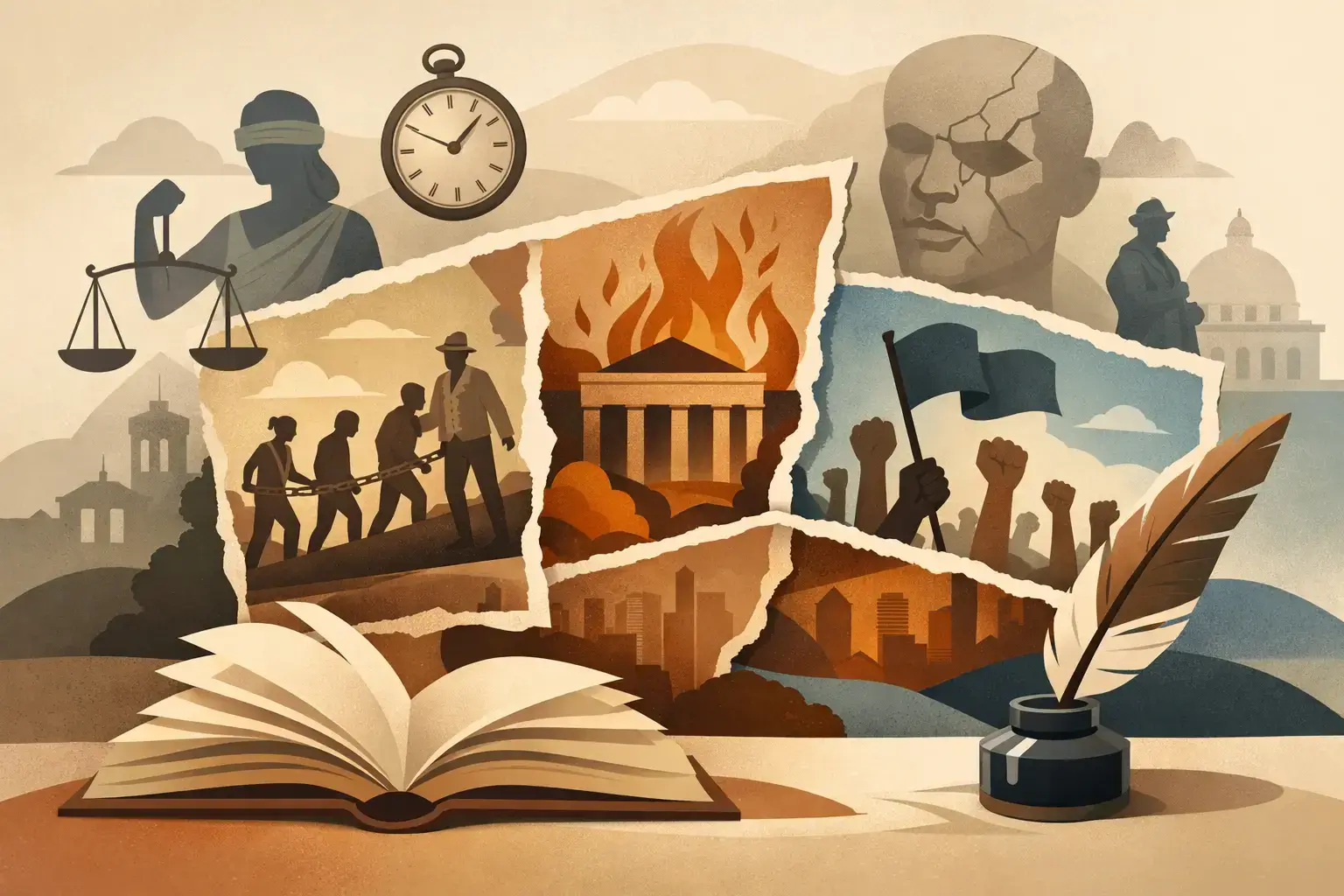
Some novels do not arrive as entertainment. They arrive as evidence.
That is the moral charge of historical reckoning literature. It does not merely set a story in the past or borrow history for atmosphere. It asks harder questions: What has a society refused to remember? Who has been made to carry grief in private because the public record remained silent? And what kind of future becomes possible when literature names what power preferred to leave unspoken?
For readers concerned with memory, justice, and the unfinished work of history, this category matters because it restores proportion. It reminds us that violence does not end when the shooting stops, when the decree is signed, or when a new flag is raised. Historical violence survives in family speech, in absences, in regional suspicion, in class arrangements, in the architecture of shame. Literature is uniquely equipped to trace those afterlives because it can hold the intimate and the structural in the same frame.
What historical reckoning literature actually does
Historical reckoning literature is not simply fiction about a real event, nor is it reducible to political messaging. Its task is interpretive before it is declarative. It reconstructs damaged time. It places personal memory beside official forgetting and asks readers to sit inside the friction.
This kind of writing often begins where archive and testimony fail each other. The archive may be incomplete, partisan, or sanitized. Testimony may be fragmented by trauma, fear, or the erosion of time. Literature enters that difficult space not to replace fact, but to illuminate what factual record alone cannot fully convey: interiority, inherited dread, moral ambiguity, and the sensation of living inside history rather than simply studying it.
That distinction matters. A state can publish reports and still evade reckoning. A school can teach dates and still produce amnesia. Literature, at its best, interrupts that evasiveness. It forces proximity. It makes readers feel the cost of abstraction.
Historical reckoning literature and the politics of memory
Every society organizes memory unevenly. Some losses are memorialized with ceremony and stone. Others are folded into silence, dismissed as unfortunate complexity, or relegated to the private burden of survivors and their descendants. Historical reckoning literature challenges that hierarchy.
In African and diasporic contexts especially, this work carries a particular urgency. Colonial rule, civil war, military violence, ethnic persecution, forced migration, and economic dispossession have all generated vast fields of memory that remain undernarrated or badly narrated. Too often, mainstream discourse prefers legibility over truth. It wants Africa as spectacle, lesson, or humanitarian shorthand. It has less patience for layered memory, for moral contradiction, for stories in which the wound is historical but the consequences are still unfolding.
Reckoning literature resists that flattening. It insists that a nation is not only its official myths. It is also its suppressed testimonies, its unburied dead, its inherited silences, and its repeated evasions. The writer’s work is not to produce innocence. It is to produce clarity.
That clarity can be costly. Once a text names what has been disavowed, readers can no longer pretend that violence belonged only to the past. They must confront how old harms are administered in new forms – through exclusion, selective mourning, educational omission, and the ordinary language of denial.
Why fiction can carry truth more fully than argument
There are truths that argument can state but not make fully felt. Fiction can.
An essay may explain the logic of collective denial. A novel can show a son inheriting a father’s silence without knowing its origin. A historian can document famine, massacre, displacement, or detention. A story can render the shame, superstition, tenderness, and fractured loyalty that remain in the body long after the event itself. Neither form cancels the other. But literature has a special capacity to move from record to recognition.
This is one reason readers return to novels and literary essays when public language becomes thin. Policy vocabulary tends to generalize. Journalism often must compress. Public commemoration can become ceremonial. Literature slows perception. It makes room for contradiction: the victim who is also compromised, the survivor who misremembers, the witness who was never believed, the inheritor who feels haunted by a history they did not directly live but cannot escape.
That complexity is not a weakness. It is the condition of honest reckoning.
The risk of aestheticizing pain
Still, the category is not above criticism. Historical reckoning literature can fail when it mistakes suffering for depth or treats collective trauma as a backdrop for prestige. There is always the danger of converting catastrophe into literary atmosphere while avoiding the harder labor of moral inquiry.
The question is not whether a text includes violence. Many do. The real question is what the text believes its responsibility to be. Does it return dignity to those history reduced to numbers? Does it reveal structures as well as scenes? Does it understand that memory is contested, not pure? Or does it simply stage pain for emotional effect?
Readers who care about justice can usually tell the difference. One kind of writing extracts. The other accompanies.
This is where voice matters. A serious work of reckoning does not posture as all-knowing. It understands limits. It may leave some questions unresolved because unresolvedness is itself part of historical truth. There are losses that cannot be repaired by plot. There are archives that will remain incomplete. There are communities in which the right to narrate is itself politically charged.
What readers are really seeking in historical reckoning literature
Many readers come to these books because they want explanation. What they often find, if the work is good enough, is relation.
They begin to see how public catastrophe settles into domestic life. They recognize how history enters naming, marriage, migration, prayer, appetite, language, and fear. They understand that memory is not only retrospective. It is active. It organizes who is trusted, who is mourned, who is granted complexity, and who is asked to move on for the comfort of others.
This helps explain why the most enduring works in this field are rarely content with exposure alone. Exposure matters, but it is only the first movement. The deeper ambition is rehumanization. To read such work is to have one’s moral attention rearranged.
For diaspora readers, that rearrangement can be especially profound. Distance often produces both longing and distortion. One inherits fragments – stories half-told, names without context, family caution mistaken for temperament, national history reduced to headlines. Literature can bridge that distance, not by offering simple belonging, but by giving form to inherited complexity. It can make estrangement legible.
Beyond remembrance toward repair
The strongest historical reckoning literature does not confuse memory with virtue. Remembering alone does not heal a polity. A nation can remember selectively and still refuse justice. It can commemorate the dead while preserving the arrangements that dishonor the living.
What literature can do, however, is prepare the ground for a different kind of civic imagination. It can teach readers to perceive links between past injury and present structure. It can resist the seduction of amnesia. It can create a language for grief that is not private only, and for responsibility that is not abstract only.
This is where the idea of repair becomes useful, provided we handle it carefully. Repair is not a sentimental promise that art can mend everything broken by war, empire, or state violence. It is a more demanding proposition. It asks whether storytelling can help build conditions under which truth becomes speakable, mourning becomes shareable, and the future is no longer organized around denial.
That is a modest claim in one sense and a radical one in another. It does not promise redemption on demand. It does insist that silence is not neutral.
At Akajiofo Press, this question sits close to the center: how literature can move from memory toward speculative repair without simplifying the wound. That movement requires discipline from both writer and reader. It asks us to resist neat endings, to honor historical specificity, and to remain open to forms of witness that do not flatter us.
The enduring value of historical reckoning literature lies here. It teaches that the past is not over because it is over. It remains active wherever truth is deferred, wherever grief is privatized, wherever official language tries to close what justice has not yet opened. The task of reading, then, is not only to admire craft. It is to become more answerable to the worlds that made us – and to the ones we are still making.
Leave a Reply