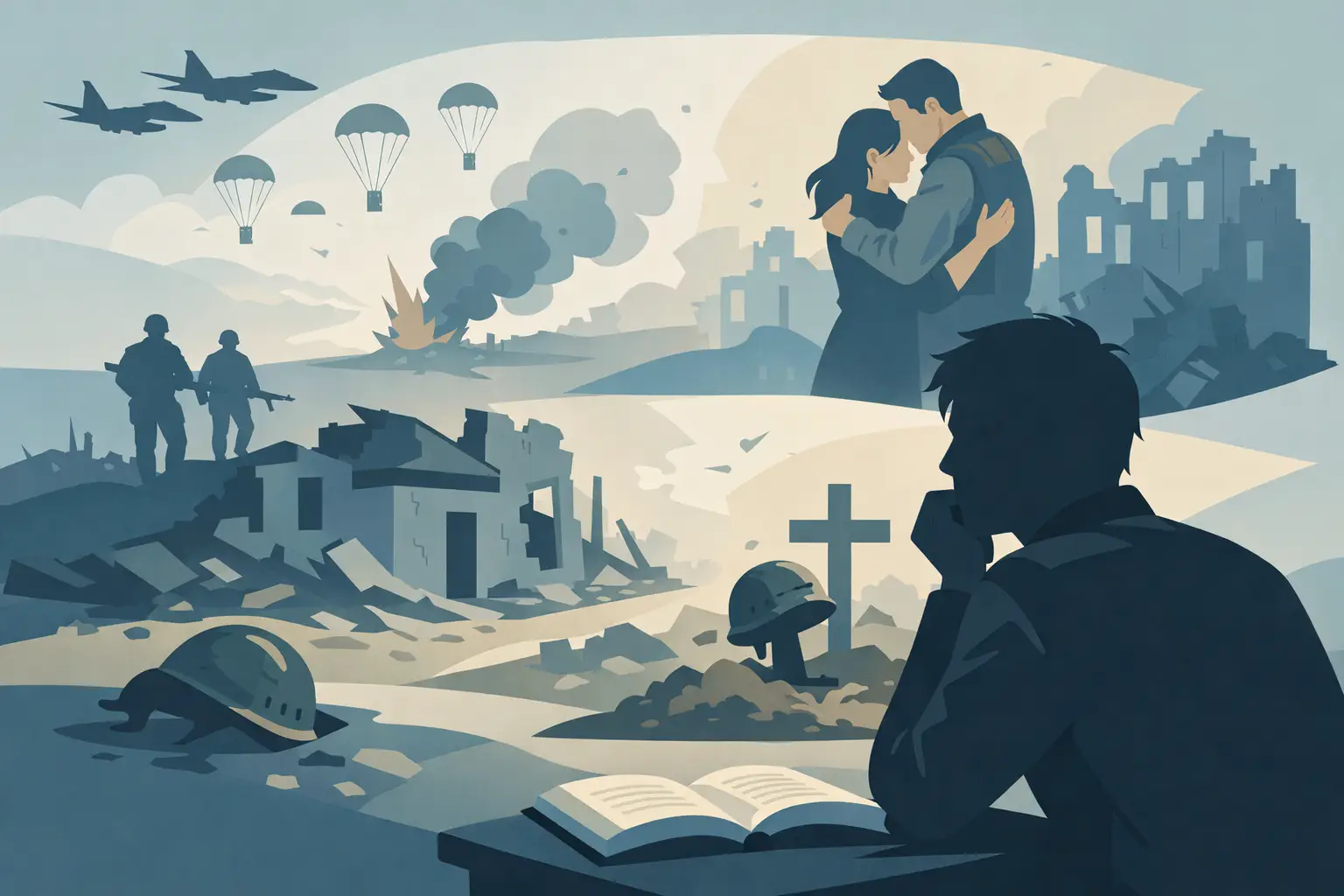
A war rarely ends when the guns go quiet. It lingers in kitchens, in silences between parents and children, in damaged streets that get renamed before they are repaired. That is one answer to the question why do novels revisit war aftermath: because history does not stop at ceasefire, and neither does human consequence.
Readers often ask this question with a trace of fatigue. How many ruined cities, haunted veterans, displaced families, and inherited griefs can literature return to before it begins to repeat itself? The fair answer is that some novels do repeat familiar gestures. They can turn suffering into atmosphere, or treat war as a backdrop for private drama without reckoning with political cause. But the strongest fiction returns to aftermath for a different reason. It understands that war is not only an event. It is a structure of feeling, a rearrangement of memory, and often a long argument over whose pain will be recorded and whose will be asked to disappear.
Why do novels revisit war aftermath so often?
Because aftermath is where the moral truth of war becomes hardest to evade. During conflict, public language is crowded with slogans – victory, sacrifice, security, nation. Afterward, those abstractions begin to fray. A widow sorting through a drawer of letters can expose more about the cost of war than official speeches ever will. A child growing up among adults who refuse to name what happened can reveal how violence enters the bloodstream of ordinary life.
This is one of fiction’s distinctive powers. It can stay with the slow time of consequence. Histories and reports establish sequence, policy, casualty, and scale. Novels can do something adjacent but different. They can show how a society carries damage unevenly, how survival can feel compromised, and how the past remains active inside the present.
That matters especially in societies where public memory is fractured. When states prefer amnesia, when schoolbooks soften atrocity, or when global audiences recognize only the most legible victims, the novel becomes a site of counter-memory. Not perfect memory, not neutral memory, but memory with texture, contradiction, and conscience.
Aftermath is where private life meets political truth
War fiction is often misread as being about combat. In fact, much of the most enduring literature about war is less interested in the battlefield than in what follows from it. The return home. The missing body. The compromised peace. The uneasy rebuilding of domestic life under the shadow of what has been done.
This is why aftermath attracts serious novelists. It forces the question of continuity. Who gets to resume life as if nothing happened? Who must live among ruins, literal or psychological? Which communities are told to reconcile without truth, or to move forward without repair?
The novel is especially suited to these questions because it attends to scale in a supple way. It can hold the intimate and the historical together. A marriage strained by unspoken wartime choices can stand beside a state trying to narrate itself into innocence. A city rebuilding its markets can also be rebuilding its hierarchy of whose dead matter.
In that sense, aftermath fiction is not obsessed with the past. It is trying to diagnose the present. If corruption hardens after war, if exile becomes a permanent condition, if ethnic fear is transmitted to children who never saw the original violence, then the war is not simply over. It has changed the grammar of social life.
The unfinished life of violence
Violence does not vanish when direct killing stops. It can become bureaucratic, domestic, economic, and memorial. It can hide in housing patterns, in who is denied return, in who is believed, in who is asked to forgive first. Novels revisit aftermath because they can trace these transformations without reducing them to a thesis.
That subtlety matters. A sermon can tell readers what should be remembered. A novel can show why remembrance is difficult, compromised, or contested. It can reveal that some survivors want justice, others want forgetting, and many want both at once. That is not indecision. It is the pressure of living after devastation.
Why aftermath novels matter for African and diasporic readers
For African and diasporic readers in particular, the return to aftermath carries an additional charge. Too often, African wars enter the global imagination as spectacle – chaos without history, suffering without context, conflict without intellectual depth. In that shallow frame, the continent appears as a place where violence erupts rather than a place where political forces, colonial inheritances, resource struggles, and state failures produce knowable consequences.
The novel resists that flattening by restoring interiority and historical scale. It insists that people living through war and after war are not symbols of tragedy. They are thinkers, mourners, strategists, compromised witnesses, reluctant inheritors. Their lives do not begin at the moment foreign media notices them, and they do not end when headlines move on.
This is one reason an independent literary space such as Akajiofo Press matters. It treats fiction not as ornament but as a form of historical listening. In that framework, the aftermath of war is not niche subject matter. It is one of the places where memory, justice, and the future meet.
Memory is never only archival
When novels return to war’s aftermath, they also challenge a narrow idea of historical record. Archives preserve documents. Novels preserve pressure – the pressure of fear, of shame, of partial witness, of damaged inheritance. They register what official language cannot fully contain.
This does not mean fiction replaces history. It means fiction can approach truths that are experiential rather than merely evidentiary. The tremor in a father who refuses to discuss a lost brother. The daughter who mistakes emotional distance for cruelty, only later understanding it as a survival pattern. The veteran who cannot decide whether telling the truth will honor the dead or betray the living. These are not footnotes to history. They are part of its human substance.
The risk of returning to war too often
There is, however, a real trade-off. Not every return to war’s aftermath is ethically serious. Some novels aestheticize wreckage. Some ask readers to admire endurance without asking who caused the suffering. Others use historical violence as a shortcut to emotional gravity.
So the question is not only why do novels revisit war aftermath. It is how they do so. Do they illuminate structures of power, or merely recycle pain? Do they give characters agency, however constrained, or turn them into vessels of damage? Do they let the future enter the frame, or do they trap entire peoples inside permanent sorrow?
This is where judgment matters. A meaningful aftermath novel does not only mourn. It investigates. It asks what kind of social world has been produced by violence and what forms of repair might still be imaginable. Repair, here, is not sentimental healing. It may be incomplete, contested, and politically expensive. But fiction that cannot imagine any horizon beyond injury risks mistaking devastation for destiny.
Novels revisit aftermath to test what repair could mean
The deepest reason novels return to aftermath may be this: they are testing the conditions under which a damaged world might still become legible to itself. Not pure again. Not restored to innocence. But made speakable.
War shatters narrative. It breaks chronology, trust, belonging, and language itself. After such rupture, people often live among fragments. The work of the novel is not to pretend those fragments form an easy whole. Its task is to arrange them honestly enough that readers can feel both the wound and the demand it places on the future.
That demand can take many forms. Sometimes it is testimony. Sometimes accusation. Sometimes the quiet insistence that ordinary life after violence is still worthy of attention. Sometimes it is the refusal to let the victorious monopolize memory.
And sometimes it is a question posed to readers: what would justice require from us, now that we know this happened and know that its effects remain?
That is why these novels endure. Not because writers are unable to leave war behind, but because societies keep trying to do so prematurely. Fiction returns where public life becomes evasive. It returns where grief has been privatized, where accountability has been deferred, where children inherit fear in the form of manners and silence.
The best novels of aftermath do not merely revisit damage. They insist that we look at what damage becomes when institutions fail to reckon with it. They remind us that peace without memory can be another name for abandonment, and that remembrance without imagination can harden into ritual despair.
A serious novel enters that narrow space between amnesia and paralysis. It asks how people continue, what they carry, and what they refuse. If it does its work well, it leaves us with something more demanding than sympathy. It leaves us more answerable to the lives that war tried, and failed, to erase.
Leave a Reply