
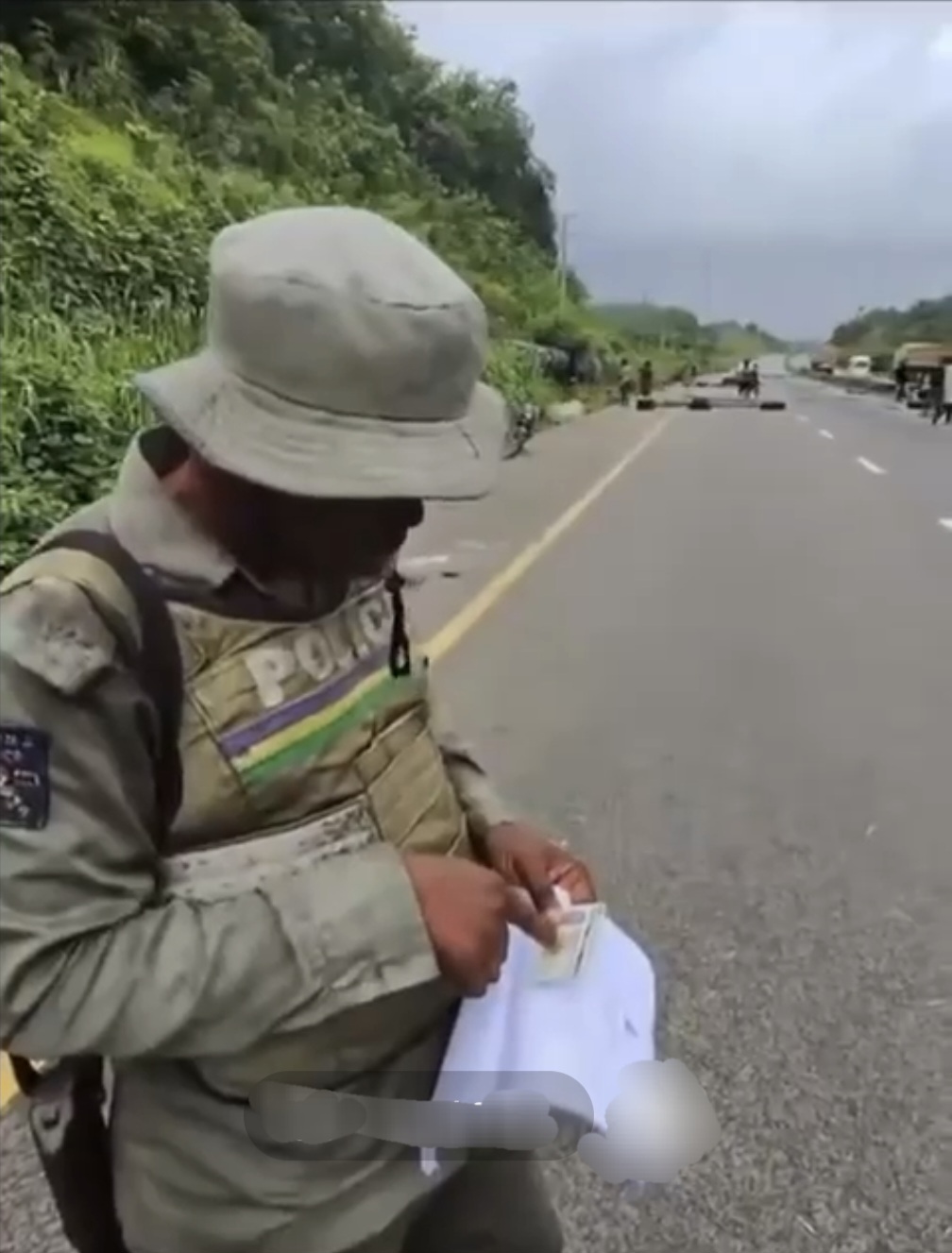
LAGOS / ONDO — Public outrage has erupted following a viral video documenting an encounter between highway police officers and a traveler on the Shagamu–Benin Highway. What began as a routine stop-and-search quickly spiraled into a national flashpoint after an officer was recorded blatantly telling a motorist that he was fortunate not to be of Igbo ethnicity, asserting he would have been detained on the spot regardless of carrying complete legal documentation.
The account—shared by a Nigerian returnee stranded along the dangerous corridor after refusing to offer a bribe—highlights a double threat: the ongoing risk of highway criminality and the systemic extortion, illegal detention, and ethnic profiling practiced by elements within state security forces.
Following widespread digital mobilization and calls for accountability, regional police commands have reportedly initiated disciplinary proceedings against officers captured in the footage. Yet for millions of citizens, the exchange is a stark reminder of a deeper, institutional malaise that papering over policy guidelines cannot fix.
THE GHOST IN THE SYSTEM: WHY THE CIVIL WAR NEVER TRULY ENDED
The economic and social costs of allowing these institutional fractures to fester are staggering.
Research has shown that unresolved historical grievances create a “political risk premium” that deters investment, stifles innovation, and perpetuates poverty. When citizens cannot trust the state to protect them equally, they withdraw their participation, their capital, and their hope.
- Foreign Direct Investment in regions perceived as “agitation-prone” remains consistently lower than in other parts of the country.
- Human capital continues to flee—not just from the Southeast, but from every region where citizens feel the state is not their protector but their predator.
- Trust—the essential lubricant of any economy—remains critically low, raising the cost of every transaction, from business deals to daily market interactions.
The officer’s threat was not just an insult to one traveler. It was an injury to the entire nation’s economic and social fabric.
FROM CRISIS TO RECONSTRUCTION: THE IMPERATIVE FOR INSTITUTIONAL HEALING
Stopping police extortion requires more than isolated suspensions or press statements; it demands structural renewal across law enforcement and public governance. In his follow-up policy paper, Speculative Repair: A Framework for Reimagining Nations, Paul C. Ibekwe outlines how nations in recovery must move past passive silence and commit to active, systemic repair.
Key pillars for institutional healing include:
- Mandatory Digital Transparency: Implementing operational body cameras and digital logbooks for all highway patrol units to remove discretionary impunity. When every interaction is recorded, the space for ethnic profiling and extortion shrinks dramatically.
- Binding Institutional Sanctions: Moving beyond internal reassignments to full dismissal and judicial prosecution of officers engaged in extortion or ethnic profiling. Impunity is the oxygen of abuse. Remove it, and the fire dies.
- Civic Rights Enforcement: Guaranteeing that complete documentation strictly insulates citizens from unlawful harassment, regardless of their state of origin or ethnicity. The constitution promises this. It is time to enforce it.
- Truth and Reconciliation: Nigeria has never had a national conversation about the civil war. It has never created an archive of civilian testimonies. It has never taught its children the full, unvarnished history of 1967–1970. This silence is not peace. It is a ceasefire—and ceasefires are fragile.
- Educational Reform: The curriculum must teach students to read primary sources—ration ledgers, diaries, government memos—and draw their own conclusions. This is not indoctrination. This is inoculation against the weaponization of history.
ESSENTIAL READING: HOW “THE CITY HE NEVER RETURNED TO” MAPS THE HUMAN COST
To understand the emotional, historical, and intergenerational toll of these systemic failures, Paul C. Ibekwe’s debut novel, The City He Never Returned To, offers a timely literary lens.
Set against the backdrop of memory, displacement, and institutional bias, the narrative explores what happens when citizens are forced to navigate a society where belonging is constantly questioned. The novel follows Okechukwu Nwankwo, a civil servant who flees Lagos during the 1967 war, carrying only his wife, his daughter, and a leather-bound ledger. That ledger evolves from a record of ambition to a record of survival—garri rations, the names of the dead, and a humiliating twenty-pound note offered by the state as “settlement” for a lifetime of erased savings.
Decades later, his daughter Chidinma transforms that private document into the foundation of a national Reconciliation Commission—an institution that archives the truth, reforms the curriculum, and begins the slow, painful work of repair.
The novel is not just a story. It is an argument: that lateness is different from never, and that a debt acknowledged changes everything.
For readers, it is a mirror reflecting Nigeria’s current civic challenges and a call toward reimagining a nation built on genuine equity, dignity, and justice.
THE UNANSWERED QUESTION
The viral video from the Shagamu–Benin Highway has sparked outrage. But outrage, without action, is merely performance.
The question Nigeria must now answer is this:
Will this incident become another fleeting moment of anger, quickly forgotten when the next crisis emerges?
Or will it become a turning point—a moment when Nigerians across all ethnicities, all regions, and all generations decide that the ghost of 1967 must finally be laid to rest?
The officers involved may face discipline. But discipline is not repair.
Repair means acknowledging that the problem is not a few bad officers but a system that made their behaviour possible. Repair means investing in institutions that protect citizens equally. Repair means teaching the next generation that their identity is not a threat but a gift. Repair means finally, fully, and honestly confronting the ghost in the breadline.
The ledger of history is open. The question is whether we will balance it.
RESOURCES & ACTION LINKS
📖 Order the Novel:
Get The City He Never Returned To on Akajiofo Press
👉 https://akajiofo.com/product/1157/
📝 Read the Essays:
- The Ghost in Our Breadline: Why the 1967 War is Every Nigerian’s Problem
Speculative Repair: A Framework for Reimagining Nations
📩 Join the Conversation:
Subscribe to weekly analytical essays on governance and speculative thought at The Speculative Circle.
📺 Watch the Report:
For real-time coverage and broadcast reports on the police command’s official response to this incident, watch the TVC News Report on the Highway Police Arrests. This video provides critical context regarding the police command’s arrest of the officers involved following the public outcry.
FINAL WORD
The officer on the Shagamu–Benin Highway said: “If you were Igbo, I would have detained you.”
He was wrong. But he was also right.
He was wrong because no Nigerian should be detained for their ethnicity.
He was right because his words exposed a truth millions of Nigerians already know: that the institutions of the state have yet to learn to treat all citizens equally.
The question is not whether the officer will be punished. The question is whether Nigeria will finally begin the work of repair.
The ghost is still in the breadline. It will remain there until we decide to exorcise it—together.
SHARE YOUR THOUGHTS
I would love to hear your reflections on this incident and what it reveals about Nigeria’s unhealed institutional fractures.
Reply here or message me privately.
With you,
Ibekwe Paul Chukwuemeka
.
Leave a Reply