
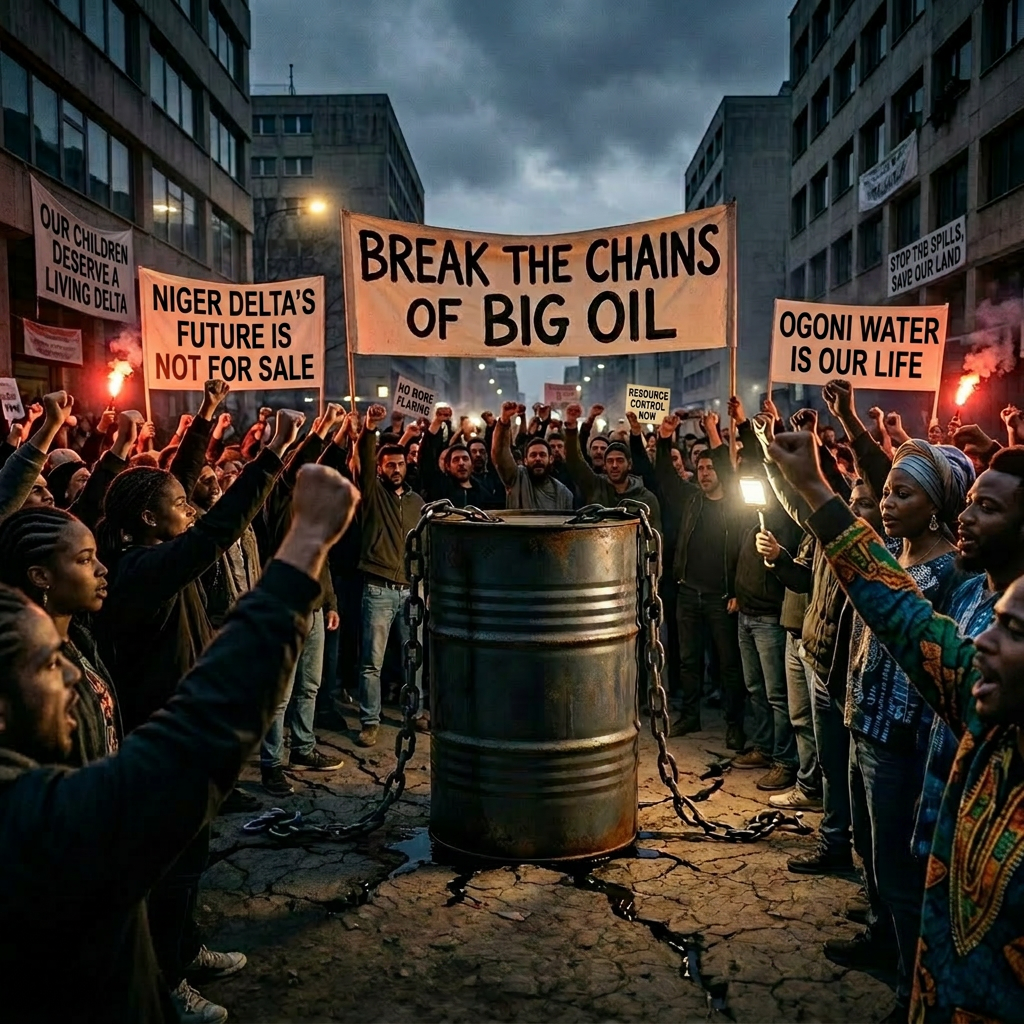
📌 THE FACTS (What Actually Happened)
The Niger Delta is Nigeria’s economic engine—and its greatest environmental crime scene.
For over six decades, multinational oil companies (Shell, Chevron, ExxonMobil) alongside state actors have extracted hundreds of billions of dollars in crude oil from the region. In return, the Delta has received catastrophic pollution, systemic neglect, and structural poverty. Continuous oil spills, toxic gas flaring, and heavy metal contamination have decimated farm settlements, river estuaries, and drinking water sources.
The people of the Niger Delta have supplied the wealth that funds the Nigerian state, yet they bear almost the entire ecological burden of its extraction.
📌 THE CHALLENGES
| Challenge | Impact |
| Ecological Ruin & Legacy Spills | Tens of thousands of documented spills have destroyed fragile mangroves and fertile farmland, destroying traditional fishing and agrarian economies. |
| Corporate Divestment Liability | Major international oil companies are selling onshore assets to domestic firms, attempting to leave behind decades of un-remediated environmental disaster without paying reparations. |
| Flawed Legislative Frameworks | While the Petroleum Industry Act (PIA) created Host Community Development Funds, it controversially penalizes communities for pipeline sabotage—treating victims as security guards. |
| Artisanal Refining & Toxic Soot | Denied economic access, local youth have turned to illegal refining (“kpo-fire”), exacerbating environmental damage and blanketing cities like Port Harcourt in carcinogenic black soot. |
| Resource Curse & Security Failure | Centralized control of oil revenues in Abuja has fueled systemic corruption, while militarized state responses continue to treat community grievances as security threats rather than human rights failures. |
📌 WHAT MUST CHANGE
True justice for the Niger Delta requires moving beyond token corporate social responsibility to structural economic and environmental restitution.
| Action | Description |
| Comprehensive Ecological Restoration | Enforce fully funded, independently monitored remediation programs (scaling up the delayed HYPREP Ogoni cleanup model across the entire region). |
| Mandatory Corporate Accountability | Legally block oil multinationals from exiting onshore assets until they fully remediate legacy contamination and settle community court claims. |
| Host Community Sovereignty | Amend the PIA to give host communities real decision-making power, direct equity ownership in energy assets, and oversight over environmental monitoring. |
| Economic Diversification & Just Transition | Invest oil revenues directly into regional infrastructure, maritime industries, modern agro-processing, and clean energy to prepare for a post-oil economy. |
| Ending Gas Flaring Realistically | Enforce strict financial penalties and legal deadlines against gas flaring, diverting captured gas into local power generation rather than atmospheric waste. |
📌 THE VERDICT
The Niger Delta is an open wound on Nigeria’s collective consciousness. It reflects the worst impulses of extractivism—where land is valued for what can be pumped out of it, while the human beings living on top of it are treated as disposable.
Decolonizing and transforming Nigeria is impossible while the Niger Delta remains a sacrifice zone. Environmental justice for the Delta is not an act of charity—it is a long-overdue debt.
💬 DISCUSSION QUESTIONS
Circle,
Week 18 is up: The Niger Delta – Environmental Justice and Economic Transformation.
A few questions I’ve been sitting with:
- How do we prevent multinational oil companies from selling off their assets and exiting Nigeria before cleaning up their historical pollution?
- Is the Petroleum Industry Act’s (PIA) approach to host community funding genuinely empowering, or does it unfairly transfer security burdens onto affected residents?
- What does a “Just Transition” look like for a region whose entire formal economy has been structured around oil for 60+ years?
I’d love to hear your thoughts.
Next week: Nigerian Youth – The Leaders Nigeria Deserves
With you,
Ibekwe P.C
Leave a Reply